


The Inside Story: How Biocompatible Printing Materials Enable Customized Surgical Guides and Models
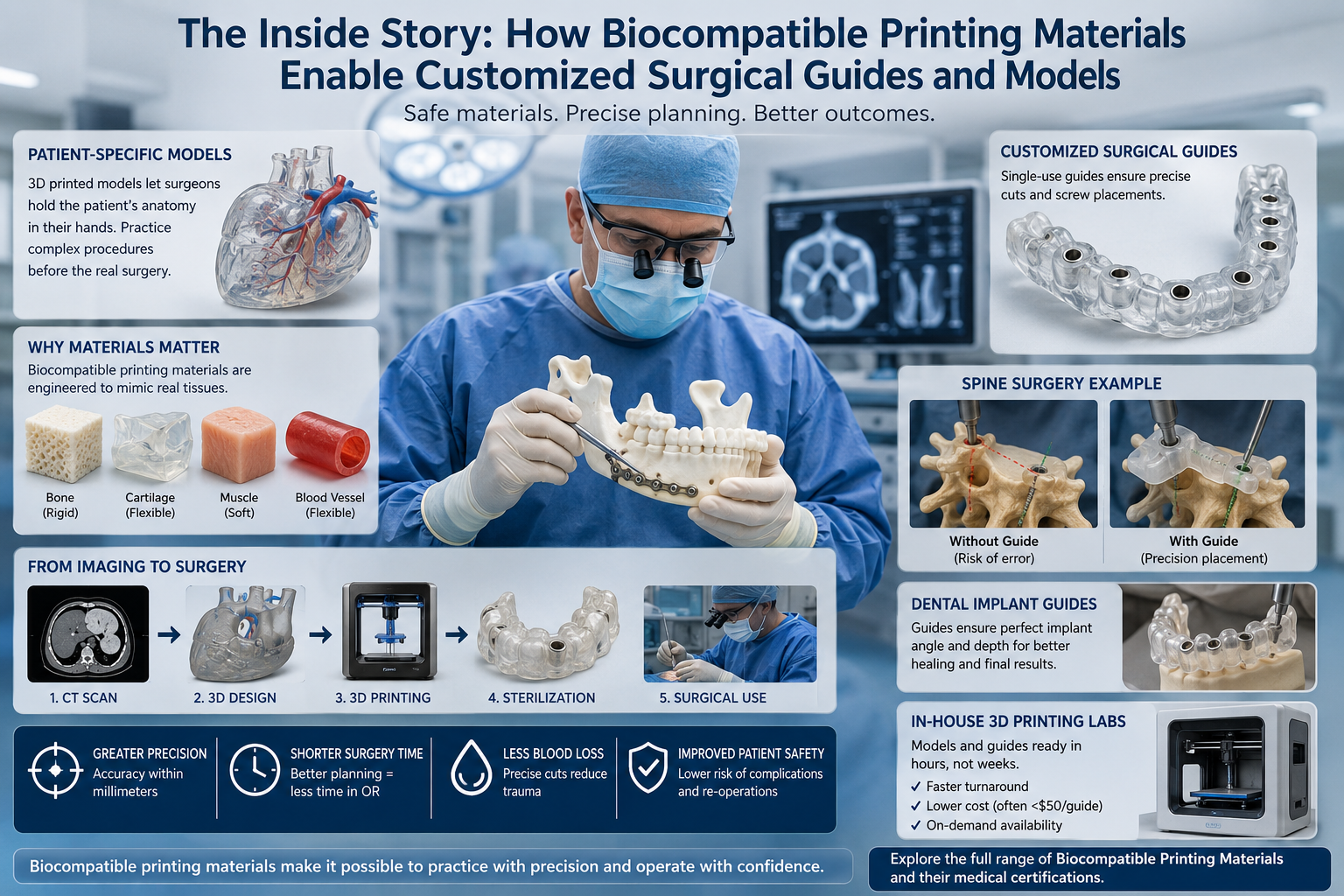
Before a surgeon makes the first cut, they need a plan. In complex operations, looking at a flat X-ray or CT scan is not enough. That is why more hospitals are using Biocompatible Printing Materials to create physical models of tumors, fractured bones, and deformed organs. These models allow surgeons to hold the patient’s anatomy in their hands. And when the surgery begins, they rely on Customized Surgical Guides and Models to make precise cuts and place screws perfectly.
Why does the material matter so much? Because a surgical model must behave like real tissue. If it is too hard, the surgeon will not learn the correct pressure to apply. If it is too soft, drills will slip. Biocompatible printing materials are engineered to mimic the mechanical properties of bone, cartilage, or even blood vessels. Some materials are rigid like cortical bone. Others are flexible like skin or muscle.
For a maxillofacial surgeon repairing a shattered jaw, a 3D printed model made from bone-mimicking material is invaluable. They can practice cutting the model, bending plates, and drilling screw holes. When they enter the operating room, they have already solved every problem. The surgery takes half the time, and the patient loses less blood.
Customized surgical guides take this one step further. These are single-use plastic devices that snap directly onto the patient’s bone during surgery. They have pre-drilled holes that tell the surgeon exactly where to cut or place screws. Without a guide, the surgeon measures by eye and risks being off by a few millimeters. With a guide, the error drops to near zero.
Spine surgery is a perfect example. The spinal cord is delicate. A misplaced screw can cause paralysis. A customized surgical guide fits onto the back of a vertebra like a puzzle piece. It locks into place using the bone’s unique surface features. Then the surgeon drills through the guide’s hole, knowing the screw will go exactly where planned.
The materials used for these guides must be sterilizable. They cannot warp under high heat or react with cleaning chemicals. Biocompatible resins and medical-grade polymers meet these strict requirements. They are also radiolucent, meaning they do not show up on X-rays taken during surgery. This allows the surgeon to confirm screw positions without removing the guide.
Another exciting application is in dental implant surgery. Placing a titanium screw into the jawbone requires millimeter precision. A 3D printed surgical guide sits over the patient’s teeth and gums. The dentist drills through the guide and places the implant at the perfect angle. This reduces healing time and improves the final crown fit.
Hospitals are now setting up in-house 3D printing labs. A surgeon can request a model or guide in the morning and have it ready by afternoon. No waiting weeks for an external company. No expensive shipping fees. The cost per guide is often under fifty dollars.
As printers become faster and materials more diverse, we will see guides for heart surgery, brain surgery, and fetal surgery. The ability to practice on a patient-specific model before touching the real patient is the closest thing medicine has to a rehearsal.
To explore the full range of available materials and their medical certifications, review the detailed specifications on Biocompatible Printing Materials.

 Bangla