

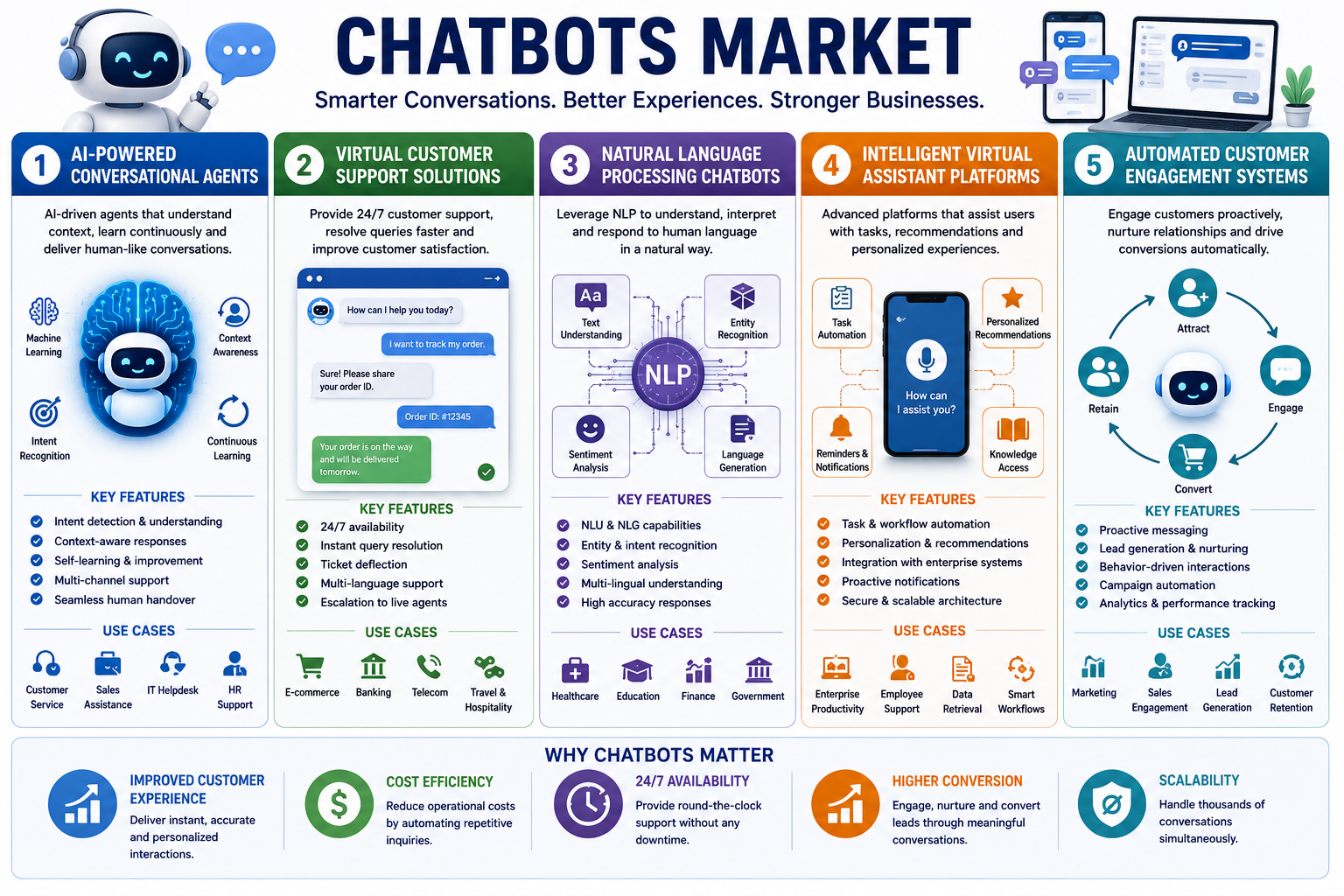

The volume of customer inquiries has grown exponentially with the rise of digital channels. Social media, messaging apps, and websites generate millions of questions daily. According to a market analysis from Market Research Future (MRFR), Virtual Customer Support Solutions are helping organizations manage this volume by automating routine inquiries. These solutions combine chatbots, knowledge management, and intelligent routing to provide efficient, consistent service across channels.
The Chatbots Market is projected to grow from $7.81 billion in 2025 to $42.23 billion by 2035, reflecting the accelerating adoption of automated customer support solutions. Organizations recognize that virtual support is essential for meeting customer expectations and managing costs.
Components of Virtual Customer Support Solutions
Virtual customer support solutions include several integrated components. Chatbots handle routine inquiries through text-based conversations. Voice bots extend this capability to voice channels. Knowledge bases provide self-service options for customers who prefer to find answers independently. Intelligent routing directs complex inquiries to the most qualified human agents. Analytics dashboards provide visibility into support operations, identifying trends and opportunities for improvement.
A financial services firm might deploy a virtual customer support solution to manage account inquiries. The solution's chatbot handles balance checks, transaction history, and account updates. Customers who need help with loan applications or fraud disputes are routed to specialized human agents. The firm provides fast service for routine inquiries while ensuring complex issues receive expert attention.
AI-Powered Conversational Agents for Intelligent Interactions
While virtual customer support solutions provide the overall framework, AI-Powered Conversational Agents provide the intelligence for natural interactions. These agents use NLP to understand user intent, machine learning to improve over time, and integration APIs to connect with backend systems.
A hotel chain might use AI-powered conversational agents to manage guest inquiries. The agent handles booking modifications, amenity requests, and local recommendations. It learns from each interaction, becoming more accurate and helpful over time. Guests receive instant responses, and hotel staff are freed from routine inquiries.
Market Drivers: Personalization and Efficiency
The Chatbots Market is increasingly characterized by a growing focus on personalization. Businesses are recognizing the importance of tailoring interactions to meet individual customer needs. Chatbots equipped with data analytics capabilities can analyze user behavior and provide personalized recommendations, thereby enhancing the overall customer experience. Research indicates that personalized interactions can lead to a 20% increase in customer satisfaction.
The rising demand for customer support automation is another key driver. Companies utilizing chatbots can reduce operational costs by up to 30%. This trend is particularly pronounced in sectors such as retail and telecommunications, where customer interaction volumes are high.
Deployment Models
The market includes cloud and on-premise deployment options. Cloud deployment dominates due to its scalability, ease of access, and lower upfront costs. On-premise solutions are growing, particularly in sectors with stringent data security and compliance requirements.
Industry Verticals and Usage
The BFSI sector holds the largest market share, driven by increasing demands for customer service automation and efficiency. Retail is the fastest-growing vertical, capitalizing on consumer demand for personalized shopping experiences. Chatbots are most commonly deployed on websites, with social media emerging as the fastest-growing usage channel.
