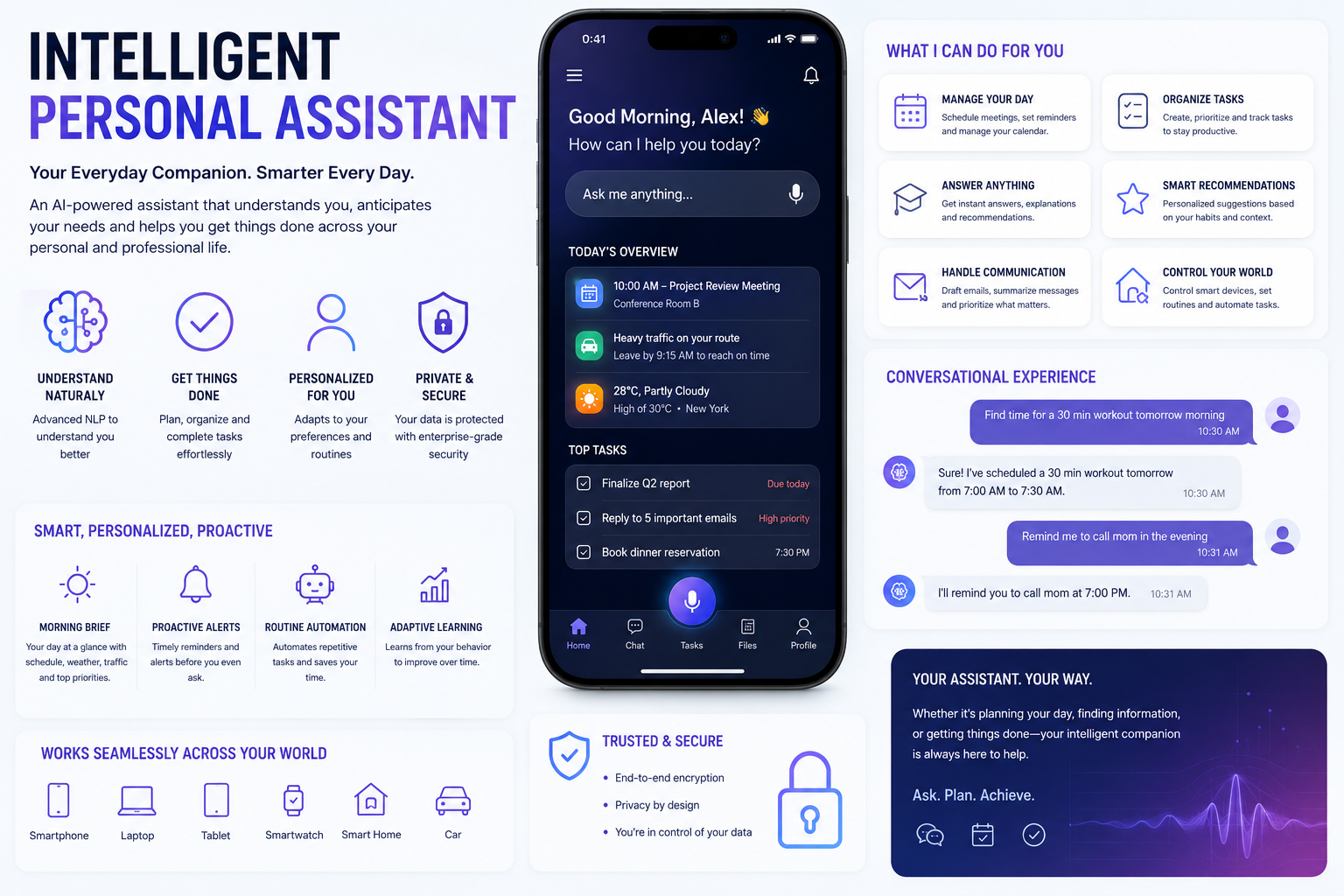
The Intelligent Personal Assistant Market presents exceptional growth opportunities with projections indicating sustained expansion through 2035. Market Research Future reports the intelligent personal assistant market was valued at $12.55 billion in 2024 and is projected to grow at an extraordinary 32.1% CAGR, reaching $268.26 billion by 2035. This remarkable trajectory reflects the intelligent personal assistant market's evolution from niche technology to essential infrastructure across consumer and enterprise applications. The intelligent personal assistant market is benefiting from the exponential growth of smart devices and IoT connectivity, creating unprecedented opportunities for personalized assistance and automation. The intelligent personal assistant market is also positioned to benefit from advancements in AI technologies that continue to expand capabilities in natural language processing, computer vision, and multimodal interaction. Emerging applications within the intelligent personal assistant market include healthcare personalization, enterprise productivity enhancement, and automotive integration. The intelligent personal assistant market's ability to adapt to evolving technology landscapes and address emerging customer needs will be a key factor in its continued growth. Organizations that invest in the intelligent personal assistant market are positioning themselves to leverage AI as a strategic asset for customer engagement, operational efficiency, and competitive differentiation. As 5G networks, edge computing, and generative AI technologies mature, the intelligent personal assistant market will offer increasingly sophisticated capabilities. The intelligent personal assistant market's long-term potential is supported by projections showing Smart Speakers reaching $148.26 billion and Chatbots reaching $120.0 billion by 2035, reflecting sustained demand across both consumer and enterprise segments.
Emerging Opportunities and Innovation Areas
The intelligent personal assistant market presents numerous emerging opportunities that promise to shape its future development. Development of AI-driven customer service platforms represents a significant opportunity within the intelligent personal assistant market, enabling organizations to automate support, personalize interactions, and scale operations. Expansion into healthcare for personalized patient management offers the intelligent personal assistant market opportunities to support remote monitoring, medication adherence, and health education. Integration with smart home devices for enhanced user experience continues to drive innovation within the intelligent personal assistant market, creating comprehensive connected living solutions. The intelligent personal assistant market is also exploring opportunities in areas such as automotive integration, where AI assistants enhance driver experience and safety. Generative AI represents an emerging frontier for the intelligent personal assistant market, enabling automated content creation, summarization, and personalization at scale. The intelligent personal assistant market is developing solutions for education, where AI tutoring and personalized learning support enhance educational outcomes. Enterprise applications present significant opportunities within the intelligent personal assistant market, with AI assistants supporting productivity, knowledge management, and collaboration. As the intelligent personal assistant market continues to evolve, privacy-preserving analytics techniques are becoming increasingly important, offering opportunities for solutions that deliver insights while protecting individual privacy. The intelligent personal assistant market's innovation pipeline is robust, with ongoing research and development across multiple areas that promise to expand capabilities and address emerging customer needs. Organizations that invest early in these emerging areas of the intelligent personal assistant market will be well-positioned to benefit from the next wave of AI innovation.
Technological Convergence and Integration
The intelligent personal assistant market is benefiting from the convergence of multiple technologies that are expanding capabilities and applications. The integration of intelligent assistants with IoT ecosystems within the intelligent personal assistant market creates comprehensive platforms for smart home automation, enterprise monitoring, and personalized services. Edge computing is transforming the intelligent personal assistant market by enabling on-device processing that reduces latency and enhances privacy, particularly important for applications requiring immediate responses. The combination of intelligent assistants with augmented and virtual reality within the intelligent personal assistant market creates immersive experiences with embedded AI assistance. The intelligent personal assistant market is also integrating with blockchain technology for enhanced security and verification of AI interactions. These technological convergences within the intelligent personal assistant market enable capabilities such as proactive assistance, multimodal interaction, and predictive analytics. As 5G networks expand, the intelligent personal assistant market will benefit from increased bandwidth and reduced latency, enabling new applications and more sophisticated real-time analysis. The convergence of intelligent assistants with business intelligence platforms within the intelligent personal assistant market enables organizations to combine AI insights with other business data for comprehensive decision-making. The intelligent personal assistant market's integration with wearable devices, vehicles, and public infrastructure creates opportunities for context-aware assistance across diverse environments. As the intelligent personal assistant market continues to integrate with emerging technologies, its applications will expand across industries, creating new opportunities for value creation and competitive differentiation. The intelligent personal assistant market's ability to leverage technological convergence will be crucial for addressing evolving user expectations and application requirements.
Challenges and Mitigation Strategies
The intelligent personal assistant market, while offering significant opportunities, faces several challenges that organizations must address for successful implementation. Data privacy and regulatory compliance represent primary concerns for the intelligent personal assistant market, with organizations navigating complex frameworks including GDPR and CCPA. The intelligent personal assistant market is responding with privacy-preserving techniques including on-device processing, differential privacy, and transparent data practices that deliver personalized experiences while protecting user information. Technical challenges within the intelligent personal assistant market include ensuring accuracy and reliability across diverse languages, accents, and environments, requiring continuous model improvement and extensive testing. The intelligent personal assistant market is addressing these challenges through advanced AI architectures, diverse training datasets, and continuous feedback mechanisms that improve performance over time. Security concerns within the intelligent personal assistant market are being addressed through enhanced encryption, authentication mechanisms, and vulnerability testing. The high cost of implementation and integration can be a barrier for some organizations within the intelligent personal assistant market, particularly smaller enterprises. The intelligent personal assistant market is responding with cloud-based solutions, scalable pricing models, and simplified implementation approaches that reduce barriers to entry. User acceptance and trust represent another challenge for the intelligent personal assistant market, requiring transparent communication about capabilities, limitations, and data practices. The intelligent personal assistant market is addressing this through education, user-friendly interfaces, and demonstrable value propositions. As the intelligent personal assistant market continues to mature, these challenges will likely diminish, making AI assistance capabilities more accessible to organizations and individuals across diverse contexts. Successful adoption of the intelligent personal assistant market requires comprehensive strategies that address technical, operational, and regulatory considerations while focusing on delivering measurable value and enhancing user experience.