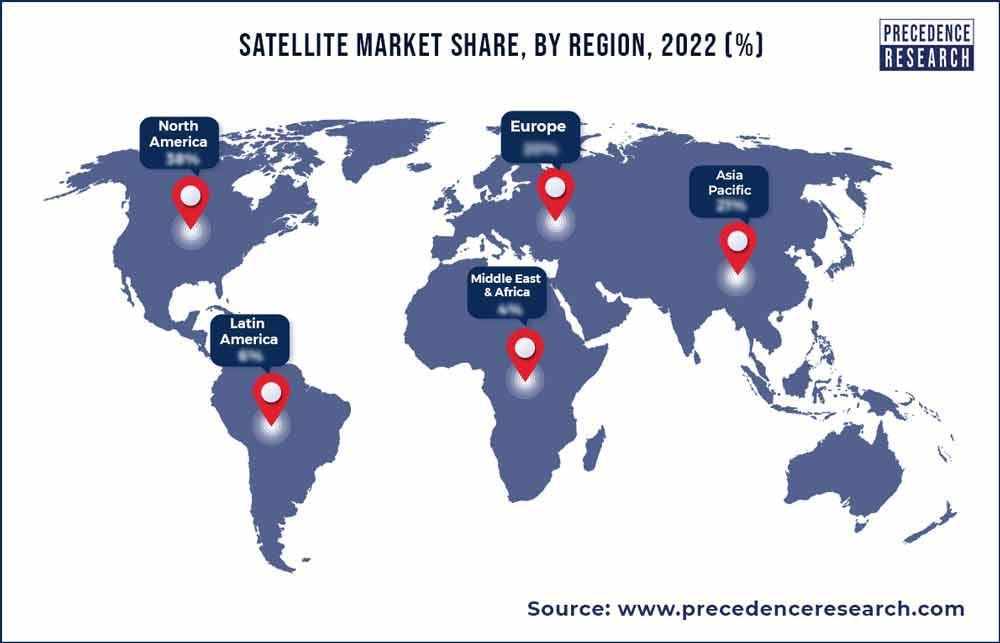
The Satellite Manufacturing And Launch industry exhibits strong regional characteristics, with North America leading in market share and the Asia-Pacific region experiencing the highest growth rate. As per Market Research Future, North America dominates the market, driven by substantial investments from the U.S. government and space agencies. The United States holds the largest market share within the region, with major industry players like SpaceX, Boeing, Lockheed Martin, and Northrop Grumman driving innovation and growth. NASA's role as an anchor customer for scientific missions and the Department of Defense's investments in national security satellites further solidify North America's market leadership. The development of reusable launch systems and the presence of a robust commercial space ecosystem contribute significantly to the region's dominance .
The Asia-Pacific region is experiencing remarkable growth, with countries like China, India, and Japan investing heavily in satellite manufacturing and launch capabilities. China's mass-production hubs and commercial launch activity are intensifying capacity across vehicles and satellites. The country is developing multi-constellation programs and expanding domestic industrial capacity to support ambitious space initiatives. India's liberalized policies encourage domestic firms to build and launch commercial spacecraft, with ISRO securing international payload contracts for its advanced heavy-lift missions. Japan leverages its long-standing reputation for reliability to partner with U.S. companies on next-generation smallsat buses. South Korea's Hanwha Aerospace invests in turnkey factories aimed at regional operators. Australia is also emerging as a significant player, investing in satellite infrastructure and launch facilities .
Europe maintains a solid market share through established players like Airbus, Arianespace, and Thales Alenia Space, but faces slower growth due to programmatic fragmentation and strict export frameworks. The European Space Agency's sovereignty initiatives support indigenous component lines for secure processors, solar cells, and electric thrusters. The Middle East and Africa region shows rising demand for satellite bandwidth for connectivity and intelligence services but remains reliant on imports. Latin America is emerging as a key market for satellite manufacturing and launches, driven by growing demand for connectivity and remote sensing applications. These regional dynamics create both opportunities and challenges for market participants, with developing regions presenting significant growth potential for companies that can navigate local regulatory environments and partnership requirements .
FAQ 1: How does the regional market share distribution compare globally?
North America holds the largest share (approximately 60-67%), followed by Europe and Asia-Pacific, with the latter region experiencing the fastest growth rate.
FAQ 2: What factors contribute to Asia-Pacific's rapid market growth?
Factors include massive investments in national space programs by China, India, and Japan, expanding commercial space sectors, growing satellite launch infrastructure, and increasing demand for satellite-based services across the region.