


The global O-ring seals market is a cornerstone of industrial reliability, providing essential leak-prevention solutions across the world's most critical sectors. From the internal combustion engines of passenger vehicles to the high-pressure environments of deep-sea oil drilling and aerospace engineering, O-ring seals serve as the silent guardians of machinery efficiency and safety.
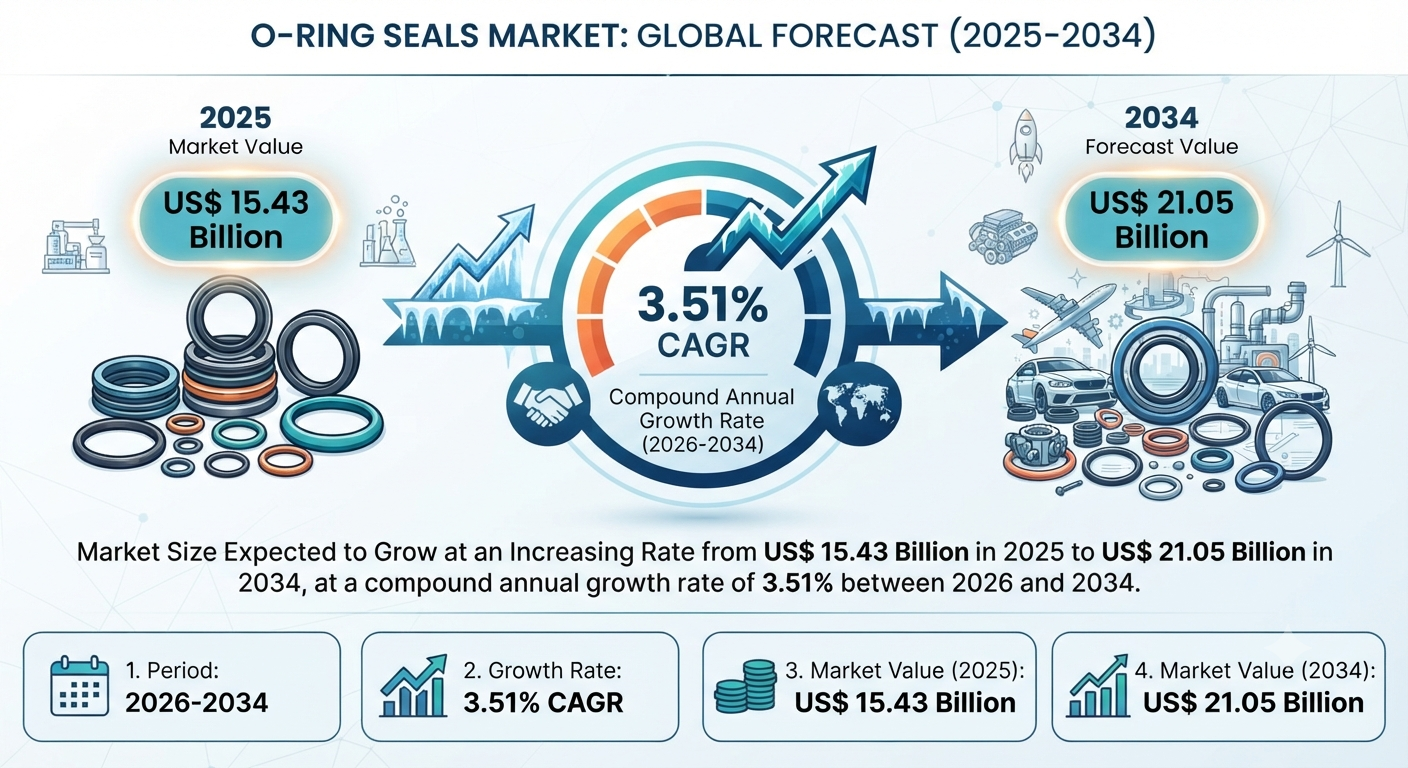
According to Renub Research, the global O-ring seals market is expected to grow from US$ 15.43 billion in 2025 to US$ 21.05 billion by 2034, registering a Compound Annual Growth Rate (CAGR) of 3.51% from 2026 to 2034. This growth trajectory is fundamentally supported by rapid global industrialization, infrastructure development, and continuous advancements in materials science.
Download Free Sample Report: https://www.renub.com/request-sample-page.php?gturl=o-ring-seals-market-p.php
Market Overview: The Essential Seal
O-ring seals are ring-shaped mechanical components designed to prevent the leakage of liquids or gases between two connected parts. Their popularity stems from their simplicity, cost-effectiveness, and versatility. By utilizing materials with high elasticity—such as nitrile, silicone, fluorocarbons, and specialized polymers—these seals can conform to mating surfaces, maintaining an effective barrier in both static and dynamic conditions.
As industrial machinery becomes more complex and the requirements for energy efficiency and environmental compliance tighten, the role of high-performance sealing technology has shifted from a commodity requirement to a critical engineering priority.
Key Growth Drivers
1. Robust Demand from Automotive and Transportation
The automotive sector remains the primary consumer of O-ring seals. These components are vital in engines, fuel delivery, braking, and hydraulic systems. The shift toward electric vehicles (EVs) has not reduced demand; instead, it has created a new requirement for specialized seals that protect sensitive battery units and electronic components from moisture and environmental contaminants. Furthermore, the industry-wide push for reduced emissions and improved fuel economy is driving a transition toward O-rings made from advanced materials capable of withstanding higher temperatures and harsh chemicals.
2. Expansion of Global Manufacturing and Industrialization
Industrial machinery, including pumps, compressors, and hydraulic systems, relies on O-rings to maintain operational efficiency and minimize maintenance downtime. As developing nations accelerate infrastructure projects and expand their chemical processing, construction, and power generation capabilities, the aggregate demand for durable sealing solutions continues to rise.
3. Critical Applications in Oil & Gas and Aerospace
Both the oil & gas and aerospace industries operate under extreme conditions—characterized by high pressure, extreme temperature fluctuations, and exposure to corrosive substances. The rising global demand for energy and the steady growth of air travel require aircraft and drilling equipment that can operate safely over long service intervals. Consequently, these sectors drive the market for high-performance, heat-resistant, and chemically inert O-ring seals.
Challenges and Competitive Landscape
-
Raw Material Volatility: Since many O-rings are derived from petrochemical-based synthetic rubbers, the market is highly sensitive to fluctuations in crude oil prices. Supply chain disruptions, whether geopolitical or logistical, can impact manufacturer profitability and product availability.
-
Alternative Sealing Technologies: Manufacturers face ongoing pressure from alternative technologies, such as advanced gaskets and mechanical seal innovations, which may provide superior performance in specific niche environments. To remain competitive, companies are investing heavily in R&D to develop elastomers with enhanced durability and specialized resistance properties.
Market Segment Highlights
Synthetic Rubber O-ring Seals
Synthetic rubber remains the dominant material segment due to its excellent flexibility and chemical resilience. Nitrile, silicone, and EPDM rubbers continue to be the standard for a vast range of applications, providing the reliability required in demanding operating conditions.
Regional Insights
-
United States: A highly developed market driven by mature automotive and aerospace sectors. Heavy R&D investment in the U.S. keeps it at the forefront of material innovation for sealing technologies.
-
United Kingdom: Growth is focused on high-precision manufacturing, renewable energy projects, and an advanced aerospace industry that prioritizes top-tier quality and reliability.
-
India: Rapid industrialization and a growing focus on infrastructure are creating a surge in demand for standardized and cost-effective sealing solutions across the machinery and automotive sectors.
-
Saudi Arabia: The market is anchored by the massive oil and gas industry. Diversification efforts under Vision 2030 are also stimulating demand for seals within the power, construction, and emerging manufacturing sectors.
Frequently Asked Questions (FAQs)
1. What is the projected market size of the global O-ring seals market by 2034? According to Renub Research, the global O-ring seals market is expected to reach US$ 21.05 billion by 2034.
2. What is the expected CAGR of the O-ring seals market from 2026 to 2034? The market is forecasted to grow at a CAGR of 3.51% during the period of 2026–2034.
3. What role does the automotive industry play in the growth of this market? The automotive industry is a primary driver because O-rings are essential for ensuring leak-proof functionality in engines, fuel systems, and braking systems. The rise of EVs also contributes to demand for seals that protect electronic and battery components.
4. Why is the oil and gas industry a significant consumer of O-ring seals? Operations in this sector involve extreme pressures, high temperatures, and harsh chemical exposure. O-ring seals are critical for preventing leaks in drilling equipment, pipelines, and valve systems, directly impacting operational safety and environmental compliance.
5. How are material advancements influencing the O-ring market? Material science innovation is allowing for seals that are more resistant to extreme heat, chemical degradation, and wear. This increased lifespan reduces maintenance costs for end-users and keeps O-rings competitive against other types of mechanical seals.
6. What are the main challenges faced by O-ring manufacturers? Manufacturers primarily struggle with fluctuating raw material costs (linked to petrochemical prices) and the threat posed by alternative sealing technologies that may offer better performance in highly specialized or extreme-duty applications.
7. Why is the machinery manufacturing segment growing? As industrial operations globally invest in more efficient hydraulic and pneumatic systems, the demand for reliable, high-performance sealing components like O-rings grows in tandem to prevent fluid leaks and maintain machinery uptime.
