

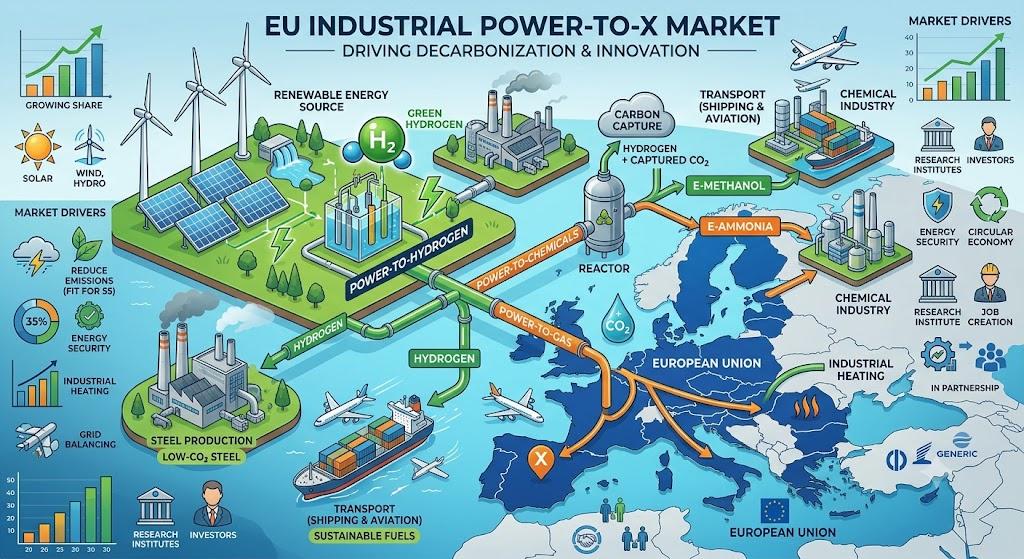

The Europe Industrial Power-to-X Market is gaining strategic importance as industries seek reliable pathways to reduce emissions and improve sustainability performance. Power-to-X technologies enable the conversion of renewable electricity into hydrogen, synthetic fuels, and chemicals, making them essential for sectors that cannot rely solely on direct electrification. As climate policies tighten across Europe, these technologies are moving from pilot stages toward commercialization.
Industrial players are increasingly exploring Power-to-X as a long-term solution to energy transition challenges. The ability to store renewable energy in chemical form offers flexibility and helps stabilize energy supply. This is particularly important in Europe, where renewable energy generation can be intermittent due to varying weather conditions. By converting excess electricity into usable fuels, industries can maintain operational continuity.
A deeper understanding of the Europe Industrial Power-to-X Market Analysis reveals strong alignment between policy frameworks and technological innovation. Governments are actively promoting hydrogen strategies, carbon pricing mechanisms, and funding programs that support Power-to-X development. These initiatives are creating a favorable environment for market expansion.
The industrial application of Power-to-X is diverse and expanding. In the steel sector, hydrogen is being used as a cleaner alternative to coal in production processes. Similarly, the chemical industry is adopting green hydrogen to produce ammonia and methanol with lower carbon footprints. Transportation sectors such as aviation and shipping are also exploring synthetic fuels derived from Power-to-X technologies.
Infrastructure development plays a crucial role in shaping market dynamics. The establishment of hydrogen pipelines, storage facilities, and distribution networks is essential for scaling operations. Without adequate infrastructure, the widespread adoption of Power-to-X solutions could face delays. However, several European countries are investing heavily in building these capabilities.
Challenges remain, particularly in terms of cost competitiveness and technological maturity. While production costs are gradually declining, they are still higher compared to conventional fossil-based alternatives. Continued innovation and economies of scale will be necessary to bridge this gap. Collaboration among stakeholders will also be key to overcoming barriers.
In the coming years, the Europe Industrial Power-to-X Market is expected to evolve rapidly. Increased investment, supportive policies, and technological advancements will drive adoption across multiple industries. As companies prioritize sustainability and regulatory compliance, Power-to-X solutions will become an integral part of industrial energy strategies.
