

How Will India’s Push for Clean Energy Drive the Gas Genset Market to $420.6 Million by 2034?

As India accelerates its industrial expansion, urban transformation, and commitment to carbon neutrality, the nation's reliance on continuous, high-quality electrical power has never been more critical. From high-tech data centers in bustling metro centers to chemical manufacturing hubs stretching across industrial corridors, uninterrupted energy is the bedrock of modern economic growth. However, with environmental standards tightening and diesel generator restrictions mounting, a quiet revolution is taking place in backup and prime power generation.
The gas-powered generator set—or gas genset—has emerged as a key technology in India's broader transition toward cleaner fuel sources. Running on natural gas, piped natural gas (PNG), compressed natural gas (CNG), liquefied petroleum gas (LPG), or renewable biogas, these units offer a low-emission, highly efficient alternative to traditional diesel engines.
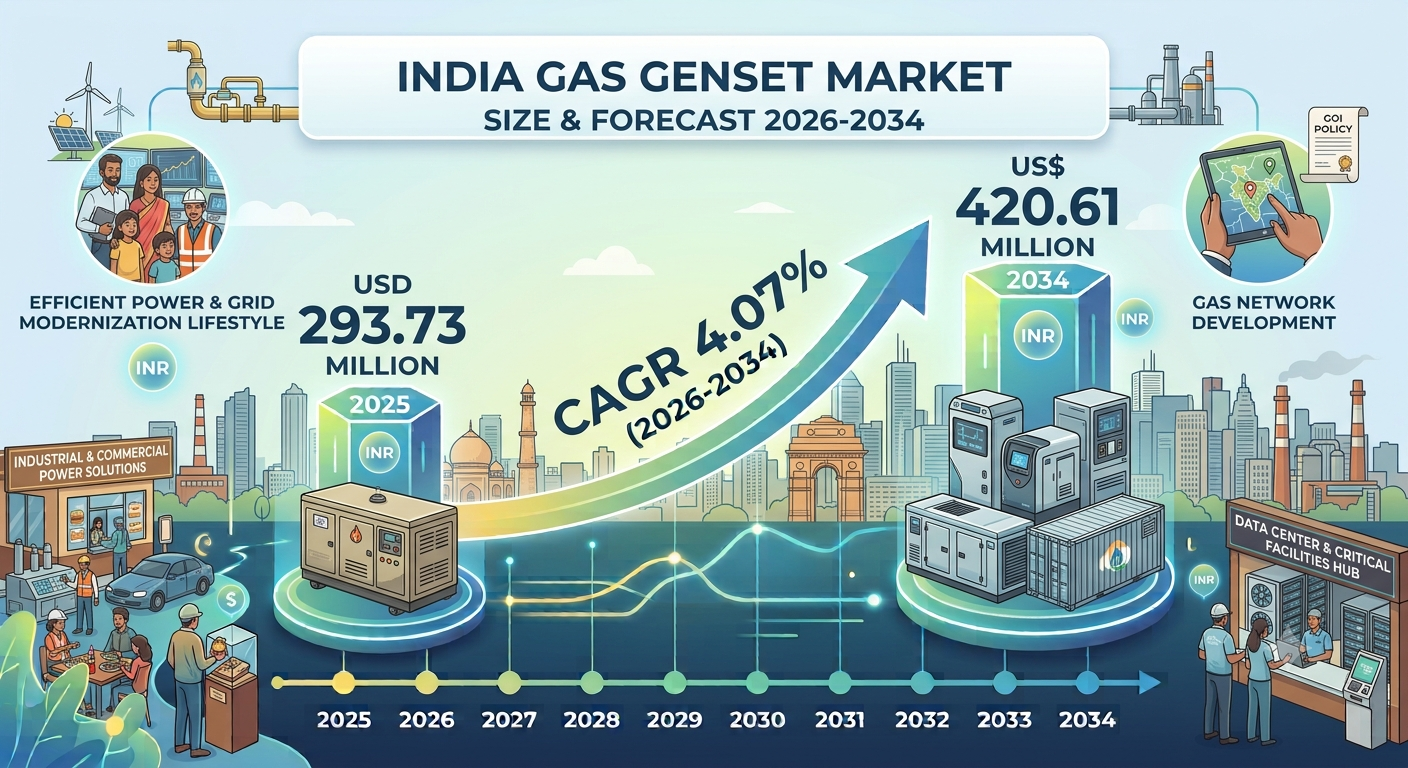
According to market projections by Renub Research, the India Gas Genset Market size is valued at USD 293.73 million in 2025 and is forecasted to reach USD 420.61 million by 2034. This growth trajectory represents a steady Compound Annual Growth Rate (CAGR) of 4.07% over the forecast period from 2026 to 2034.
What key factors are accelerating this transition? How are city gas distribution networks, evolving emissions rules, and industrial expansion shaping the future of decentralized power in India?
Download Free Sample Report:https://www.renub.com/request-sample-page.php?gturl=india-gas-genset-market-p.php
Industry Overview: What Is a Gas Genset and Why Is It Gaining Traction?
A gas genset is an integrated power generation unit that pairs a gas-fueled internal combustion engine with an electrical alternator. Designed to generate electrical energy efficiently, these systems serve as primary (continuous) power sources in off-grid locations or as reliable standby units during grid outages.
Unlike conventional diesel-fueled generators, gas gensets offer several operational and environmental advantages:
-
Cleaner Combustion: They emit significantly lower quantities of nitrogen oxides ($NO_x$), sulfur dioxide ($SO_2$), and particulate matter ($PM$), making them ideal for urban centers with strict air quality standards.
-
Quiet Operation: Gas engines generally operate with lower noise levels, rendering them suitable for commercial hubs, hospitals, educational institutions, and residential complexes.
-
Fuel Cost Savings: Where piped natural gas infrastructure is well-established, gas gensets often deliver lower running costs per kilowatt-hour ($kWh$) compared to diesel generators, which are exposed to fuel delivery logistics and price volatility.
-
Decentralized Biogas Potential: Beyond fossil fuels, gas gensets can operate on biogas harvested from agricultural residue, municipal waste, and anaerobic digestate—enabling sustainable off-grid electricity generation in rural and semi-urban settings.
Across India, key end users in healthcare, hospitality, information technology, commercial real estate, and heavy manufacturing are increasingly opting for gas gensets as part of their broader Environmental, Social, and Governance (ESG) strategies.
India Gas Genset Market Value Trajectory (USD Millions)

2025 : $293.73 Million  | #########################
2034 : $420.61 Million  | ####################################
                        (CAGR: 4.07% from 2026 to 2034)
Primary Growth Drivers Shaping the Indian Market
The market's expansion between 2026 and 2034 is anchored by structural developments in energy infrastructure, evolving environmental policy, and rising commercial power requirements.
                            MARKET GROWTH DRIVERS
                                      |
         +----------------------------+----------------------------+
         |                            |                            |
[Gas Infrastructure]        [Regulatory Pressures]        [Commercial Demand]
Expanding CGD networks      Strict emission norms,        Data centers, IT parks,
& March 2026 Govt Order     July 2025 CPCB IV+ product    & industrial CHP/co-gen
streamlining pipelines      launches (Daimon Genset)      applications
1. Rapid Expansion of City Gas Distribution (CGD) Infrastructure
The most foundational enabler of gas genset adoption is the expanding footprint of India's natural gas pipeline network. The Indian government has actively prioritized increasing the share of natural gas in the national primary energy basket, leading to massive investments in cross-country pipelines, LNG import terminals, and City Gas Distribution (CGD) networks.
Key Regulatory Benchmark (March 2026):
The Government of India, through the Ministry of Petroleum and Natural Gas, enacted the Natural Gas and Petroleum Products Distribution (Laying, Construction, Operation, and Expansion of Pipeline and Other Infrastructure) Order, 2026 under the Essential Commodities Act, 1955. This landmark directive establishes a streamlined, time-bound process for laying and expanding gas pipelines across states, effectively addressing long-standing delays in land acquisition and right-of-way permissions.
By making Piped Natural Gas (PNG) and Compressed Natural Gas (CNG) readily accessible across Tier-I, Tier-II, and Tier-III cities, the government has substantially reduced the supply risk that historically discouraged businesses from investing in gas-fired machinery.
2. Stringent Environmental Regulations and Corporate Sustainability Goals
With urban air quality under intense regulatory scrutiny—particularly across the National Capital Region (NCR) and major industrial belts—the Central Pollution Control Board (CPCB) and regional authorities have tightened emission thresholds for power generation equipment.
Unlike diesel generators, which face seasonal operation bans or strict running-hour caps in heavily polluted regions, gas-powered units comply naturally with stringent environmental mandates. This has turned gas gensets into a practical solution for industrial units needing uninterrupted operational continuity.
Key Technological Milestone (July 2025):
Demonstrating rapid domestic innovation, a high-profile collaborative effort led to the launch of the ‘Daimon Genset,’ recognized as India’s first CPCB IV+ rated 10 kVA LPG genset. Exclusively manufactured by Cooper Corporation, this compact, highly efficient unit set a benchmark for low-emission, cost-effective backup power. Engineered for both domestic deployment and international export, the product highlights India's growing capacity for sustainable engineering.
3. Escalating Demand Across Commercial, Industrial, and Digital Hubs
India’s rapid industrialization and digital expansion have raised power reliability requirements to absolute mission-critical levels. A momentary power dip can lead to data loss in IT parks or ruin production batches in pharmaceutical and chemical processing facilities.
Commercial establishments—including five-star hotels, multi-specialty hospitals, shopping malls, and corporate towers—are increasingly turning to gas gensets because they integrate cleanly into urban surroundings without generating excessive noise or soot. Furthermore, the rapid growth of hyperscale data centers across India is opening new opportunities for high-capacity gas gensets, particularly those configured for Combined Heat and Power (CHP) or cogeneration setups that maximize total energy efficiency.
Key Market Challenges and Operational Bottlenecks
Despite favorable market trends, the India gas genset sector faces specific structural hurdles that influence vendor adoption rates.
+-----------------------------------------------------------------------+
|                         INDUSTRY BOTTLENECK ANALYSIS                  |
+-----------------------------------------------------------------------+
| Infrastructure Gaps   --> Gas pipelines remain urban-centric; remote  |
|                           industrial zones still lack PNG connections.|
|                                                                       |
| Capital Expenses      --> Higher upfront equipment costs compared to  |
| (CapEx Concerns)          traditional diesel-fueled units.            |
|                                                                       |
| Commodity Volatility  --> International LNG price swings impact       |
|                           operational cost forecasts for end users.   |
+-----------------------------------------------------------------------+
Uneven Gas Distribution Network
While urban centers and major industrial corridors enjoy growing PNG access, vast semi-urban and rural areas remain unconnected to the natural gas grid. Transporting compressed gas via virtual pipelines (truck-mounted CNG/LNG cascades) adds transport costs, making gas gensets less economically viable in remote regions compared to ubiquitous diesel alternatives.
High Initial Capital Expenditure (CapEx)
Gas engine generator sets require specialized fuel injection mechanics, precision gas train controls, safety shut-off systems, and dedicated supply piping. As a result, their initial procurement cost is generally higher than that of an equivalent diesel generator. For Small and Medium Enterprises (SMEs) with limited capital budgets, this upfront price gap remains a major consideration, despite the lower long-term operating costs (OpEx) of gas units.
Global Gas Price Volatility
Because India imports a portion of its natural gas requirement as Liquefied Natural Gas (LNG), domestic gas prices can fluctuate based on global geopolitical conditions and supply chain shifts. Price unpredictability can make long-term operational expense modeling difficult for cost-sensitive commercial operators.
Capacity Deep-Dive: Low kVA vs. High kVA Genset Markets
The Indian gas genset market is structurally divided based on electrical output capacity, catering to distinct consumer needs.
                    CAPACITY RANGE BREAKDOWN
                               |
       +-----------------------+-----------------------+
       |                                               |
[Low kVA Gensets]                              [High kVA Gensets]
- Capacity: Up to 75 kVA                       - Capacity: Exceeding 75 kVA
- Primary Users: Retail outlets, clinics,      - Primary Users: Data centers, hospitals,
  small offices, residential complexes           manufacturing plants, tech parks
- Key Strengths: Compact footprint, low        - Key Strengths: Continuous power supply,
  noise, easy PNG/LPG connection                 CHP integration, heavy industrial load
Low kVA Gas Gensets (Up to 75 kVA)
Low kVA gas gensets are widely deployed across urban and semi-urban commercial ecosystems. Powered by PNG, CNG, or LPG cylinders, these units offer compact dimensions, low noise signatures, and minimal exhaust smoke. They serve as ideal backup power systems for:
-
Retail outlets, banks, and neighborhood clinics
-
Restaurants and small commercial offices
-
Educational institutions and residential communities
As city gas networks expand deeper into residential and commercial zones, low kVA gas gensets are increasingly replacing small, noisy diesel backup units.
High kVA Gas Gensets (Exceeding 75 kVA)
High-capacity gas gensets are engineered for high-duty cycle, heavy-load applications where continuous, clean power is paramount. These units power extensive infrastructure operations, including:
-
Hyperscale data centers and IT parks
-
Multi-specialty hospital campuses and international airports
-
Heavy manufacturing facilities (pharmaceuticals, food processing, textiles)
High kVA units are frequently integrated into Combined Heat and Power (CHP) systems. In a CHP setup, the waste heat generated by the gas engine exhaust is captured to produce hot water, steam, or absorption-chilled air for industrial processes or facility climate control, raising total energy efficiency above 80%.
Sectorial Breakdown: Commercial vs. Industrial Applications
+------------------+----------------------------------------------------+
| Sector           | Primary Drivers & Core Applications                |
+------------------+----------------------------------------------------+
| Commercial       | Driving factors: Strict urban noise/pollution      |
|                  | norms, ESG compliance, CGD availability.           |
|                  | Applications: HVAC backup, elevators, lighting,    |
|                  | computing systems in malls, hotels, and hospitals. |
|                  |                                                    |
| Industrial       | Driving factors: Decarbonization mandates, need    |
|                  | for 24/7 continuous process power, CHP potential.  |
|                  | Applications: Pharma, chemical processing, food    |
|                  | manufacturing, textiles, ceramic production.       |
+------------------+----------------------------------------------------+
Commercial Sector Demand
In dense metropolitan environments, commercial operators are subject to strict municipal environmental codes. Gas gensets provide a clean solution for keeping essential services operational during grid outages—such as HVAC climate control, elevator operations, emergency lighting, and server room cooling—without generating heavy exhaust smoke or loud engine clatter.
Industrial Sector Demand
Manufacturing industries require clean, reliable electrical power to maintain continuous production runs. Industries like pharmaceuticals, specialty chemicals, food processing, and textiles rely heavily on gas gensets because gas-fired power eliminates the fuel storage and fuel degradation challenges associated with bulk diesel tanks. Furthermore, industrial plants are leveraging gas gensets to advance corporate net-zero roadmaps and lower their operational carbon footprints.
Geographic Landscape: Key State Markets in Focus
The adoption of gas gensets across India varies significantly based on regional gas grid connectivity, state-level industrial policies, and urban density.
                      KEY REGIONAL MARKETS
                               |
   +---------------+-----------+---------------+---------------+
   |               |                           |               |
[Maharashtra]  [Uttar Pradesh]          [Andhra Pradesh]   [Gujarat]
Mumbai-Pune    Noida-Ghaziabad          Visakhapatnam SEZs Established gas grid,
industrial     urban corridor,          ports, pharma      petrochemicals &
hub, CGD density smart cities           & textile hubs     ceramics leadership
1. Maharashtra: The Commercial & Industrial Pioneer
Maharashtra stands out as one of the largest markets for gas gensets in Western India. Driven by extensive industrial clusters across Mumbai, Pune, Thane, and Nagpur, the state possesses a highly developed City Gas Distribution network.
-
Key End Users: IT parks, financial institutions, pharmaceutical labs, automotive assembly plants, and hyperscale data centers.
-
Market Dynamics: Stringent regional pollution enforcement combined with high commercial density makes Maharashtra a prime adopter of gas-powered power solutions.
2. Uttar Pradesh: Fast-Paced Urban & Industrial Growth
Supported by rapid infrastructure investment and expanding natural gas grids, Uttar Pradesh is emerging as a growth market for gas generator sets.
-
Key Cities: Noida, Greater Noida, Ghaziabad, Lucknow, and Kanpur.
-
Market Dynamics: The rapid development of commercial hubs, IT parks, healthcare facilities, and industrial corridors in the National Capital Region (NCR) fringe has driven strong demand for clean standby power systems to replace aging diesel units.
3. Andhra Pradesh: Coastal Industrial & SEZ Expansion
Andhra Pradesh leverages strong industrial policies, a long coastline, and expanding LNG import infrastructure to build out its gas-powered energy ecosystem.
-
Key Hubs: Visakhapatnam, Vijayawada, and Tirupati.
-
Market Dynamics: Proximity to coastal gas pipelines and port infrastructure makes natural gas access increasingly feasible for pharmaceutical manufacturing, food processing plants, textile mills, and special economic zones (SEZs).
4. Gujarat: The Natural Gas Infrastructure Benchmark
Gujarat leads the country in natural gas utilization, boasting a mature, state-wide pipeline grid, multiple operational LNG terminals, and comprehensive city gas coverage.
-
Key Cities: Ahmedabad, Surat, Vadodara, and Rajkot.
-
Market Dynamics: With natural gas deeply integrated into the state's energy mix, gas gensets are widely deployed across petrochemical refineries, ceramic manufacturing units, textile mills, and commercial complexes.
Comprehensive Market Segmentation & Competitive Landscape
To better understand how the overall power generation industry is structured in India, market analysts categorize generator systems across several dimensions:
Industry Segmentation Framework
-
By kVA Capacity Range:
-
Low kVA Range (Up to 75 kVA)
-
Medium kVA Range (75 kVA to 375 kVA)
-
High kVA Range (Above 375 kVA)
-
-
By End-User Application:
-
Residential Complexes
-
Commercial Facilities (Data Centers, Hospitals, Malls, Hotels, IT Parks)
-
Industrial Establishments (Pharma, Chemical, Food Processing, Automotive, Textiles)
-
-
By Key Regional States:
-
Maharashtra, Gujarat, Uttar Pradesh, Tamil Nadu, Karnataka, West Bengal, Rajasthan, Telangana, Andhra Pradesh, and Madhya Pradesh.
-
Leading Market Competitors
The Indian gas generator landscape features established domestic manufacturers and prominent international engineering groups. Key market players analyzed across revenue, technology portfolios, and SWOT metrics include:
-
Kirloskar Oil Engines Limited (KOEL): A domestic pioneer in internal combustion engines and power generation, offering localized gas-powered generator solutions.
-
Mahindra & Mahindra Ltd (Powerol Division): A major supplier of compact, fuel-efficient gensets tailored for small-to-medium enterprise and commercial applications.
-
Cummins India Ltd: A dominant player in medium and high-capacity gas gensets, heavily preferred for industrial, data center, and CHP installations.
-
Ashok Leyland: A leading domestic manufacturer expanding its alternative-fuel power generation portfolio across commercial segments.
-
Greaves Cotton Ltd: Focuses on fuel-flexible power solutions and compact gensets for urban commercial users.
-
Caterpillar Inc.: A global heavy-equipment manufacturer supplying heavy-duty, high-kVA gas gensets for critical infrastructure and continuous-run industrial plants.
-
Escorts Kubota Limited: Provides power solutions across agriculture, commercial, and light-industrial sectors.
-
Powerica Ltd.: A major power engine original equipment manufacturer (OEM) delivering gas genset packages across key commercial markets.
Final Thoughts: The Path to 2034
As India works toward its goal of expanding the natural gas share in its energy mix to 15%, the gas genset industry will play a vital role in balancing industrial growth with environmental stewardship. Projected to grow from USD 293.73 million in 2025 to USD 420.61 million by 2034, the market's 4.07% CAGR reflects a steady transition toward cleaner, quieter, and more compliant power generation.
Driven by government policy support—such as the March 2026 pipeline construction framework—and milestone product innovations like the CPCB IV+ rated LPG units, gas gensets are no longer just an alternative power source. They are becoming an essential component of India’s sustainable industrial strategy.

