

Liquid Laundry Detergent Industry Growth Supported by Enzyme Innovation and Smart Laundry Solutions

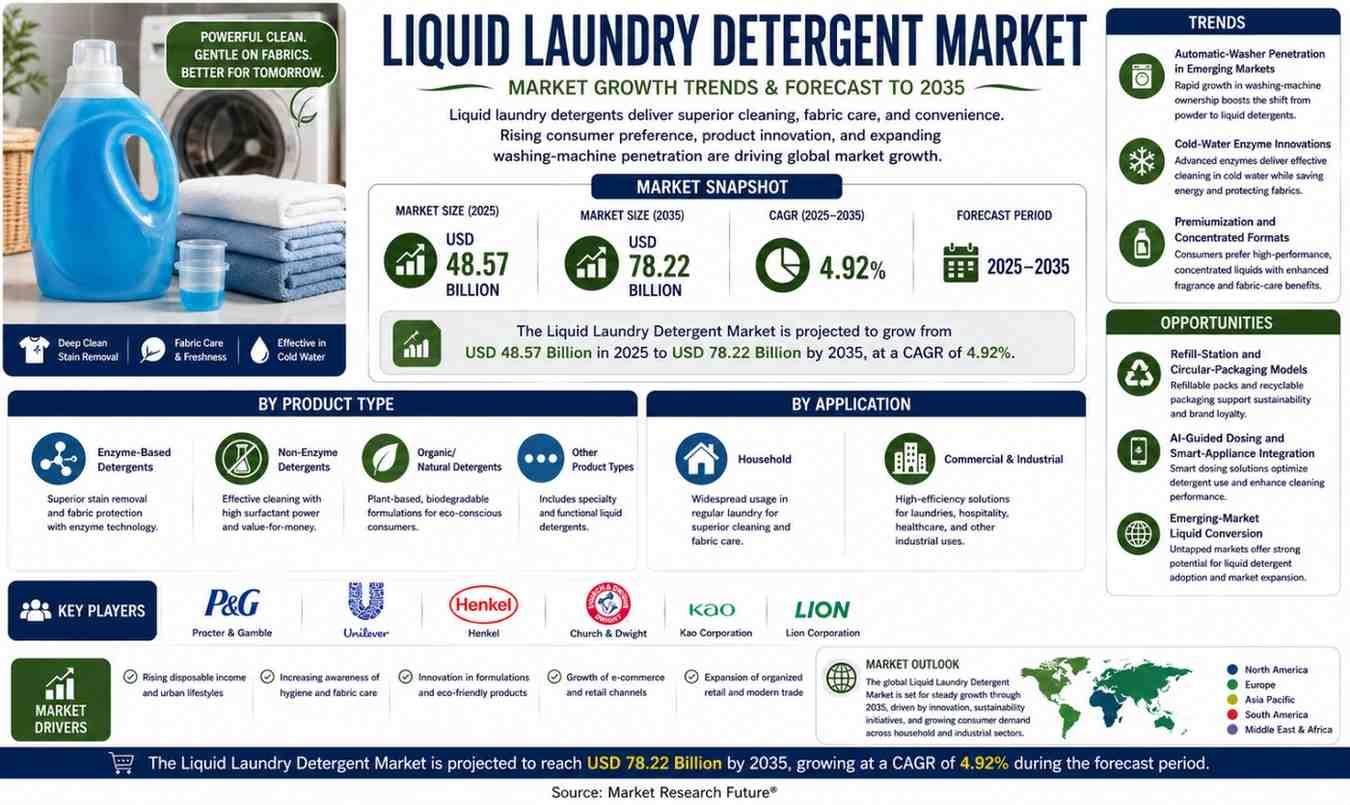
According to Market Research Future®, the Liquid Laundry Detergent Market Size is projected to expand from USD 48.57 billion in 2025 to USD 78.22 billion by 2035, registering a CAGR of 4.92% during the forecast period.
The global liquid laundry detergent market is experiencing consistent growth as households and commercial users increasingly prefer convenient cleaning products that deliver improved washing efficiency, fabric protection, and ease of use. Liquid detergents have become a preferred choice among consumers because they dissolve quickly, perform effectively in modern washing machines, support low-temperature washing, and provide targeted cleaning performance for different fabric categories.
Growing urbanization, rising disposable incomes, increasing adoption of automatic washing machines, and expanding demand for premium household care products are accelerating market development across global regions. Emerging economies are witnessing a significant transition from traditional detergent formats toward liquid formulations as consumers adopt modern lifestyles and advanced laundry appliances.
Manufacturers are responding to changing preferences by developing concentrated detergent solutions, natural and organic formulations, cold-water enzyme technologies, and sustainable packaging systems. Leading companies including Procter & Gamble, Unilever, Henkel, Church & Dwight, Kao Corporation, and Lion Corporation are focusing on innovation, brand expansion, and environmentally responsible product development to strengthen their global market positions.
Get a sample report pdf| https://www.marketresearchfuture.com/sample_request/25042
Market Overview
The liquid laundry detergent market is an essential segment of the global cleaning products industry, supplying advanced washing solutions for household consumers as well as commercial and industrial users.
Liquid laundry detergents are available in multiple formulations, including enzyme-based detergents, non-enzyme detergents, organic or natural detergents, and specialty products designed for specific cleaning requirements.
Compared with traditional detergent formats, liquid formulations offer advantages such as faster dissolution, reduced residue formation, improved compatibility with washing machines, and enhanced performance across various water temperatures.
The increasing focus on fabric care, convenience, hygiene, and sustainable household products continues supporting demand for liquid laundry detergent solutions worldwide.
Market Size Analysis
The liquid laundry detergent market reached USD 48.57 billion in 2025, supported by strong household consumption and expanding commercial cleaning requirements.
Household applications continue dominating market demand as consumers increasingly select liquid detergents for everyday laundry activities. The growing number of automatic washing machines and rising preference for convenient cleaning solutions are encouraging consumers to shift toward liquid-based products.
Commercial and industrial applications are also contributing to market growth through increasing usage in hotels, hospitals, professional laundry services, restaurants, and manufacturing facilities where efficient cleaning performance is essential.
Premium detergent products featuring advanced stain removal, fragrance enhancement, fabric protection, and specialized formulations are gaining popularity among consumers seeking higher-value cleaning experiences.
Market Forecast
The liquid laundry detergent market is expected to reach USD 78.22 billion by 2035, driven by increasing adoption of advanced detergent technologies, sustainable product innovations, and changing consumer lifestyles.
Expansion of emerging markets, rising demand for premium cleaning products, and increasing awareness regarding environmentally responsible formulations are expected to create significant growth opportunities during the forecast period.
Technology and Innovation
Technological innovation continues reshaping the liquid laundry detergent industry through improvements in formulation science, sustainability, and user convenience.
Enzyme-based detergent technologies are enabling manufacturers to develop highly effective cleaning solutions capable of removing complex stains while maintaining fabric quality. Advances in cold-water enzyme systems are particularly gaining attention as consumers increasingly seek energy-efficient washing methods.
Concentrated liquid detergent formats are becoming increasingly popular because they reduce packaging requirements, lower transportation costs, and support more sustainable consumption patterns.
Artificial intelligence-based dosing technologies and connected appliance integration are introducing new possibilities for personalized laundry management. Smart washing systems can optimize detergent usage based on load size, fabric type, and cleaning requirements.
Manufacturers are also investing in biodegradable ingredients, plant-derived formulations, recyclable packaging, and refill-based distribution models to reduce environmental impact.
Industry Trends
The increasing penetration of automatic washing machines in developing economies remains a major factor supporting liquid detergent adoption.
Premiumization continues influencing the market as consumers show greater interest in concentrated formulas, specialized cleaning solutions, and enhanced fragrance experiences.
Sustainability has become a critical industry trend, encouraging companies to develop environmentally responsible ingredients, reduced-plastic packaging, and circular product models.
Growth Opportunities
Refill stations and circular packaging systems represent significant opportunities for detergent manufacturers seeking to address sustainability concerns and reduce packaging waste.
Integration of artificial intelligence and smart appliance technologies is creating opportunities for improved detergent efficiency, personalized recommendations, and optimized product usage.
Emerging markets offer substantial growth potential as rising incomes, expanding urban populations, and changing consumer habits accelerate the adoption of liquid laundry detergents.
Competitive Landscape
The liquid laundry detergent market remains highly competitive as manufacturers focus on formulation improvements, sustainable innovation, brand development, and global distribution expansion. Procter & Gamble, Unilever, Henkel, Church & Dwight, Kao Corporation, and Lion Corporation continue investing in advanced cleaning technologies, research and development, sustainable packaging, and consumer-focused solutions.
Market participants are increasingly competing through product differentiation, environmentally responsible practices, premium formulations, and innovative delivery formats. Companies capable of combining strong brand recognition, effective cleaning performance, sustainability initiatives, and broad market reach are expected to maintain competitive advantages.
Future Outlook
The global liquid laundry detergent market is expected to maintain steady growth through 2035 as consumers continue adopting convenient, efficient, and sustainable cleaning solutions. Increasing demand for premium detergents, natural formulations, concentrated products, and technologically integrated laundry systems will remain key factors shaping future industry development.
Future growth will be supported by advancements in enzyme chemistry, artificial intelligence-enabled dosing systems, biodegradable ingredients, smart washing technologies, refill packaging models, and sustainable manufacturing practices that improve cleaning performance while addressing evolving environmental expectations.
