

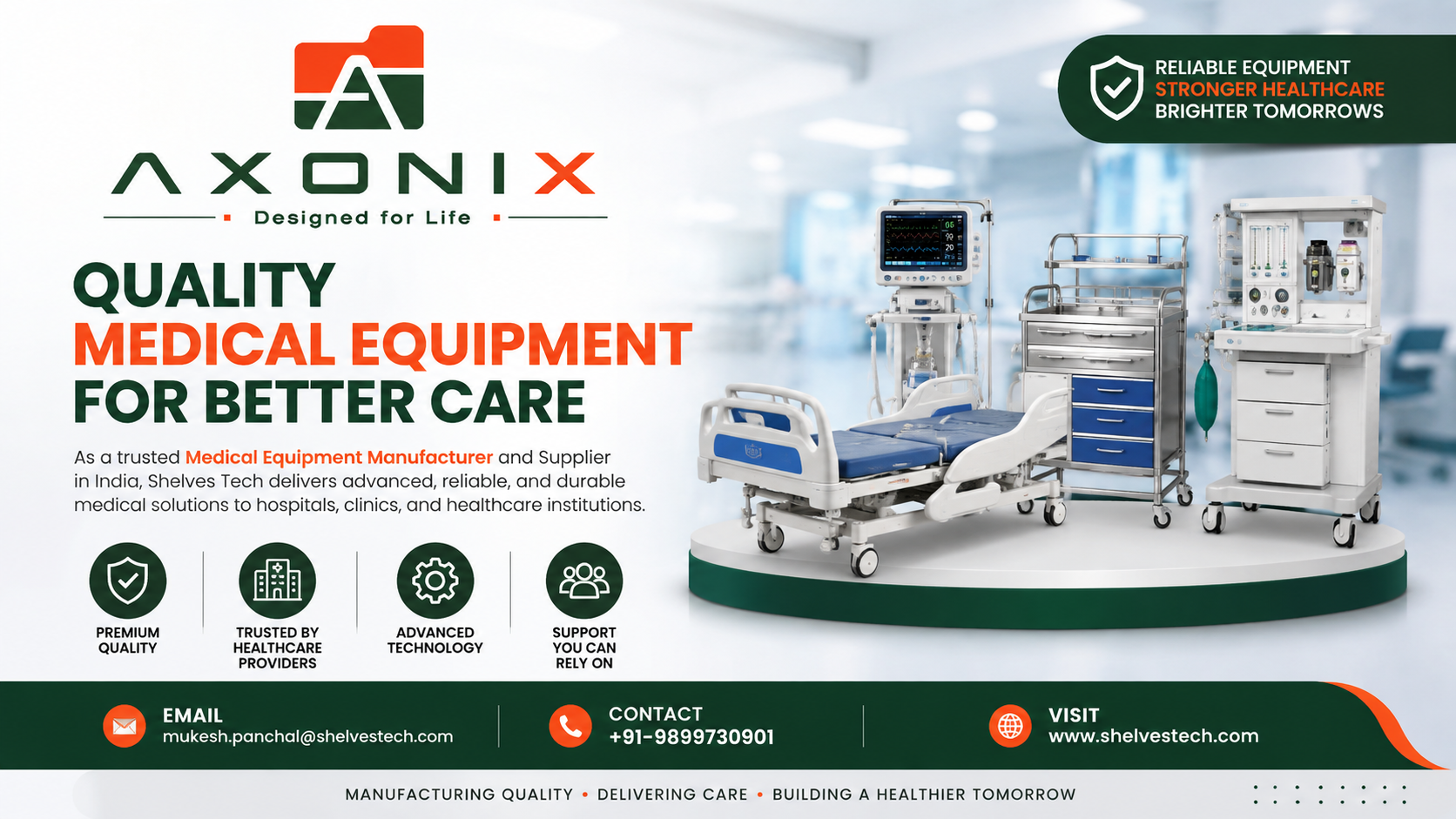
Medical Equipment: 10 Essential Factors Every Hospital Should Consider Before Buying

A quotation can look reasonable until the biomedical engineering team finds that the equipment needs a different electrical load, replacement parts take weeks to arrive, or installation was never included.
Buying medical equipment is not a routine price comparison. Hospitals are committing money to assets that may operate continuously, influence clinical workflows and require years of maintenance. One vague specification can become an expensive operational problem after commissioning.
India’s National Medical Devices Policy 2023 specifically aims to strengthen domestic manufacturing and improve access to cost-effective medical devices. That makes supplier evaluation more important, not less.
The 10 Specifications That Belong in Every Purchase File
Clinical and Operational Application
Define where the equipment will operate, who will use it and how many hours it may run daily. ICU, ward, laboratory and industrial applications do not place the same demand on a machine.
Rated Capacity
Capacity should match peak demand, not the hospital’s current average usage. For an oxygen plant, buyers must compare flow rate, operating pressure and simultaneous consumption across connected outlets.
Output Quality
Ask for measurable output parameters. PSA medical oxygen is commonly specified at 93% ±3% purity, representing an accepted range of 90% to 96%.
Regulatory Documentation
Request product-specific licences, test documents and applicable quality records before issuing the purchase order. A generic company certificate does not automatically prove that every quoted product meets the required specification.
Utility Requirements
Check voltage, phase, air quality, ventilation, drainage, room dimensions and ambient operating conditions.
This is the detail buyers skip most often.
Automation and Alarm Controls
Critical systems should provide clear operating status, fault alerts and shutdown protection. Automation is useful only when hospital technicians can understand and troubleshoot it.
Installation Scope
Clarify unloading, positioning, piping, cabling, civil work, commissioning and performance testing. “Installation included” is too vague for a hospital purchase order.
Preventive Maintenance
Obtain the maintenance frequency, consumable list and estimated annual service requirement in writing.
Spare-Part Availability
Identify which parts are stocked in India and which are imported. A low-cost machine becomes expensive when one sensor leaves it idle for 19 days.
Training and Handover
Training should cover operation, daily checks, alarm response, basic maintenance and emergency shutdown—not merely a 20-minute demonstration.
Five Supplier Answers That Expose Procurement Risk
Before selecting a Medical Equipment Manufacturer, evaluate these five points:
-
Technical documentation: A good supplier submits model-specific data sheets. A bad answer is, “The final details will come after the order.”
-
Compliance evidence: Ask which requirement applies to the quoted product. “We follow all standards” proves nothing.
-
Service coverage: Request technician locations, escalation contacts and expected attendance time. “Support is available anywhere” is not a service plan.
-
Installation responsibility: Demand a written scope matrix. A bad supplier keeps electrical, piping and civil responsibilities deliberately unclear.
-
Warranty exclusions: Check coverage for labour, travel, electronic parts and consumables. “Defects will be handled case by case” means the buyer carries the risk.
Most buyers negotiate the equipment price aggressively and barely negotiate downtime responsibility. That is backwards.
How Better Equipment Selection Protects Hospital Budgets
Correct capacity selection reduces overloading and premature component failure. Defined utility requirements prevent expensive site modifications after delivery. Documented training lowers operator error, while local spare availability reduces shutdown duration.
And yet, lifecycle cost matters more than the opening quotation.
A direct manufacturer can also help control specification changes, customization and technical communication. Shelves Tech publicly positions itself as a manufacturer and supplier of PSA oxygen plants, medical equipment, hospital furniture and related healthcare solutions.
Reliable equipment selection protects five financial areas: asset life, energy consumption, maintenance expenditure, staff time and clinical continuity.
Medical Equipment Supply Across India
Hospitals searching for a Medical Equipment Manufacturer in India should assess service reach alongside manufacturing capability. India’s size makes spare-part positioning and technician availability genuine supply-chain issues; dispatching a component from Delhi to a nearby NCR facility is different from supporting an installation several states away.
Likewise, Medical Equipment Suppliers in India, Medical Equipment Dealers in India and Medical Equipment Wholesalers in India should disclose whether they provide installation themselves or depend on another company.
Shelves Tech states that it serves hospitals, laboratories and industrial facilities across India and promotes oxygen generation solutions for both medical and industrial applications.
What We Ask Before Recommending a System
At Shelves Tech, we manufacture and supply medical equipment, hospital solutions and PSA oxygen generation systems for healthcare and industrial applications.
We first need the application, required capacity, operating hours, site utilities and installation location. Without those five inputs, a quotation may be fast, but it will not be dependable. Our focus is to match the system configuration with the facility’s actual operating requirement rather than pushing one standard model into every project.
For PSA systems, flow measured at the plant is not the whole story; usable pressure and flow at the final outlet also need checking during commissioning.
Send Shelves Tech a Purchase-Ready Requirement
Send us your equipment name, quantity, required capacity, application, delivery city, site utility details and expected commissioning date.
We will prepare the relevant configuration and quotation through Shelves Tech. Ask our team to confirm the applicable MOQ, quotation response time, warranty, installation scope and service commitment in writing before finalising the order.
Medical Equipment Decisions Should Survive the Next Five Years
The right medical equipment must remain serviceable, measurable and supportable after the first installation day. Price deserves attention, but undocumented specifications and weak service terms deserve more. Hospitals that buy against lifecycle requirements will be better prepared for rising patient loads and tighter infrastructure planning.
Frequently Asked Questions
What should hospitals check before buying medical equipment?
Check application, capacity, compliance documents, utility needs, installation, warranty, maintenance, spare parts, training and service coverage. Missing even one area can increase lifecycle cost.
Should hospitals buy directly from a Medical Equipment Manufacturer?
Direct purchasing can simplify customization and technical coordination. The caveat is that manufacturing capability does not automatically prove strong nationwide service, so verify technician and spare-part coverage.
How are Medical Equipment Suppliers evaluated?
Reliable Medical Equipment Suppliers provide model-specific specifications, commercial terms, installation responsibilities and service contacts. Reject quotations that substitute brochures for technical documentation.
Are Medical Equipment Dealers suitable for hospital projects?
Experienced Medical Equipment Dealers can support standard purchases, especially where local inventory matters. However, confirm who owns warranty, installation and technical escalation after delivery.
When should buyers work with Medical Equipment Wholesalers?
Medical Equipment Wholesalers may suit bulk or multi-location purchases. They may not handle commissioning themselves, so hospitals should identify the authorised technical service provider before ordering.
