

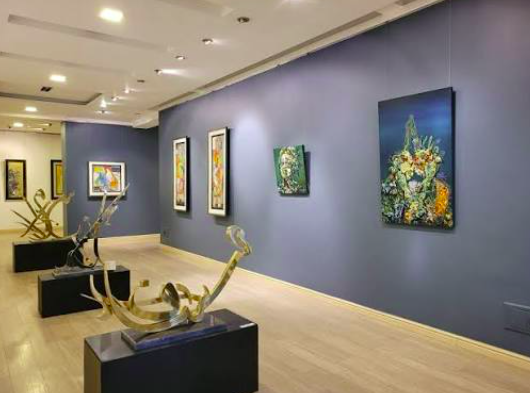

There's a common assumption that collecting original art is something you get into once you already have money to spare — that it's a hobby for people who've already sorted out everything else. In practice, a lot of serious collectors started small, buying pieces well within a modest budget long before they had any real disposable income for art. If you're interested in contemporary Pakistani painting but assume it's out of reach financially, it's worth rethinking that assumption.
Why Starting Small Actually Makes Sense
There's a real advantage to building a collection gradually rather than trying to buy your way into "serious collector" status with one big purchase. Buying modestly priced pieces early gives you room to make mistakes, develop your taste, and learn what you actually respond to, without the pressure of every purchase needing to be a major decision. Some of the most interesting collections aren't defined by a handful of expensive pieces — they're defined by a consistent eye, built up slowly over dozens of smaller, well-considered choices.
It also means you're not shutting yourself out of a huge amount of genuinely excellent work. Plenty of skilled, seriously trained contemporary artists are still early enough in their careers that their work remains accessible, and buying from artists at this stage is often how collectors end up with the most personally meaningful pieces in their entire collection.
Where the Budget-Friendly Opportunities Actually Are
Emerging artists. Newer artists, particularly those recently out of art school or early in their independent practice, are often priced more accessibly than established names, simply because their reputation and demand are still building. This doesn't mean lower quality — it often means genuinely skilled, well-trained artists whose work hasn't yet caught up to their talent in terms of pricing.
Smaller works. A smaller canvas or paper piece from a well-regarded artist can be considerably more accessible than a large-scale work by the same person, while still carrying the same quality of technique and thinking.
Prints and limited editions, if that fits your goals. These are a different category from original paintings, and it's worth being clear-eyed about that distinction, but a well-produced limited edition print from a respected artist can be a reasonable entry point if originals are genuinely out of reach for now.
Group exhibitions and student or graduate shows. These often feature emerging talent at more accessible price points, and they're also a great way to see a wide range of new work in one visit, which helps with developing your own taste.
How to Buy Well on a Limited Budget
Ask about payment plans. Many galleries are more flexible on this than people assume, particularly for a piece you're genuinely committed to. It's a reasonable question to ask rather than assuming it's not an option.
Don't confuse "affordable" with "compromise." A modestly priced piece doesn't have to mean settling for something you don't really want. Take the same care choosing a lower-priced piece that you would a more expensive one — the goal is a collection you actually love, not just one that fits a number.
Prioritize pieces that genuinely move you over pieces that seem like safe choices. With a limited budget, it's tempting to play it safe with something inoffensive and easy to place. But collectors who look back fondly on their early purchases usually cite the pieces that actually grabbed them, not the ones that were simply convenient.
Build relationships with galleries early, even on small purchases. A gallery that sees you as a genuine, engaged collector — even if your early purchases are modest — is more likely to flag pieces or opportunities that suit your taste and budget as your collection grows.
Contemporary art doesn't have to be purely decorative to fit a smaller budget — some of the most interesting entry points are pieces that carry real substance and perspective, including work that engages directly with social or cultural themes. Ejaz Art Gallery has written more on how contemporary art functions as social commentary here, which is worth reading if you're drawn to work with more to say than purely decorative pieces typically offer — that kind of work is often found among emerging artists at more accessible prices.
What to Avoid When Collecting on a Budget
Buying purely because a price seems like a bargain. A low price isn't automatically a good deal if the piece doesn't actually appeal to you or hold up technically. Value only matters relative to whether you genuinely want the piece.
Skipping the questions you'd ask about a more expensive piece. Authenticity, medium, and the artist's background matter just as much for a modestly priced piece as an expensive one. Don't let a lower price tag lower your diligence.
Assuming budget pieces can't be part of a "real" collection. A collection built thoughtfully from accessible work is just as legitimate as one built from expensive pieces — what defines a real collection is consistency of eye and intention, not price point.
Building From Here
The collectors who end up with genuinely interesting collections tend to be the ones who started paying attention early, bought within their means, and stayed curious as their taste developed. If you're just getting started, spend time browsing broadly, ask plenty of questions, and don't feel like you need to wait until you have more money to begin.
Ejaz Art Gallery represents a range of artists across different career stages, which makes it a reasonable place to start exploring if you're building a collection on a modest budget.
Frequently Asked Questions
1. Is it realistic to start collecting original art on a small budget? Yes. Many collectors start with modestly priced work by emerging artists or smaller pieces by more established names, and build their collection gradually over time.
2. Are prints a good way to start collecting if I can't afford originals yet? They can be, as long as you understand the distinction between a print and an original painting. A well-produced limited edition from a respected artist is a reasonable entry point for some collectors.
3. Do galleries usually offer payment plans for art purchases? Many do, particularly for pieces a buyer is genuinely committed to. It's worth asking directly rather than assuming it isn't an option.
4. Is buying from emerging artists risky compared to established names? It carries different considerations, but it isn't inherently riskier from a personal enjoyment standpoint — many emerging artists are highly skilled, and buying their work early is often how collectors end up with especially meaningful pieces.
5. What's the biggest mistake people make when collecting on a limited budget? Choosing a piece purely because the price feels like a bargain, rather than because it genuinely appeals to them. A collection built on real interest tends to hold up better over time than one built on discount-chasing.
