

Global Material Handling Equipment Market Outlook: Automation, Sustainability, and Digital Warehousing Shape Future Growth

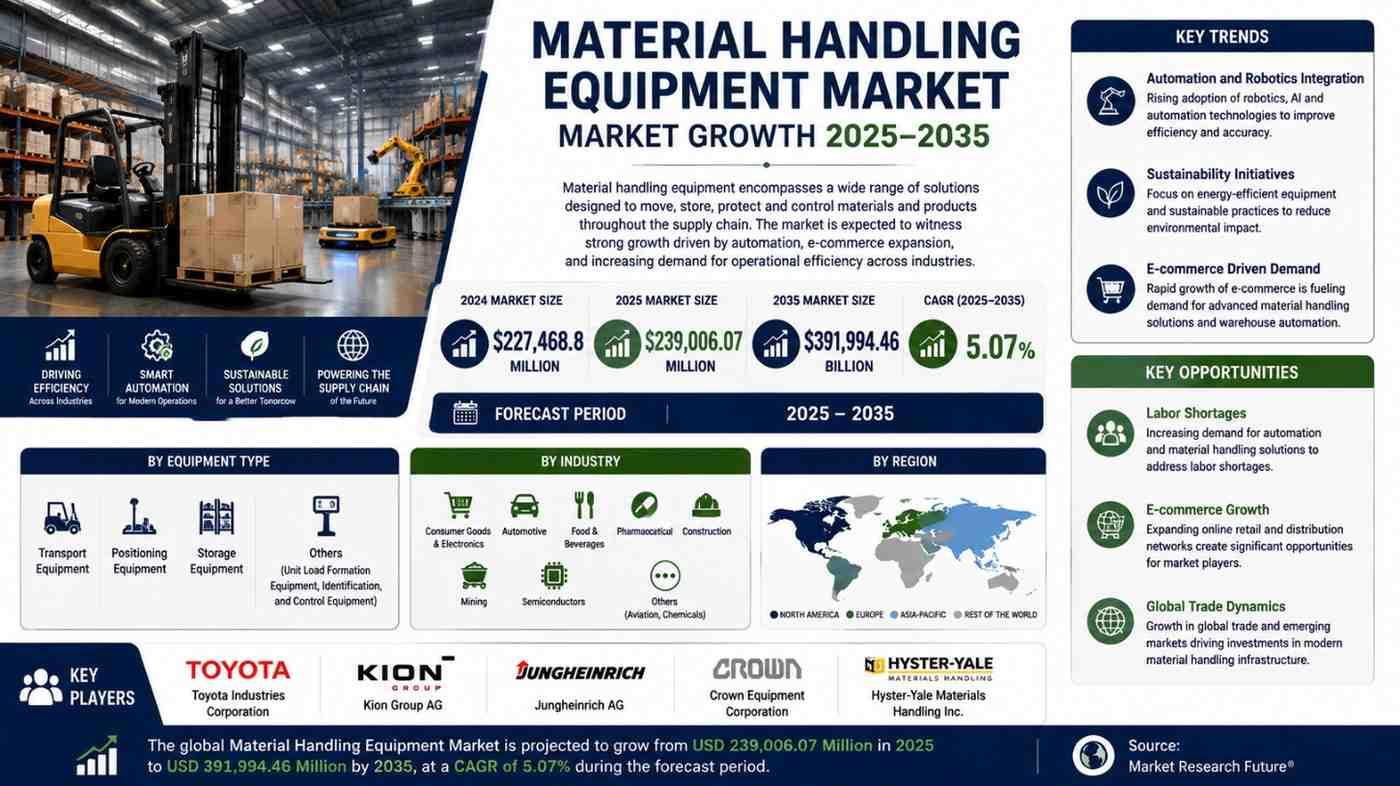
According to Market Research Future®, the Material Handling Equipment Market Growth was valued at USD 227.47 billion in 2024 and is forecast to expand from USD 239.01 billion in 2025 to USD 391.99 billion by 2035, registering a CAGR of 5.07% during the forecast period.
The global material handling equipment market is undergoing significant transformation as businesses across manufacturing, logistics, retail, and industrial sectors prioritize faster operations, optimized workflows, and improved supply chain resilience. Material handling systems have evolved from traditional lifting and transportation tools into intelligent industrial solutions powered by automation, robotics, artificial intelligence, and connected technologies.
The rapid expansion of e-commerce has become a major catalyst for market growth. Online retail platforms require highly efficient fulfillment centers capable of handling large order volumes with speed and accuracy. This has increased demand for automated conveyors, robotic sorting systems, automated storage and retrieval systems, and advanced warehouse management solutions.
Manufacturing industries are also accelerating investment in advanced handling technologies. Automotive plants, semiconductor facilities, pharmaceutical production units, and food processing industries are adopting specialized equipment to improve material flow, reduce production interruptions, and maintain strict quality standards.
The growing challenge of labor availability is encouraging organizations to adopt automated solutions. Autonomous vehicles, robotic handling systems, and smart warehouse technologies are helping companies improve productivity while reducing reliance on manual operations.
Sustainability is increasingly influencing equipment design and purchasing decisions. Manufacturers are developing electric forklifts, energy-efficient warehouse systems, and low-emission technologies to support environmental objectives and reduce operational costs.
Key market participants including Toyota Industries Corporation, Kion Group AG, Jungheinrich AG, Crown Equipment Corporation, and Hyster-Yale Materials Handling Inc. continue strengthening their global presence through innovation, automation solutions, strategic partnerships, and manufacturing expansion.
Get a sample report pdf| https://www.marketresearchfuture.com/sample_request/3214
Market Overview
The material handling equipment market forms a vital part of the global industrial ecosystem by enabling efficient movement, storage, and management of materials throughout manufacturing and supply chain operations.
The industry includes transport equipment, positioning equipment, storage equipment, unit load formation equipment, identification systems, and control technologies designed to improve operational efficiency.
Transport equipment such as forklifts, conveyors, cranes, and automated guided vehicles supports movement of goods within warehouses, factories, ports, and distribution facilities.
Storage and positioning equipment enables organizations to maximize space utilization, improve inventory management, and enhance workplace safety.
Market Size Analysis
The material handling equipment market reached USD 239.01 billion in 2025, reflecting strong demand from industrial automation, logistics infrastructure, and manufacturing modernization.
The automotive sector remains a major consumer as manufacturers require advanced handling systems for assembly lines, component movement, and electric vehicle production.
Consumer goods and electronics industries are increasingly adopting automated warehouse systems to support high-volume production and rapidly changing customer demand.
Pharmaceutical companies continue investing in precise and controlled material handling solutions to maintain product integrity and regulatory compliance.
Construction and mining industries also contribute to market demand through requirements for heavy-duty lifting, transportation, and storage equipment.
Market Forecast
The material handling equipment market is projected to reach USD 391.99 billion by 2035, supported by increasing warehouse automation, industrial digitalization, and global supply chain development.
The adoption of intelligent logistics systems and connected equipment is expected to create new growth opportunities for manufacturers.
Technology and Innovation
Technological advancement remains a defining factor shaping the future of material handling equipment.
Robotics and automation technologies are enabling warehouses and factories to achieve higher throughput, improved accuracy, and reduced operational complexity.
Autonomous mobile robots are increasingly deployed for flexible material transportation in warehouses and manufacturing environments.
Artificial intelligence-based analytics are helping companies optimize inventory movement, predict maintenance requirements, and improve equipment performance.
Industrial Internet of Things platforms provide real-time equipment monitoring and operational insights that improve productivity.
Electric and hydrogen-powered equipment solutions are gaining attention as companies seek cleaner alternatives to conventional fuel-powered systems.
Digital twins and simulation technologies are also supporting warehouse planning, equipment optimization, and process improvement.
Industry Trends
Automation integration continues to dominate industry development as companies transition toward smart factories and intelligent warehouses.
Sustainability initiatives are accelerating adoption of energy-efficient and electric-powered equipment.
E-commerce-driven logistics expansion continues increasing demand for advanced fulfillment and distribution technologies.
Growth Opportunities
Labor shortages represent a significant opportunity for automated material handling equipment providers as companies seek solutions that improve efficiency and operational continuity.
E-commerce growth continues supporting investments in warehouse automation, distribution centers, and last-mile logistics infrastructure.
Global trade expansion is increasing demand for efficient material handling systems across ports, manufacturing hubs, and international supply chains.
Competitive Landscape
The material handling equipment market remains highly competitive as manufacturers focus on technological advancement, automation capabilities, sustainability, and customer-specific solutions.
Leading companies including Toyota Industries Corporation, Kion Group AG, Jungheinrich AG, Crown Equipment Corporation, and Hyster-Yale Materials Handling Inc. continue investing in robotics, electric equipment, digital platforms, research and development, and global production networks.
Companies offering reliable equipment, intelligent automation solutions, energy-efficient technologies, and comprehensive service capabilities are expected to maintain strong market positions.
Future Outlook
The global material handling equipment market is expected to maintain steady growth through 2035 as industries continue embracing automation, digitalization, and efficient supply chain management.
Future expansion will be shaped by autonomous equipment, artificial intelligence, robotics, electric-powered systems, smart warehouse platforms, predictive maintenance, and advanced logistics technologies.
As global industries continue moving toward connected and automated operations, material handling equipment will remain essential for improving productivity, efficiency, and competitiveness across supply chains.
