


Fasteners Explained: Types, Uses & How to Choose the Right One
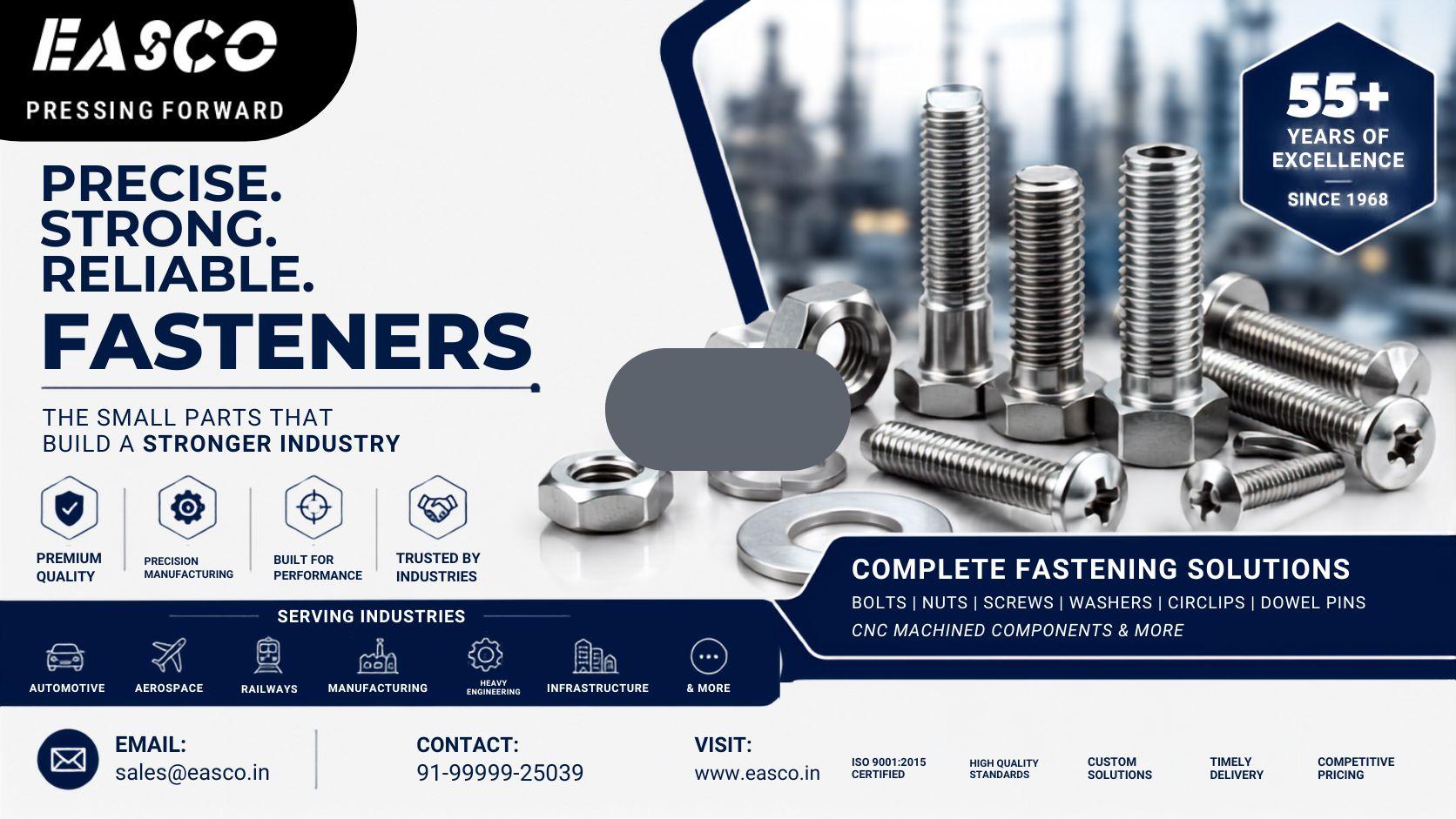
A machine builder in Pune once told us he'd rejected an entire batch of fasteners over a 0.02mm thread tolerance mismatch. The line stopped for six hours. That's the real cost of getting fasteners wrong — not the piece price, the downstream chaos. Fasteners hold assemblies together, literally, and choosing the wrong type, grade, or supplier shows up months later as field failure, not a line-item on an invoice. Most buyers treat fastener sourcing as a commodity decision. It isn't. Get the spec wrong once and you'll spend the next three purchase cycles fixing it.
The Spec Detail Most Buyers Skip
Fasteners aren't one product — they're a category with real technical variation, and the differences matter more than most procurement sheets suggest.
Common Types by Function
-
Bolts and screws — load-bearing, threaded, used where torque and clamping force matter
-
Nuts — paired with bolts, graded to match tensile strength
-
Washers — distribute load, prevent surface damage, often skipped in cost-cutting
-
Rivets — permanent joints, common in sheet metal and structural assemblies
-
Studs and threaded rods — used where a nut sits on both ends
Material and Finish
Carbon steel, stainless steel (304/316), and alloy steel each behave differently under vibration, heat, and corrosion exposure. A fastener rated for indoor machinery won't survive a coastal plant's salt air for two years — we've had buyers learn this the expensive way, replacing entire batches inside 18 months.
Here's the detail most buyers skip entirely: thread pitch tolerance. Two fasteners can look identical, pass a visual check, and still fail to seat properly because one supplier is machining to a looser tolerance band. It doesn't show up until assembly. By then it's your production line's problem, not the supplier's.
What a Weak Supplier Evaluation Actually Misses
Evaluating a fasteners manufacturer isn't about asking "can you supply this." It's about finding where they'll cut corners under pressure. Five criteria worth checking, and what a bad answer sounds like for each:
-
Dimensional accuracy control — Ask how tolerances are verified batch to batch. A bad answer: "our machines are calibrated regularly," with no mention of actual measurement records or CNC/centerless grinding process.
-
Material traceability — Ask for mill certificates tied to the specific batch. A bad answer: "we use quality raw material," offered without documentation.
-
Bulk consistency at scale — Ask what changes between a 500-unit order and a 50,000-unit order. A bad answer: "nothing changes," which is almost never true and usually means nobody's tracking it.
-
Custom manufacturing capability — Ask if they can work from your drawing, not just their catalog. A bad answer: "send us a sample and we'll match it," which skips engineering review entirely.
-
Defect and rejection policy — Ask what happens when a batch fails inspection after delivery. A bad answer: "we'll handle it case by case." That's not a policy. That's a negotiation you'll lose after the shipment has already landed on your floor.
Why the Right Fastener Supplier Protects Your Margin, Not Just Your Assembly
-
Decrease in line stoppages T hermeasured tolerances will result in fewer rejected batches and reduce unexpected downtime due to line breakdown.
-
Lower total cost of ownership A modest premium from a precision fasteners manufacturer, may prove to be a good investment to avoiding the cost of field failures, recalls or warranty claims down the line.
-
More efficient purchasing process - Supplier who is familiar with the OEM drawing reduces the number of iterations.
-
Less inventory risk : You do not order too much as hedge against not consistent quality. (You always can produce guaranteed best quality bulk before)
-
More robust supplier accountability If a manufacturer can point to written QC procedures when a batch is not perfect, it has more heft than a grrr.
-
Abetter long-term component performance CNC-machined, centerless-ground fasteners will last longer under vibration and load, which is especially important in automotive and industrial machinery.
Why Location Is a Supply Chain Decision, Not Just an Address
Getting from the Indian line this is not just a customer’s opportunity to save. It offer lead time predictability too, an insulation component manufacturer running on JIT when a delay of two weeks via ocean freight would be unusable.
The sheer scale of the Indian fasteners manufacturing base – concentrated in a number of industrial hubs – also means that OEM buyers benefit from raw material supply chains, forging & machining capacity and experience in export documentation that much smaller, regional suppliers simply can‘t offer. However, close proximity to raw material stocks not necessarily equal to a shorter lead time; plant location, the depth of in-house machining and the proportion of processing that is outsourced tend to have a far greater impact than the address on the label. For example, the market leader in India that has established in-house CNC machining and grinding facilities is typically quicker to deliver than a competitor that sub-contracts the polishing to a third party based several miles away.
About Us
We're Easco Fasteners, and we've spent years figuring out where fastener specs actually break down in real production environments — not in a lab, on a factory floor. Our CNC machining and centerless grinding setup exists because we got tired of seeing "close enough" tolerances cause assembly-line problems for our customers. We manufacture to customer drawings and specifications, not just catalog standards, because OEM buyers rarely need "standard" — they need exact. One thing we changed early on: we moved to tighter incoming raw-material inspection after a batch of externally sourced steel came in under-spec on hardness. We caught it before it shipped. Not every supplier does.
Get a Quote From Easco Fasteners
Send us your drawing, spec sheet, or sample — even a rough one — and we'll respond with a quote and feasibility check within 48 hours. We work with MOQs starting from bulk production runs suited to OEM and industrial machinery buyers, and custom tooling is discussed upfront, not after the first sample fails. Reach out to Easco Fasteners directly through our website with your technical requirements.
Conclusion
Selecting the proper fasteners isn‘t about getting the cheapest bid. It‘s about selecting a manufacturer whose tolerances, materials and reliability last long after the invoice is paid. The ones who are left holding the bag are the buyers who cut corners on the spec chat in order to meet the timeline. Do yourself a favor and inquire more before locking in the order and less after the order arrives.
FAQs
What's the difference between a fastener and a bolt?
Fastener is the umbrella term — bolts, screws, nuts, washers, and rivets are all types of fasteners. A bolt specifically works with a nut or tapped hole to create clamping force.
How do I know if a fasteners manufacturer can handle custom specifications?
Ask them to quote against your actual drawing, not a catalog match. If they can't discuss tolerance bands, material grade, or finish requirements from your spec sheet, they're not set up for custom work — they're set up for standard parts.
What certifications should a fasteners supplier have?
ISO 9001 is the baseline for most industrial buyers. Beyond that, ask for material test certificates on the specific batch, not a general company certificate. A supplier who can only produce the latter isn't tracking traceability properly.
Can a leading fasteners supplier handle both small and bulk orders?
Most can technically process both, but consistency sometimes drops at extreme ends of that range. We'd rather be upfront: very small custom runs cost more per unit because tooling setup doesn't scale down cheaply.
What industries typically need custom fastener manufacturing?
Automotive components, industrial machinery, and equipment manufacturing are the biggest users of custom fasteners, mainly because standard catalog parts rarely match the exact load and vibration requirements of these applications.

 Bangla