


Can Tidal Energy Become Europe’s Next Renewable Energy Frontier?
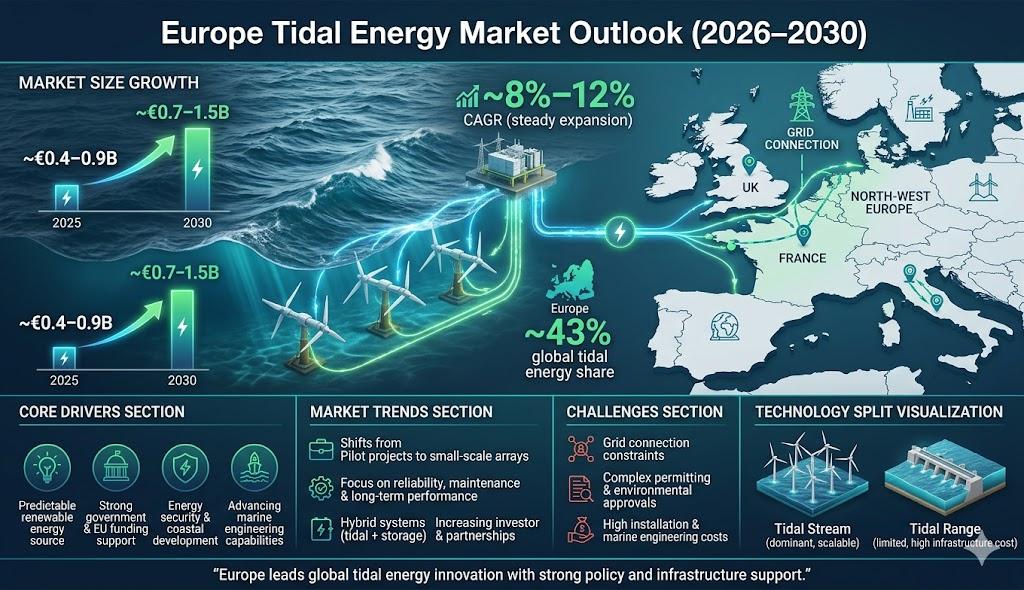
How Tidal Energy Could Strengthen Europe’s Clean Power Mix
Europe's electricity system is becoming increasingly diverse, with wind and solar providing growing volumes of low carbon generation. Yet greater renewable penetration also increases the need for resources that can improve predictability and system balance. Tidal power offers one distinctive advantage: its underlying resource is governed by astronomical cycles that can be forecast years in advance.
Tidal output still varies predictably. Production rises and falls with the tides, but those changes are highly predictable. That characteristic can help system planners anticipate renewable output and coordinate complementary technologies. As electricity markets become more flexible, predictable generation may gain value alongside conventional baseload and dispatchable resources.
The Europe Tidal Energy Market Analysis highlights why commercial development should be viewed through a broader energy system lens. The potential opportunity is connected to technology maturity, national energy strategies, grid investment, marine infrastructure, and the ability of developers to create financially sustainable projects.
Tidal stream systems are among the most promising approaches. Turbines installed in areas with strong currents can convert moving water into electricity. Because water is much denser than air, marine currents can deliver substantial energy through relatively compact machines. However, underwater operating conditions create demanding requirements for corrosion resistance, structural durability, access, and maintenance.
Project location is therefore critical. Developers must balance resource quality with water depth, seabed conditions, distance from shore, cable routes, ports, vessel availability, and proximity to suitable grid connections. A site with excellent tidal currents may not be commercially attractive if installation and maintenance costs are excessive.
Industrial capability can help address these challenges. Europe already has expertise in offshore wind, subsea engineering, shipbuilding, cables, marine construction, and environmental monitoring. Tidal energy developers can potentially leverage portions of this existing ecosystem, creating efficiencies and supporting cross sector innovation. Lessons learned from offshore industries may also improve project safety and reliability.
Financing remains a major hurdle. Early tidal projects typically involve technology and construction risks that conventional renewable assets have already reduced. Investors may therefore require stronger revenue visibility or public support. Demonstration funding can help technologies reach larger deployments, while long term offtake arrangements can improve bankability for commercial projects.
Regulation must evolve alongside technology. Marine projects operate in shared environments where environmental protection, navigation, fisheries, defense, and conservation interests overlap. Efficient permitting processes can reduce delays, but environmental safeguards remain essential. Transparent monitoring and stakeholder consultation can improve confidence and reduce conflicts during development.
Energy storage may also strengthen tidal economics. Batteries could absorb generation during periods of lower market value and discharge when prices or system needs are stronger. Hybrid projects combining tidal generation with other renewable technologies could provide smoother output profiles and make better use of shared grid infrastructure.
Another potential advantage is energy security. Domestic marine resources can reduce dependence on imported fuels and diversify national generation portfolios. For coastal communities, projects may also support engineering jobs, port activity, maintenance services, and specialized manufacturing. These benefits can become important components of regional development strategies.
Market adoption will depend on evidence. Developers need to demonstrate high availability, predictable performance, manageable maintenance requirements, and declining levelized costs. Each successful project can generate data that improves future designs and reduces uncertainty for financiers and policymakers.
Tidal energy is unlikely to replace wind or solar, nor does it need to. Its value may come from complementing them with a predictable renewable resource. As Europe's electricity system becomes more interconnected and flexible, that complementary role could become increasingly significant. Continued technology learning, supportive policy, and disciplined project selection will determine how far tidal power can progress from promising demonstrations toward a durable part of the continent's clean energy mix.

 Bangla