

Electronic Medical Records Market Size, Share, In-Depth Insights and Forecast 2026-2034

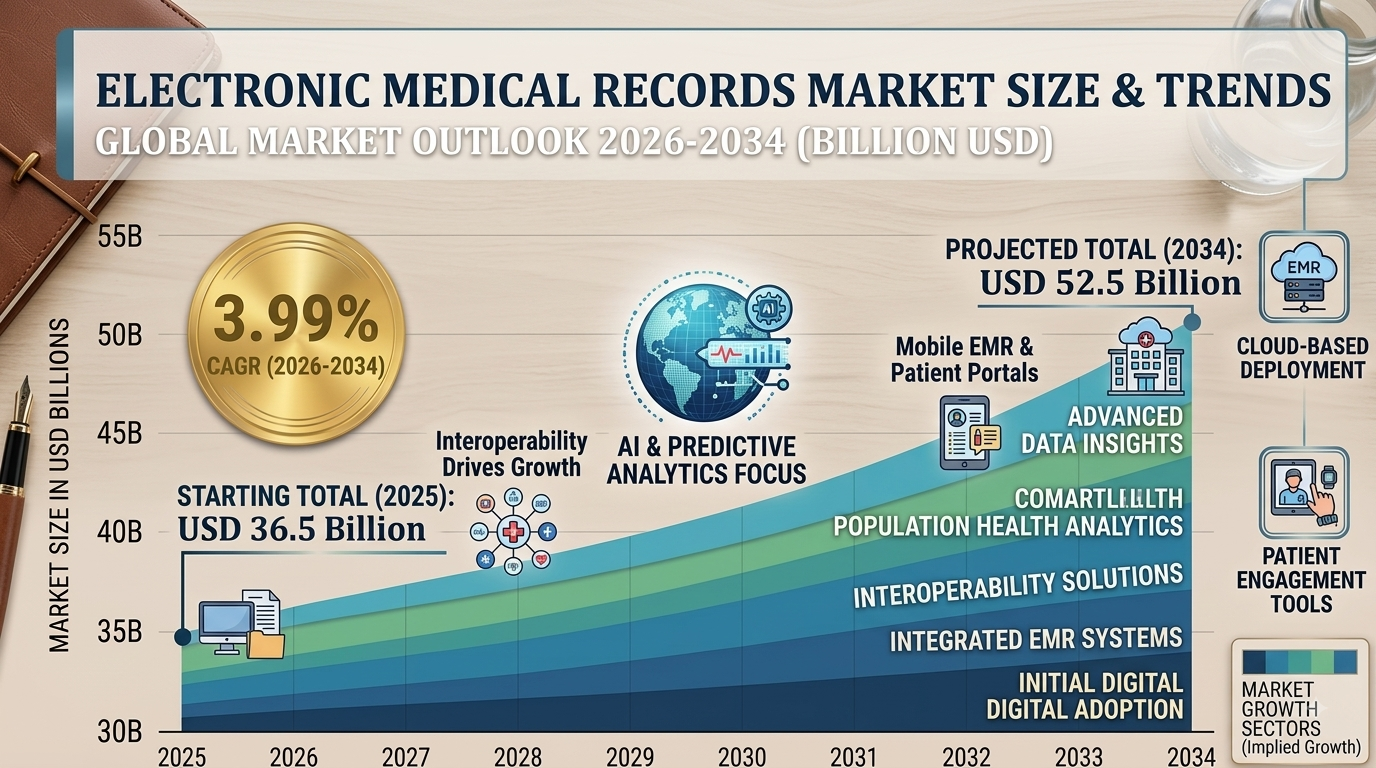
According to IMARC Group, the global Electronic Medical Records Market Size reached USD 36.5 Billion in 2025 and is projected to reach USD 52.5 Billion by 2034, expanding at a CAGR of 3.99% during 2026–2034. This steady growth trajectory reflects the expanding healthcare IT ecosystem, the rising prevalence of chronic ailments among an aging global population, and the accelerating shift toward cloud-based, interoperable, and patient-centric EMR platforms.
Electronic Medical Records Industry Overview
An electronic medical record (EMR) is a digital version of a patient's chart maintained within a single healthcare practice or organization. It consolidates patient demographics, medical history, medications, allergies, radiology reports, immunization status, laboratory results, vital signs, and billing information into one structured, searchable digital record. EMRs can be deployed via cloud computing or on-premises infrastructure — cloud-based solutions enable centralized data storage and access across multiple locations, while on-premises deployments serve organizations with localized computing and data-residency requirements.
Electronic medical records support a broad continuum of clinical and administrative use cases:
- Clinical documentation: Capturing patient history, diagnoses, treatment plans, and progress notes across inpatient and outpatient encounters
- Specialty-based charting: Structured templates and workflows tailored to cardiology, neurology, radiology, oncology, and other specialty disciplines
- Care coordination: Real-time access to patient data across providers, reducing duplicate testing and improving continuity of care
- Population health and analytics: Identifying disease patterns, tracking outcomes, and supporting quality-reporting and value-based care initiatives
- Administrative and billing functions: Streamlining scheduling, coding, claims, and revenue-cycle workflows tied directly to the clinical record
Global Electronic Medical Records Market Size & Key Statistics
Below are the key Electronic Medical Records Market statistics drawn from IMARC Group's comprehensive market analysis:
Base Year - 2025
Historical Period - 2020–2025
Forecast Period - 2026–2034
Electronic Medical Records Market Size in 2025 - USD 36.5 Billion
Market Forecast in 2034 - USD 52.5 Billion
Market Growth Rate (2026–2034) - 3.99% CAGR
Largest Region - North America
Leading Type Segment - Traditional EMRs
Leading Component Segment - Software
Leading Deployment Segment - On-premises
Leading End-Use Segment - Hospitals and Clinics
Request for a Sample Report for Detailed Electronic Medical Records Market Share Evaluation: https://www.imarcgroup.com/electronic-medical-records-market/requestsample
Key Market Drivers & Electronic Medical Records Market Trends in 2026
Several powerful forces are shaping Electronic Medical Records Market Trends and fuelling sustained adoption across global healthcare delivery systems:
1. Expanding Healthcare IT Infrastructure
The rapid growth of the broader healthcare information technology industry is one of the primary factors creating a positive outlook for the market. Government digitization mandates, hospital modernization programs, and rising IT budgets across public and private healthcare systems are collectively expanding the addressable base for EMR deployment.
2. Rising Chronic Disease Burden and Aging Population
The growing prevalence of chronic medical ailments, coupled with an expanding geriatric population that is more susceptible to such conditions, is driving demand for systematic, longitudinal patient records. EMRs enable clinicians to track disease progression, medication regimens, and treatment outcomes over time, supporting more proactive and coordinated chronic-care management.
3. Growing Adoption of Patient-Centric EMR Systems
Healthcare providers are increasingly adopting patient-centric EMR systems that facilitate direct patient involvement throughout the documentation process, from self-reported health data to shared decision-making tools. This shift is strengthening patient engagement while improving the accuracy and completeness of clinical records.
4. Advent of Cloud-Based EMR Solutions
Technological advancements such as cloud-based EMR platforms are acting as a significant growth-inducing factor. Cloud deployment provides quality, always-available care documentation and enhanced protection against data loss from accidents, hardware failure, or other disruptions — while also lowering upfront infrastructure costs for smaller practices and specialty centers.
5. Improving Healthcare Infrastructure and Population Health Programs
The steady improvement of healthcare infrastructure, particularly across emerging economies, along with the implementation of favorable population health management programs, is expected to further drive Electronic Medical Records Market Growth by expanding digital record-keeping into previously underserved regions and care settings.
6. AI-Enabled Clinical Documentation and Interoperability
Leading EMR vendors are embedding generative AI and voice-driven tools directly into clinical workflows to ease documentation burden, streamline coding, and surface evidence-based insights at the point of care. Parallel investments in interoperability — including unified patient portals and expanded data-exchange APIs — are making it easier for patient records to follow individuals seamlessly across providers and health systems.
Key Market Segmentation
IMARC Group provides an analysis of the key trends in each segment of the global electronic medical records market, along with forecasts at the global, regional, and country levels for 2026–2034. The market has been categorized based on type, component, functionality, deployment type, application, and end user.
By Type
Traditional EMRs — Largest Segment: Traditional EMR systems, built around structured digital charting of patient history, diagnoses, and treatment records, currently hold the majority Electronic Medical Records Market Share. Their established clinical workflows, broad vendor support, and deep integration with existing hospital IT systems make them the default choice across most healthcare settings.
Speech Enabled EMRs: These systems leverage voice-recognition and dictation technology to reduce clinician documentation time, and are gaining traction as ambient and voice-driven AI tools mature.
Interoperable EMRs: Designed for seamless data exchange across providers and health information networks, interoperable EMRs are central to national digital-health and care-coordination initiatives.
Others: Includes hybrid and specialty-configured EMR systems tailored to niche clinical or administrative requirements.
By Component
Software — Largest Segment: Software commands the largest Electronic Medical Records Market Share among components, reflecting continuous vendor investment in clinical modules, analytics, interoperability layers, and AI-enabled features that differentiate competing platforms.
Hardware: Encompasses on-premises servers, workstations, and networking equipment required to run and access EMR software within a healthcare facility.
Services: Covers implementation, training, technical support, and managed services that help healthcare organizations deploy and maintain EMR systems effectively.
By Functionality
Basic Systems — Largest Segment: Basic EMR systems, offering core charting, scheduling, and record-keeping functionality, currently account for the majority of the global market share, particularly among smaller practices and specialty centers with limited IT budgets.
Fully Functional Systems: These comprehensive platforms integrate clinical decision support, e-prescribing, analytics, and interoperability tools, and are increasingly favored by large hospital networks pursuing digital transformation at scale.
By Deployment Type
On-premises — Largest Segment: On-premises deployment currently holds the largest Electronic Medical Records Market Share, reflecting the preference of large hospitals and health systems for direct control over data security, customization, and compliance.
Cloud-based: Cloud-based EMR solutions are expanding rapidly, offering centralized data storage, remote access across multiple facilities, and lower upfront capital investment — an especially attractive proposition for smaller and mid-sized providers.
By Application
Specialty Based — Largest Segment: Specialty-based EMR applications, including tailored workflows for cardiology, neurology, radiology, and oncology, exhibit a clear dominance in the market as clinicians demand documentation tools built around discipline-specific data and terminology.
General Applications: General-purpose EMR applications continue to serve primary care and multi-specialty practices requiring broad, flexible charting capabilities.
By End User
Hospitals and Clinics — Largest Segment: Hospitals and clinics hold the majority of total Electronic Medical Records Market Share, operating high-volume care settings that require centralized, real-time patient documentation across emergency, inpatient, and outpatient departments.
Specialty Centers: Dedicated specialty and ambulatory centers are increasingly adopting EMR platforms configured around their specific clinical focus areas.
Others: Includes long-term care facilities, diagnostic centers, and other healthcare providers digitizing their patient documentation.
Regional Electronic Medical Records Market Analysis
North America — Largest
United States & Canada; advanced healthcare IT infrastructure, high hospital EMR adoption rates, strong regulatory push for interoperability, and presence of leading EMR vendors headquartered in the region
Europe
Germany, France, UK, Italy, Spain, Russia; national digital-health initiatives, cross-border interoperability standards, and public health system modernization programs driving EMR uptake
Asia Pacific — Fastest Growing
China, Japan, India, South Korea, Australia, Indonesia; expanding healthcare infrastructure, rising digital health investment under national health missions, and growing hospital network digitization
Latin America
Brazil, Mexico; Brazil is the largest LatAm healthcare market, with growing private hospital adoption and expanding universal health coverage driving EMR deployment
Middle East & Africa
UAE, Saudi Arabia, South Africa; healthcare modernization programmes and rising investment in digital health infrastructure
North America leads the global Electronic Medical Records Market Share, underpinned by the United States' mature healthcare IT ecosystem, widespread hospital and clinic EMR adoption driven by federal meaningful-use and interoperability requirements, and a dense concentration of leading EMR vendors serving both large health systems and ambulatory practices.
Asia Pacific represents the fastest-growing regional market, driven by rapid healthcare infrastructure expansion in China and India, rising government investment in digital health missions, and increasing adoption of EMR systems among hospitals and specialty centers across the region's developing economies.
Connect for Detailed Electronic Medical Records Market Share Segmentation Analysis — Speak to an Analyst: https://www.imarcgroup.com/request?type=report&id=2314&flag=C
Leading Players in the Global Electronic Medical Records Industry
The global electronic medical records market features a mix of diversified health IT companies and focused EMR/EHR specialists. Key companies covered in the IMARC Group report include:
- AdvancedMD Inc. (Global Payments Inc.)
- Veradigm LLC
- Oracle Corporation
- CureMD Healthcare
- eClinicalWorks
- Epic Systems Corporation
- General Electric Company
- Greenway Health LLC
- McKesson Corporation
- Modernizing Medicine Inc.
- Nextgen Healthcare Inc.
About Us
IMARC Group is a leading global market research company providing data-driven insights and expert consulting services to businesses seeking to achieve their strategic objectives. With a multi-disciplinary team of industry experts, IMARC delivers thorough, reliable market intelligence across sectors including Healthcare, Technology, Chemicals, Energy, Food & Beverages, and more.
Contact Us
IMARC Group
United States: +1-201-971-6302
India: +91-120-433-0800
United Kingdom: +44-753-714-6104

