

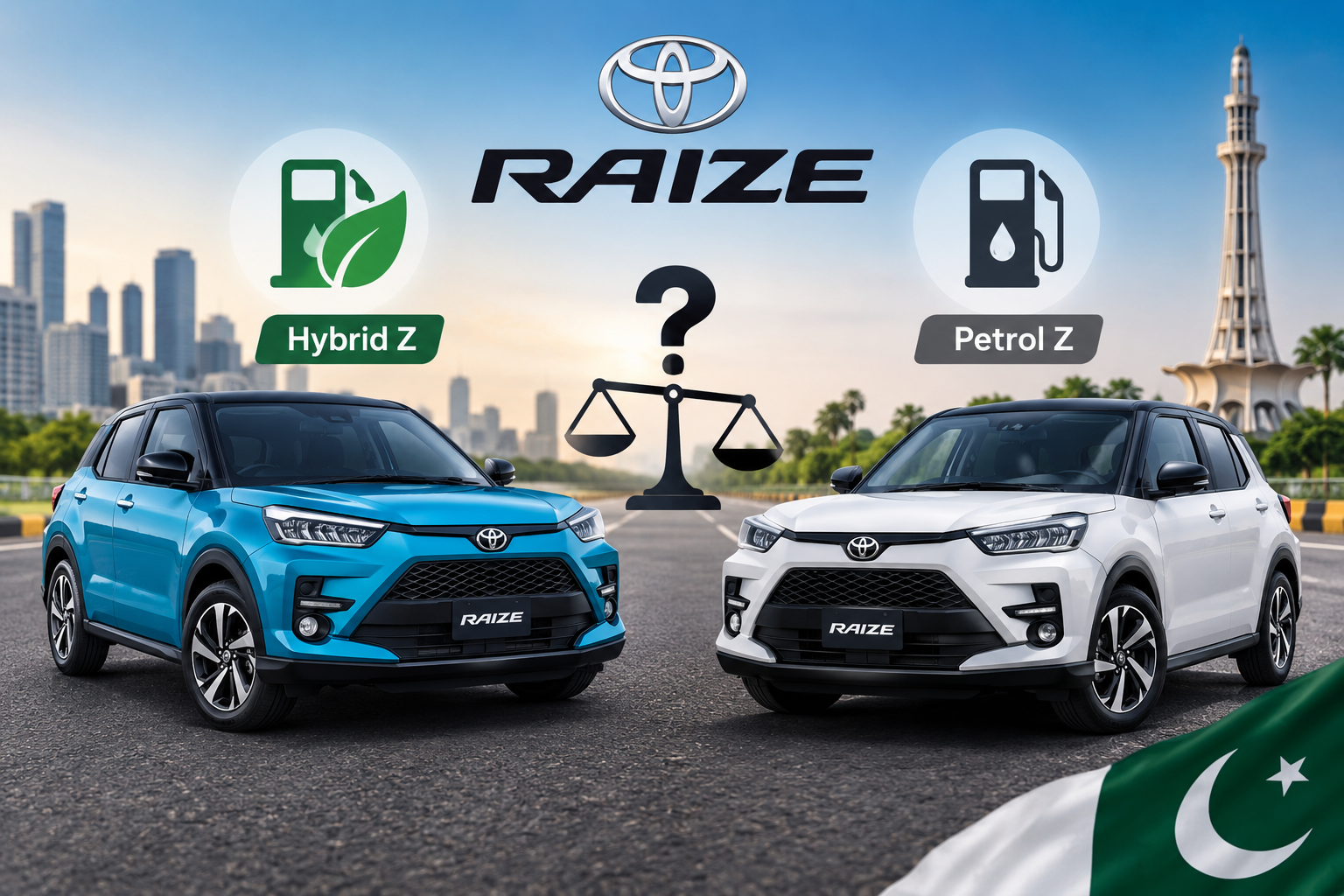
Toyota Raize Hybrid Z vs Petrol Z: Is the Higher Japanese Auction Price Worth It?

The Toyota Raize has become an increasingly attractive compact SUV for buyers seeking practicality, modern styling, efficient performance, and manageable running costs. Among the most closely compared variants are the Hybrid Z and Petrol Z. Both offer a compelling combination of urban usability and SUV-inspired design, yet their differences become particularly important when purchasing through Japan’s used-car auction market.
For buyers searching for a Toyota raize for sale in Pakistan, the question is not simply which version has better equipment. The more pertinent issue is whether the Hybrid Z’s higher Japanese auction price can be justified by its fuel economy, driving characteristics, and long-term ownership advantages.
Toyota Raize Hybrid Z vs Petrol Z: The Fundamental Difference
The Toyota Raize Hybrid Z is designed around an electrified powertrain, prioritising fuel efficiency and smooth urban driving. The Petrol Z, by contrast, relies solely on an internal-combustion engine and offers a more conventional ownership experience.
This distinction affects much more than fuel consumption. The hybrid system introduces additional technology, while the petrol version remains mechanically straightforward. For Pakistani buyers, where purchase price, fuel costs, maintenance, and access to competent workshops all influence ownership decisions, these differences deserve careful consideration.
Both variants can be attractive options within the broader market for Japanese cars in Pakistan, but their suitability depends heavily on driving habits and budget.
Why Does the Hybrid Z Cost More at Japanese Auctions?
Japanese auction prices fluctuate according to year, mileage, auction grade, condition, colour, specification, equipment, and overall market demand. Hybrid models can command a premium because of their fuel-saving technology and growing popularity.
The Z trim itself is generally appealing because it can offer desirable equipment, attractive exterior styling, and a more upscale cabin compared with lower grades. When the Hybrid Z combines this trim level with an efficient powertrain, its auction value can rise noticeably.
However, a higher hammer price does not automatically mean greater overall value. Importers must evaluate the complete landed cost rather than focusing solely on the auction bid.
Shipping, export documentation, port charges, customs duties, taxes, registration expenses, and other associated costs can substantially alter the final amount paid in Pakistan.
Fuel Economy: Where the Hybrid Z Has an Advantage
Fuel economy is arguably the strongest argument for choosing the Hybrid Z. Hybrid technology can be particularly advantageous in congested urban environments, where frequent acceleration, deceleration, and idling create ideal conditions for an electrified powertrain to demonstrate its efficiency.
For drivers covering substantial annual mileage, the cumulative fuel savings can become meaningful. Karachi, Lahore, Islamabad, Rawalpindi, and other major Pakistani cities can expose vehicles to lengthy traffic queues and stop-and-go conditions, making efficiency an important ownership consideration.
The Petrol Z may still provide respectable economy, particularly when driven sensibly, but the Hybrid Z has a distinct advantage when fuel consumption is a primary concern.
Is the Hybrid Premium Recovered Through Fuel Savings?
This is where the calculation becomes more nuanced.
Suppose the Hybrid Z costs considerably more at auction than an equivalent Petrol Z. The additional purchase cost must be compared with expected fuel savings over several years. A buyer covering a modest annual distance may find that the payback period is lengthy.
Conversely, someone driving extensively every day could recover part of the premium through reduced fuel expenditure.
Fuel prices also change over time, so the financial equation is never entirely static. A prudent buyer should calculate expected annual mileage, estimated fuel consumption, current fuel prices, and anticipated ownership duration before deciding.
The hybrid premium is therefore most defensible for buyers who intend to keep the vehicle for several years and drive it frequently.
Maintenance and Long-Term Ownership Considerations
The Petrol Z has an inherent appeal through mechanical familiarity. Conventional petrol drivetrains are widely understood, and many independent workshops are accustomed to servicing petrol-powered Japanese vehicles.
The Hybrid Z introduces additional components and systems that require appropriate diagnostic knowledge. This does not mean hybrid vehicles are inherently unreliable. Toyota's hybrid technology has an established reputation globally, but proper maintenance and qualified technical support remain important.
For buyers considering Japanese cars in Pakistan, the availability of technicians familiar with hybrid systems should therefore form part of the purchasing decision.
A well-maintained auction vehicle with verifiable history can be a more sensible acquisition than a cheaper example with questionable condition.
Battery Condition Matters
The hybrid battery deserves particular attention when purchasing a used Hybrid Z.
Auction sheets, inspection reports, service records, and vehicle history can help establish whether a vehicle has been properly maintained. Buyers should also consider the vehicle's age and mileage rather than assuming that every hybrid model will have identical battery health.
A higher-grade auction vehicle with lower mileage and excellent condition may justify paying more than a poorly maintained alternative simply because it reduces the likelihood of immediate remedial work.
This is one reason auction grade should be evaluated alongside the vehicle's actual condition rather than treated as the sole indicator of quality.
Petrol Z: The Sensible Choice for Some Buyers
The Petrol Z should not be dismissed simply because the Hybrid Z is more technologically advanced.
For buyers who prioritise a lower initial purchase price, straightforward mechanical construction, and conventional servicing, the Petrol Z can be exceptionally rational. It may also make greater financial sense for owners who drive relatively short distances or do not frequently encounter heavy urban congestion.
Another advantage is predictability. A conventional petrol powertrain is familiar to a large number of mechanics, which can simplify routine servicing and troubleshooting.
If the auction-price gap between the two variants is substantial, the Petrol Z may provide better immediate value.
Driving Experience: Hybrid Z vs Petrol Z
The Hybrid Z can feel particularly refined in urban driving. Electric assistance can contribute to smoother low-speed operation and quieter progress, especially during gentle acceleration.
The Petrol Z delivers a more traditional driving experience. Its character may appeal to buyers who prefer the familiar response of a conventional petrol engine and do not necessarily need hybrid technology.
Neither powertrain is universally superior. The better choice depends on whether the buyer prioritises efficiency and refinement or simplicity and lower acquisition cost.
Auction Grade Should Not Be Ignored
When comparing two Toyota Raize examples, variant alone should never dictate the purchase.
A Hybrid Z with an excellent auction grade, clean interior, low mileage, strong inspection history, and desirable equipment may represent better value than a cheaper Hybrid Z with significant cosmetic or mechanical concerns.
The same principle applies to the Petrol Z.
Auction sheets should be examined carefully for accident history, repaired areas, interior condition, mileage, scratches, dents, corrosion, previous usage, and other inspection remarks. A professional translation of the auction sheet can also help overseas buyers understand Japanese terminology and grading details.
Which Toyota Raize Should Pakistani Buyers Choose?
The Hybrid Z is generally the stronger choice for buyers who:
- Drive frequently in congested cities
- Cover high annual mileage
- Prioritise fuel efficiency
- Plan to keep the vehicle for several years
- Value smoother and quieter urban driving
- Are comfortable with hybrid-system maintenance
The Petrol Z may be preferable for buyers who:
- Want a lower initial purchase price
- Drive relatively limited distances
- Prefer conventional mechanical systems
- Want straightforward servicing
- Are particularly concerned about the hybrid price premium
Is the Higher Japanese Auction Price Worth It?
There is no universal answer, but the Hybrid Z's higher auction price can be worthwhile when the additional cost is balanced by fuel savings, longer ownership, superior efficiency, and desirable equipment.
For a high-mileage urban driver, paying more initially may prove economically sensible. For a low-mileage owner who primarily wants an affordable compact SUV, the Petrol Z can offer a more compelling proposition.
The smartest approach is to compare equivalent vehicles rather than simply comparing trim names. Mileage, auction grade, model year, condition, specifications, and total landed cost should all be considered.
Final Verdict
The Toyota Raize Hybrid Z represents a more sophisticated proposition, particularly for buyers who spend considerable time navigating congested Pakistani cities. Its efficiency and refined driving characteristics can make the higher Japanese auction price defensible over a longer ownership period.
The Petrol Z, however, remains a pragmatic alternative. Its lower acquisition cost and conventional powertrain can make it attractive to buyers who value simplicity and immediate savings.
For anyone evaluating a Toyota raize for sale in Pakistan, the ultimate decision should be based on total ownership economics rather than auction price alone. A carefully selected, well-inspected vehicle whether Hybrid Z or Petrol Z can provide substantially better value than simply choosing the cheapest available example.
