

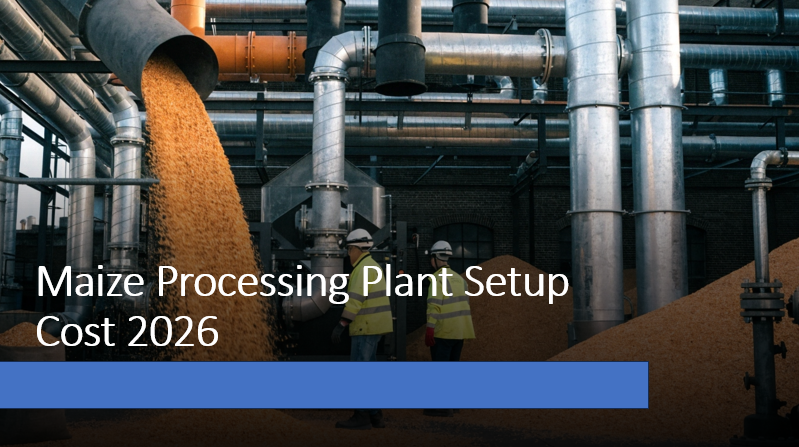
Maize Processing Plant Setup 2026: Detailed Project Report, Requirements and Cost Analysis

IMARC Group's "Maize Processing Plant Project Report 2026: Industry Trends, Factory Setup, Machinery Cost, Raw Materials, Investment Opportunities, Cost and Revenue" report provides a comprehensive guide on how to successfully set up a maize processing plant. The report offers clarifications on various aspects, such as unit operations, raw material requirements, utility supply, infrastructural needs, machinery models, labour necessities, transportation timelines, packaging costs, etc.
In addition to the operational aspects, the report also provides in-depth insights into maize processing manufacturing process, project economics, encompassing vital aspects such as capital investments, maize processing plant cost, project funding, operating expenses, income and expenditure projections, fixed and variable costs, direct and indirect expenses, expected ROI, net present value (NPV), profit and loss account, and thorough financial analysis, among other crucial metrics. With this comprehensive roadmap, entrepreneurs and stakeholders can make informed decisions and venture into a successful maize processing business plan and manufacturing unit.
What is Maize Processing?
Maize (Zea mays), commonly known as corn, is one of the world's most important and versatile cereal crops, ranking as the third most cultivated staple after rice and wheat, with global production exceeding 1.3 billion metric tons annually. Maize processing refers to the industrial transformation of raw maize grain into a wide range of value-added food, feed, and industrial products through two primary processing routes: dry milling and wet milling. Dry milling separates the kernel's components — germ, bran, and endosperm — to produce maize flour, cornmeal, grits, semolina, and corn bran, widely used in human food applications. Wet milling is a more intensive process involving steeping the grain in sulfur dioxide solution, followed by grinding, separation, and refining to yield high-value products including starch, glucose syrup, high-fructose corn syrup (HFCS), dextrose, corn oil, gluten meal, and gluten feed. Maize starch and its derivatives are extensively used across food and beverages, pharmaceuticals, paper, textiles, and bioplastics. Additionally, maize is fermented into bioethanol for use as a renewable fuel additive. Maize serves as the primary energy source in poultry, swine, and cattle feed formulations worldwide.
Market Trend and Drivers of Maize Processing:
The maize processing market is primarily driven by rising demand from the food and beverage sector for maize-derived sweeteners, starches, and snack ingredients, expanding livestock feed requirements across poultry, swine, and cattle industries, growing bioethanol production as a renewable fuel source, and increasing industrial utilization of maize-derived starches and sweeteners in pharmaceuticals, paper, and textiles. The global maize market was valued at 1.34 Billion Tons in 2025. According to IMARC Group estimates, the market is expected to reach 1.71 Billion Tons by 2034, exhibiting a CAGR of 2.8% from 2026 to 2034. The expansion of organized food processing industries in emerging economies, increasing demand for high-fructose corn syrup and glucose syrup in the beverage and confectionery sectors, and growing government mandates for bioethanol blending in transportation fuels are significantly supporting market growth. Additionally, advancements in wet milling and dry milling technologies, rising demand for non-GMO and identity-preserved maize products, and expanding export opportunities for maize starch and derivatives are creating strong growth momentum for maize processing globally.
Request a Sample Report: https://www.imarcgroup.com/maize-processing-plant-project-report/requestsample
How to Setup a Maize Processing Manufacturing Plant?
Setting up a maize processing plant requires evaluating several key factors — from maize processing plant cost and machinery requirements to operational efficiency and quality control. Some of the major considerations include:
- Detailed Process Flow: The maize processing process involves multiple stages including receiving, cleaning, and pre-conditioning of maize grain; dry milling (degermination, grinding, sifting, and classification) or wet milling (steeping, grinding, starch separation, refining, drying, and syrup conversion); germ oil extraction; and packaging of finished products. Key aspects include unit operations, raw material quality, yield optimization, and technical testing.
- Site Selection: The plant location should provide easy access to maize-growing agricultural belts, reliable grain procurement channels, and strong road or rail transport infrastructure, along with sufficient water supply (critical for wet milling operations), stable power, and proximity to food processing and animal feed industry customers.
- Plant Layout Optimization: An efficient layout is essential to streamline grain intake and cleaning, processing lines, drying and cooling, co-product handling, quality laboratory, and finished goods storage. Dry and wet processing zones should be clearly separated, and bulk grain storage silos should be planned with adequate aeration and pest management systems.
- Equipment Selection: Selecting durable and high-performance manufacturing machinery is crucial. Equipment may include grain cleaners and de-stoners, degerminator systems, roller mills and hammer mills, plansifters and classifiers, steeping tanks, disc mills, hydrocyclones, centrifuges, flash dryers, spray dryers, and bagging or bulk loading systems.
- Raw Material Sourcing: Reliable procurement of high-quality maize grain with consistent moisture content, low aflatoxin levels, and appropriate starch content is essential. Seasonal procurement planning, grain storage management, and fumigation protocols are necessary to maintain continuous and stable plant operations.
- Safety and Environmental Compliance: The facility must comply with food safety standards (FSSAI, HACCP, ISO 22000), occupational health regulations, and environmental norms. Proper dust explosion prevention, grain dust collection, wastewater treatment for steep water and process effluents, and solid by-product disposal systems should be implemented.
- Quality Assurance Systems: A strong quality management system should be established to ensure product purity, moisture content, granulation, starch content and pasting properties, protein and fat levels, microbiological safety, and compliance with food-grade or feed-grade specifications through regular laboratory analysis and process monitoring.
Requirements to Setup a Maize Processing Plant:
- Funds
- Machinery
- Lands
Types of Costs to Setup a Maize Processing Factory:
- Land, Location and Site Development Cost
- Plant Layout Cost
- Maize Processing Plant Machinery Cost
- Raw Material Requirements and Costs
- Packaging Requirements and Costs
- Transportation Requirements and Costs
- Utility Requirements and Costs
- Human Resource Requirements and Costs
Project Economics:
- Capital Investments
- Operating Costs
- Expenditure Projections
- Revenue Projections
- Taxation and Depreciation
- Profit Projections
- Financial Analysis
Ask Analyst for Customized Report: https://www.imarcgroup.com/request?type=report&id=19388&flag=C
How IMARC Can Help?
IMARC Group is a global management consulting firm that helps the world's most ambitious changemakers to create a lasting impact. The company provides a comprehensive suite of market entry and expansion services. IMARC offerings include thorough market assessment, feasibility studies, company incorporation assistance, maize processing factory setup support, regulatory approvals and licensing navigation, branding, marketing and sales strategies, competitive landscape and benchmarking analyses, pricing and cost research, and procurement research.
Services:
- Plant Setup
- Factory Auditing
- Regulatory Approvals, and Licensing
- Company Incorporation
- Incubation Services
- Recruitment Services
- Marketing and Sales
Contact Us:
IMARC Group
134 N 4th St. Brooklyn, NY 11249, USA
Email: [email protected]
Tel No:(D) +91 120 433 0800
United States: (+1-201971-6302)
