

How Industrial Construction Is Adapting to the Next Generation of Industrial Facilities

The Next Industrial Facility Will Need to Do More
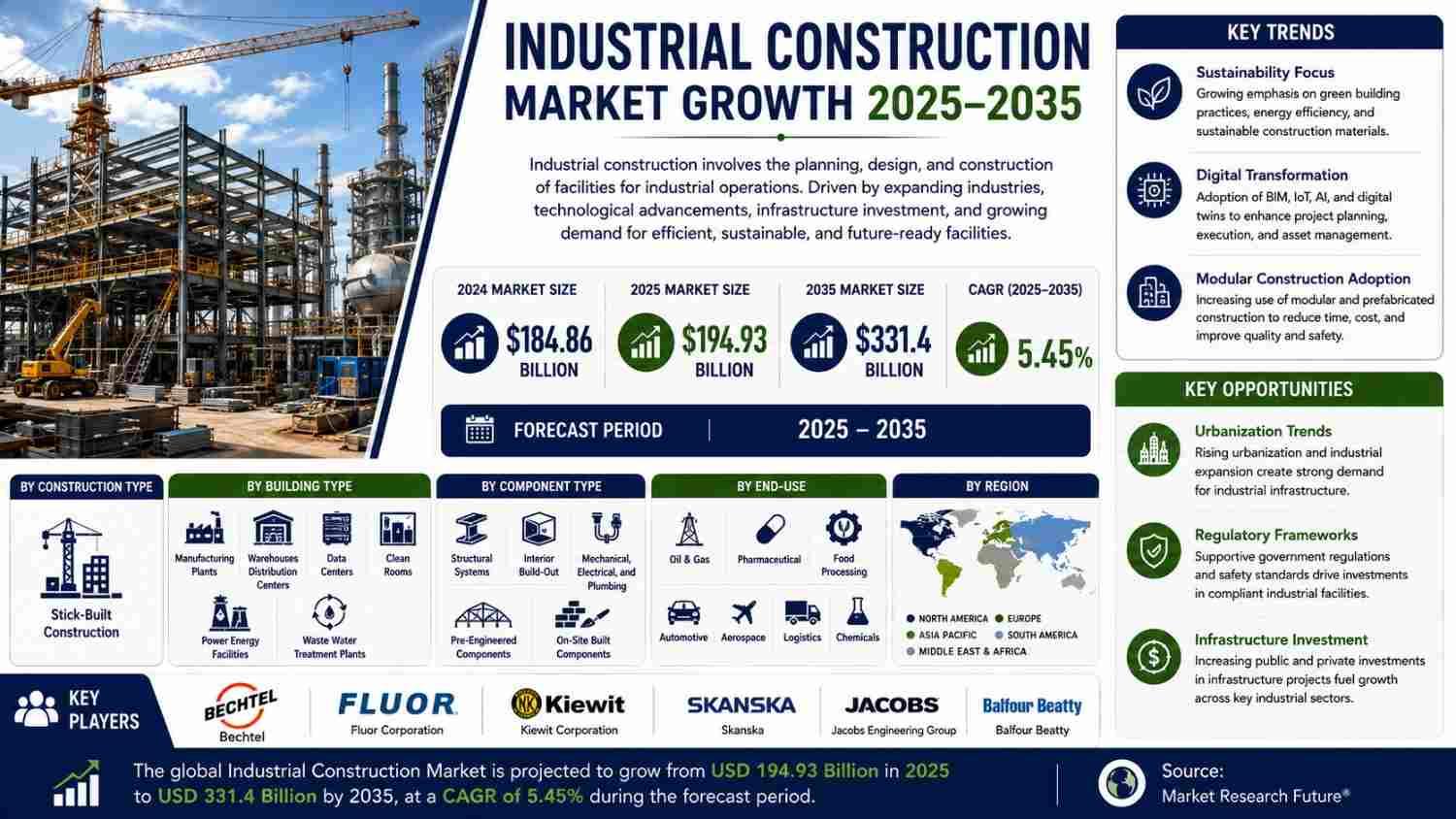
According to Market Research Future®, the Industrial Construction Market was valued at $184.86 billion in 2024 and is expected to reach $194.93 billion in 2025 and $331.4 billion by 2035, growing at a CAGR of 5.45% during 2025–2035. Sustainability focus, digital transformation, and modular construction adoption are reshaping project delivery, while urbanization, regulatory frameworks, and infrastructure investment provide opportunities. Major companies include Bechtel, Fluor Corporation, Kiewit Corporation, Skanska, Jacobs Engineering Group, and Balfour Beatty.
The industrial facility of the future cannot be evaluated only by its size or construction cost. Owners increasingly need buildings that can support automation, adapt to changing production requirements, use resources efficiently, and remain operationally effective for decades.
That raises the importance of decisions made before construction even begins.
Facility Design Is Becoming a Strategic Decision
An industrial building can influence production flow, labor requirements, energy consumption, equipment installation, maintenance, and future expansion. A design decision made during the planning stage can therefore affect operating economics for many years.
This is particularly important in manufacturing. A plant designed around one production configuration may become inefficient if equipment or product requirements change.
Flexible layouts and adaptable infrastructure can reduce this risk, although they may require greater upfront planning and investment.
Different Buildings Require Different Construction Strategies
The industrial construction market includes manufacturing plants, warehouses, distribution centers, data centers, clean rooms, power and energy facilities, and wastewater treatment plants.
Each building type creates a different set of technical requirements. A warehouse may prioritize material movement and automation, while a clean room may require tightly controlled environmental conditions.
This diversity prevents contractors from relying on one standard project model. The strongest approaches combine repeatable construction processes with sufficient flexibility to accommodate specialized requirements.
Digital Transformation Is Improving Decision-Making
Digital technologies are becoming increasingly valuable because industrial projects contain many interconnected systems. Structural components must work with mechanical, electrical, plumbing, equipment, and interior systems.
Digital coordination can help teams identify conflicts earlier and improve communication across project participants.
The value can continue after completion. Digital facility information may support maintenance and future modifications, giving owners a clearer record of what was installed and how systems are connected.
This creates a stronger connection between construction and facility management.
Sustainability Will Influence Long-Term Value
Industrial facilities can consume substantial amounts of energy, water, and other resources. Sustainability is therefore becoming a practical consideration for owners rather than a secondary feature.
Efficient building envelopes, energy systems, water infrastructure, equipment, and waste-management approaches can influence operating costs.
However, sustainability decisions need to account for project economics. Higher upfront costs may be justified when operating savings or regulatory benefits can support the investment.
The challenge is identifying which improvements create measurable long-term value.
Modular Construction Could Improve Delivery
Modular construction offers a potential response to schedule pressure and complex site conditions. Fabricating selected components away from the main site can create a more controlled production environment.
The approach can also support repeatability in projects where similar elements are required.
Its limitations are equally important. Transportation, lifting requirements, design changes, and site coordination can complicate modular projects. The benefits are strongest when the project team commits to modular thinking early rather than introducing it after conventional design decisions have already been made.
Infrastructure Investment Creates New Locations
Industrial development depends on more than available land. Reliable electricity, transportation, water, wastewater, telecommunications, and other infrastructure can determine whether a facility is viable.
Infrastructure investment can therefore unlock new industrial locations. Urbanization can increase demand for logistics and manufacturing facilities, but it can also make development more difficult because of land availability, traffic, environmental considerations, and planning requirements.
Developers need to consider infrastructure scalability as part of site selection.
Regulation Can Become Both Constraint and Opportunity
Industrial construction projects often operate within detailed regulatory environments. Safety, environmental requirements, building standards, and sector-specific rules can influence design and construction.
Compliance can increase project complexity and require additional planning. At the same time, contractors with strong regulatory expertise can help owners navigate requirements more effectively.
Early compliance planning is particularly valuable because late changes can disrupt construction schedules and increase costs.
Industry-Specific Demand Will Shape Growth
Oil and gas, pharmaceutical, food processing, automotive, aerospace, logistics, and chemical industries have different investment priorities.
Pharmaceutical projects may require controlled production environments, while aerospace facilities can demand specialized spaces and infrastructure. Logistics projects are increasingly connected to automation, and chemical facilities can involve stringent safety considerations.
These differences create opportunities for contractors with sector-specific expertise.
Competition Is Moving Beyond Construction Execution
Bechtel, Fluor Corporation, Kiewit Corporation, Skanska, Jacobs Engineering Group, and Balfour Beatty operate in a market where project delivery increasingly involves engineering, procurement, technology, sustainability, and construction management.
Competitive advantage may therefore depend on how effectively a company integrates these disciplines. Owners want fewer coordination problems and greater certainty around schedule, cost, quality, and facility performance.
The ability to manage complexity can become a stronger differentiator than construction scale alone.
The Bigger Picture Through 2035
The expected expansion to $331.4 billion by 2035 reflects the continuing need for industrial facilities, but the bigger story is the transformation of what those facilities are expected to accomplish.
Industrial construction is moving closer to an integrated model in which buildings, technology, infrastructure, production equipment, sustainability requirements, and future expansion are considered together.
The companies that benefit most will likely be those that can help owners answer a more difficult question than “How quickly can this facility be built?” The more important question is “How effectively will this facility support the business as its requirements change?” That shift toward lifecycle performance, adaptability, and operational value could ultimately define the next phase of industrial construction.
