


Hydroponic Root Enhancers Market Set for Strong Growth, Expected to Reach USD 962.9 Million by 2036
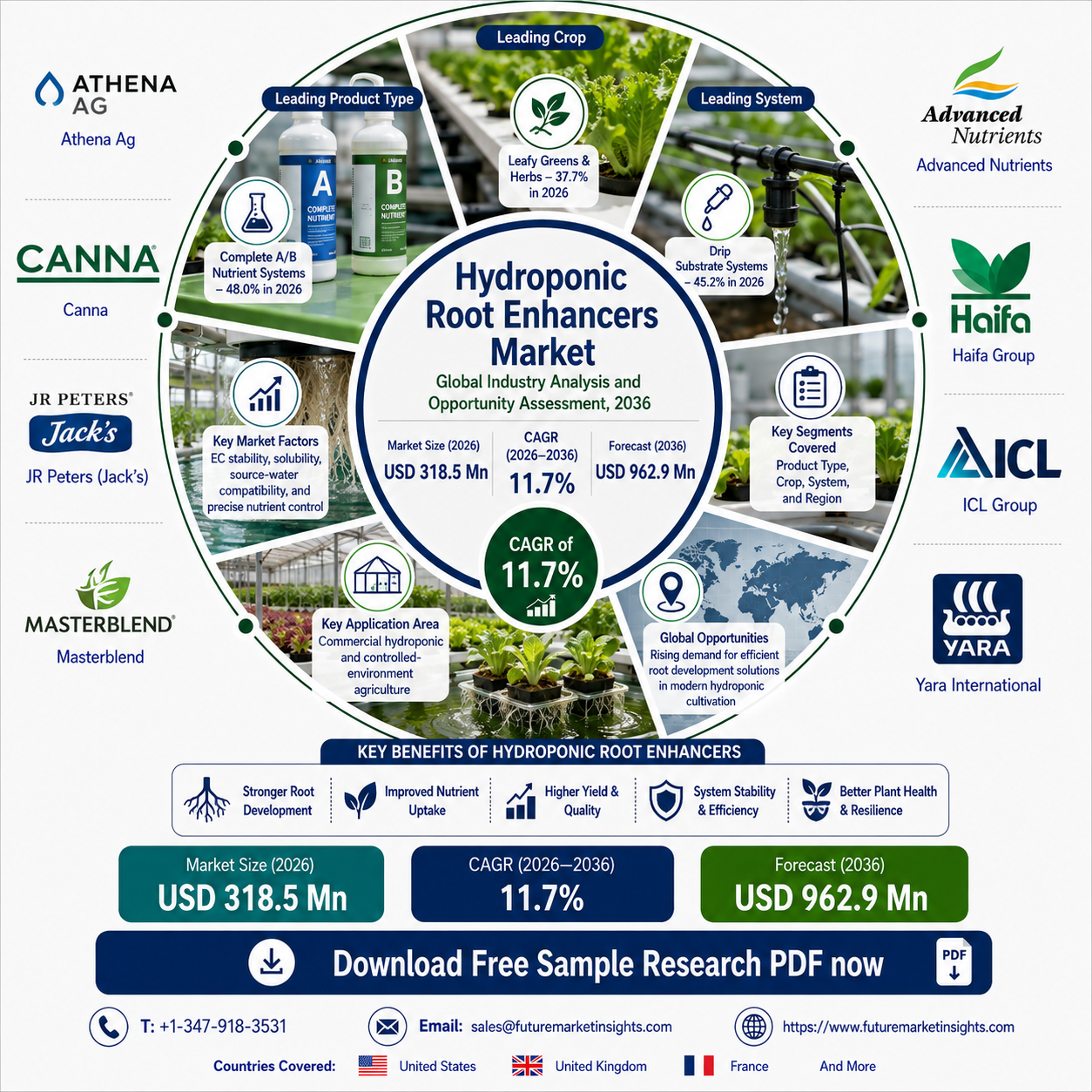
NEWARK, Del., August 25, 2026 — The global Hydroponic Root Enhancers Market is gaining momentum as controlled-environment agriculture and commercial hydroponic production increase demand for repeatable nutrient and root-zone management. According to Future Market Insights (FMI), the market is valued at USD 318.5 million in 2026 and is projected to reach USD 962.9 million by 2036, registering a CAGR of 11.7% during the forecast period.
Growing adoption of hydroponic cultivation, increasing commercial production of leafy greens and herbs, demand for precise nutrient control, and the expansion of controlled-environment farming are expected to support market growth.
👉 Get Detailed Market Forecasts, Competitive Benchmarking, and Pricing Trends: https://www.futuremarketinsights.com/reports/sample/rep-gb-34801
The market is expected to create substantial opportunities between 2026 and 2036 as growers focus on consistent root-zone chemistry, efficient nutrient preparation, water-soluble formulations, and repeatable fertigation programs across successive crop cycles.
Key Hydroponic Root Enhancers Market Highlights
- Market Size (2026): USD 318.5 Million
- Forecast Market Size (2036): USD 962.9 Million
- CAGR (2026–2036): 11.7%
- Leading Product Type: Complete A/B Nutrient Systems – 48.0% in 2026
- Leading Crop: Leafy Greens & Herbs – 37.7% in 2026
- Leading System: Drip Substrate Systems – 45.2% in 2026
- Key Market Factors: EC stability, solubility, source-water compatibility, and precise nutrient control
- Key Application Area: Commercial hydroponic and controlled-environment agriculture
- Key Segments Covered: Product Type, Crop, System, and Region
Analyst Viewpoint
Nandini Roy Choudhury, Principal Consultant at Future Market Insights, observes that hydroponic growers are increasingly evaluating root-zone programs based on operational consistency rather than product price alone. “Hydroponic growers should compare root-zone programs first on EC stability and solubility in their own source water instead of unit price. Formulations earn repeat orders by shortening mixing work and giving greenhouse crews a repeatable correction path across successive crop cycles."
As hydroponic operations become more standardized, suppliers that can provide consistent formulations, predictable mixing behavior, and practical correction protocols are expected to strengthen their position.
Why Is the Hydroponic Root Enhancers Market Growing?
The expansion of controlled-environment agriculture is one of the primary factors supporting demand for hydroponic root enhancers.
Hydroponic production requires growers to manage nutrient solution chemistry throughout crop cycles. This creates recurring demand for products that help maintain consistent root-zone conditions and support plant development.
The USDA Agricultural Research Service reported in January 2025 that vertical farming uses artificial growing systems such as hydroponics and includes research into hydroponic nutrient solutions. The continued development of these production systems is expanding the operational base that depends on repeatable nutrient inputs.
Commercial growers are also increasingly focused on water and nutrient efficiency. Precise nutrient administration can help growers maintain controlled root-zone conditions while adjusting programs according to crop stage and production requirements.
Key Growth Drivers
- Expansion of controlled-environment agriculture
- Increasing adoption of commercial hydroponic farming
- Growing production of leafy greens and herbs
- Rising demand for precise nutrient management
- Increasing use of water-soluble nutrient formulations
- Growing adoption of fertigation systems
- Need for repeatable root-zone chemistry
- Expansion of vertical farming operations
- Increasing focus on nutrient and water efficiency
- Growing investment in greenhouse production
Key Segment Insights
Why Do Complete A/B Nutrient Systems Lead the Product Type Segment?
Complete A/B Nutrient Systems are projected to account for 48.0% of the product type segment in 2026.
A/B systems separate concentrated nutrient components during storage and stock preparation, helping reduce compatibility issues associated with concentrated mineral mixtures.
For commercial growers, these systems can simplify nutrient management while supporting repeatable recipes across crop cycles.
Product Type Highlights
- Complete A/B Nutrient Systems account for an estimated 48.0% share in 2026.
- Separated concentrates can reduce compatibility risks during preparation.
- Standardized recipes support repeatable crop production.
- A/B systems can simplify commercial nutrient management.
- Consistent formulation performance can support repeat purchasing.
Why Do Leafy Greens & Herbs Lead the Crop Segment?
Leafy Greens & Herbs are expected to account for 37.7% of crop demand in 2026.
Short crop cycles increase nutrient reset frequency, creating recurring demand for root-zone and nutrient management products.
Commercial production of lettuce, herbs, and other fast-growing crops also benefits from controlled environmental conditions, where growers can closely manage water and nutrient inputs.
Crop Highlights
- Leafy Greens & Herbs represent an estimated 37.7% share.
- Short production cycles increase nutrient management frequency.
- Controlled environments support precise nutrient administration.
- Commercial leafy green production requires consistent root-zone conditions.
- Recurring crop cycles create repeat purchasing opportunities.
Why Do Drip Substrate Systems Lead the System Segment?
Drip Substrate Systems are forecast to account for 45.2% of the system segment in 2026.
These systems provide growers with precise delivery of nutrient solutions to the root zone. Buffered substrates can also support controlled fertigation schedules across commercial production environments.
The combination of targeted delivery and controlled root-zone management makes drip substrate systems an important platform for commercial hydroponic production.
System Highlights
- Drip Substrate Systems are projected to hold a 45.2% share in 2026.
- Precise nutrient delivery supports commercial fertigation.
- Buffered root zones can improve nutrient management consistency.
- Drip systems can integrate with automated irrigation programs.
- Commercial growers can adjust nutrient delivery according to crop requirements.
Root-Zone Management Considerations
Hydroponic root enhancer programs must operate effectively within the grower's existing water chemistry, injector equipment, crop protocol, and nutrient schedule.
Source-water chemistry is particularly important because differences in mineral content, pH, alkalinity, and other characteristics can influence nutrient performance.
Growers therefore need to evaluate products according to:
- EC stability
- Solubility
- Source-water compatibility
- Mixing requirements
- Injector compatibility
- Crop-specific nutrient needs
- Root-zone consistency
- Ease of formulation adjustments
These factors can influence product switching decisions and repeat purchasing.
Regional Outlook
The Hydroponic Root Enhancers Market is developing across major regions as controlled-environment agriculture, greenhouse production, and commercial hydroponic systems expand.
United Kingdom
The UK is strengthening its controlled-environment agriculture ecosystem. The Food Standards Agency classified controlled environment agriculture as a high-impact and near-term technology in June 2026 and highlighted precise nutrient administration for indoor crops such as leafy greens and herbs.
The operating environment is increasing interest in water-soluble nutrition and controlled nutrient management, although energy costs and local qualification requirements can influence adoption rates.
North America
North America remains an important market for commercial hydroponic production, supported by greenhouse operations, vertical farming, controlled-environment agriculture, and demand for locally produced crops.
Europe
European growers are increasingly focused on nutrient efficiency, resource management, controlled cultivation, and sustainable production practices. These trends can support demand for precise hydroponic nutrient solutions.
Asia-Pacific
Growing investment in controlled-environment agriculture and urban food production is creating additional opportunities across Asia-Pacific, particularly where growers seek efficient production systems and predictable crop yields.
Market Dynamics
Market Drivers
Controlled-environment agriculture expansion, commercial hydroponic production, increasing leafy green cultivation, precise fertigation, nutrient efficiency, and recurring crop cycles continue to support market development.
Market Restraints
Source-water variation, formulation compatibility, energy costs, mixing discipline, equipment requirements, crop-specific nutrient needs, and the technical complexity of changing nutrient programs can restrict adoption.
Market Trends
Innovation and changing agricultural production practices continue transforming the Hydroponic Root Enhancers Market.
Major trends include:
- Expansion of controlled-environment agriculture
- Growth of commercial hydroponic farming
- Increasing adoption of A/B nutrient systems
- Rising demand for water-soluble nutrition
- Expansion of drip substrate systems
- Growing production of leafy greens and herbs
- Increasing automation of fertigation
- Greater emphasis on EC and pH management
- Rising focus on water and nutrient efficiency
- Expansion of vertical farming
Competitive Landscape
Competition is intensifying as nutrient manufacturers and hydroponic suppliers develop products designed for commercial growers seeking consistent root-zone management.
Competitive differentiation is increasingly centered on formulation stability, solubility, source-water compatibility, ease of mixing, crop-specific performance, and technical support.
Companies capable of helping growers reduce mixing complexity and maintain consistent nutrient programs across successive crop cycles are expected to gain traction.
Major Hydroponic Root Enhancers Market Global Key Companies
- Athena Ag
- Canna
- JR Peters (Jack's)
- Masterblend
- Advanced Nutrients

 Bangla