


Defining the Expertise Behind the Automated Factory
In the relentless pursuit of efficiency, quality, and competitiveness, industries across the globe are embracing automation at an unprecedented rate. But behind every intelligent robot, sophisticated control system, and data-driven production line lies a critical and often unseen layer of human expertise. This is the domain of the global Industrial Automation Services industry, a sector dedicated to the design, implementation, management, and optimization of automated industrial processes. These services are the essential link that translates complex automation technology into tangible business outcomes. They encompass a wide range of activities, from initial consulting and system design to project management, installation, commissioning, and ongoing maintenance and support. As industrial systems become more complex, interconnected, and software-defined, the need for specialized service providers has surged. Companies can no longer simply buy automation hardware; they need a trusted partner to help them navigate the complexities of integration, cybersecurity, and data analytics, making the industrial automation services industry a vital enabler of the Fourth Industrial Revolution (Industry 4.0).
The Five Pillars of Industrial Automation Services
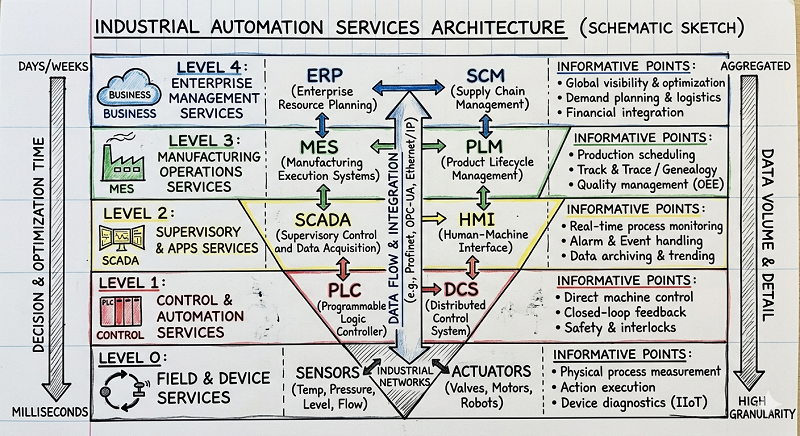
The industrial automation services industry can be understood through five main categories, each addressing a different stage of the automation lifecycle. The first is Professional Services. This is the consultative front end, including services like feasibility studies, system architecture design, technology selection, and developing the strategic roadmap for an automation project. The second pillar is Integration Services. This is the core implementation phase, where service providers integrate various hardware components (like PLCs, robots, and sensors) and software systems (like SCADA, MES, and ERP) into a single, cohesive, and functional automated system. The third is Project Management, which involves overseeing the entire implementation process from start to finish, ensuring the project is completed on time, within budget, and to the required specifications. The fourth pillar is Operational Services, which focuses on the post-implementation phase. This includes training of personnel, ongoing maintenance, and technical support to ensure the system runs smoothly and reliably. The final and increasingly important pillar is Consulting Services, which provides high-level strategic advice on topics like digital transformation, cybersecurity, and how to leverage data from automated systems to drive business intelligence and process optimization.
Key Industries Driving the Demand for Automation Expertise
The demand for industrial automation services is not uniform; it is heavily concentrated in sectors where precision, speed, and reliability are paramount. The Automotive industry has long been a pioneer and a major consumer of automation services, using them to manage complex assembly lines, robotic welding, and painting processes. The Food and Beverage industry is another major driver, leveraging automation services to ensure product quality and consistency, manage high-speed packaging lines, and comply with strict food safety regulations. The Pharmaceutical and Life Sciences sector relies on automation services to maintain sterile environments, ensure precise process control in drug manufacturing, and to manage the complex documentation and validation required by regulatory bodies like the FDA. The Oil and Gas and Chemicals industries use these services to monitor and control vast and often hazardous processes, enhancing safety and operational efficiency. As the cost of automation technology decreases, adoption is also accelerating in other sectors like logistics and warehousing, electronics manufacturing, and consumer goods, highlighting the broad and growing applicability of these essential services.
The Ecosystem of Service Providers: From OEMs to System Integrators
The industrial automation services market is served by a diverse ecosystem of providers, each with its own unique strengths. At one end are the major Original Equipment Manufacturers (OEMs) and automation technology vendors themselves, such as Siemens, ABB, Rockwell Automation, and Schneider Electric. These global giants offer a full suite of services directly to their customers, leveraging their deep product knowledge and global reach. They are often the preferred choice for large, complex projects that heavily rely on their proprietary technology platforms. At the other end of the spectrum is a vast and vital community of independent System Integrators (SIs). These are specialized engineering firms, ranging from small, local companies to large, multinational organizations, that possess deep expertise in integrating technologies from multiple vendors. They are often more agile and can provide more customized and vendor-agnostic solutions. In between are a growing number of specialized consulting firms that focus on high-level strategy, and the internal engineering teams of large manufacturing companies who manage their own automation projects. This diverse ecosystem ensures that industrial companies have a wide range of options when seeking a partner to help them on their automation journey.
➤ Latest Market Intelligence from Market Research Future:
