

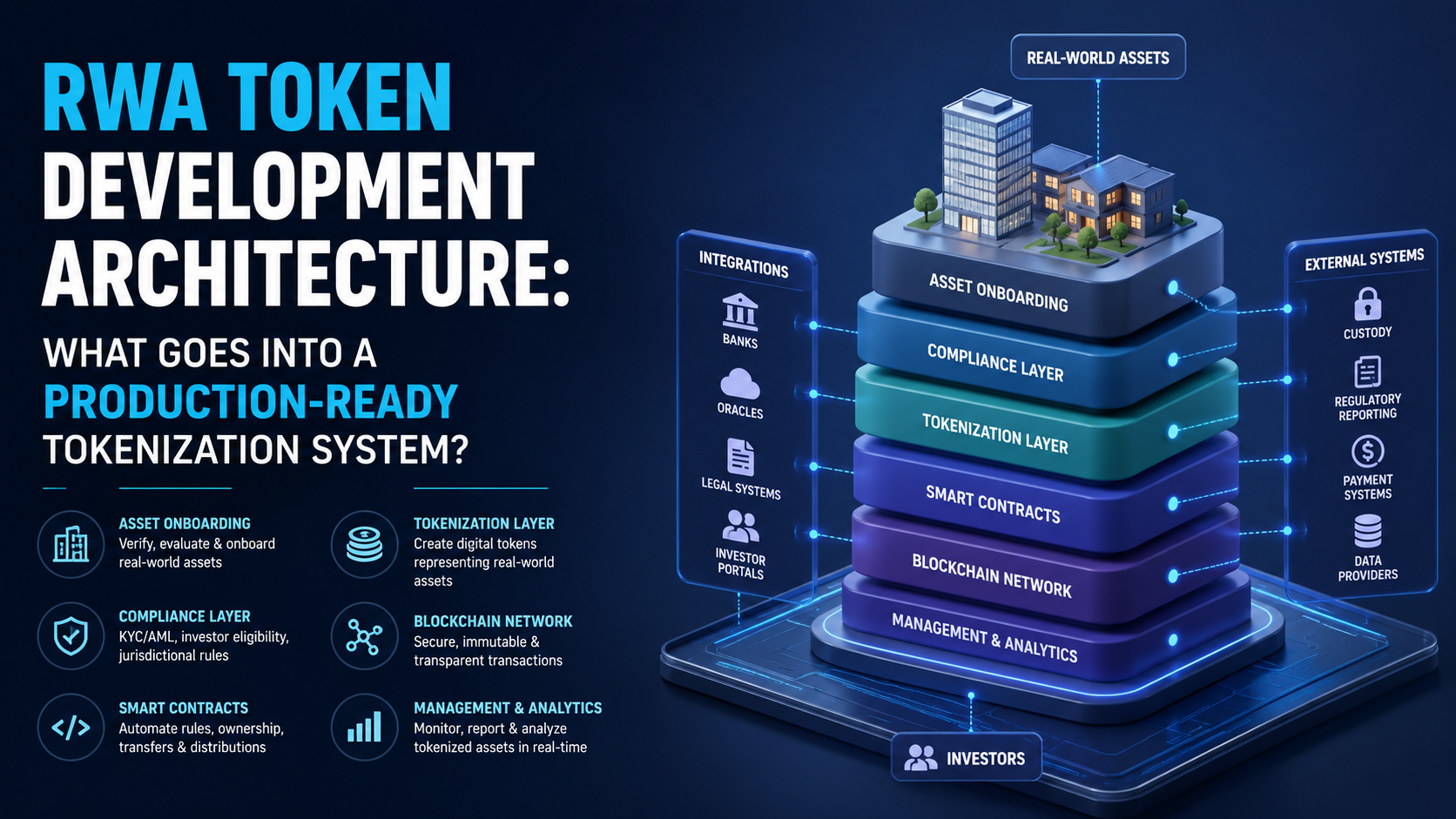
RWA Token Development Architecture: What Goes Into a Production-Ready Tokenization System?

RWA token development has moved from an experimental blockchain concept toward a practical model for representing real-world assets on digital networks. Property, private credit, commodities, funds, invoices, intellectual property, and other asset classes can be represented through blockchain-based tokens when the legal, financial, technical, and operational layers work together.
A production-ready tokenization system involves much more than creating a smart contract and issuing tokens. It requires asset verification, legal structuring, investor onboarding, custody arrangements, compliance controls, token lifecycle management, data feeds, transaction monitoring, and administrative functions. The architecture must connect these components without creating gaps between the physical asset and its digital representation.
For businesses planning RWA tokenization platform development, the architecture becomes one of the first areas that requires careful planning. A suitable structure helps determine how assets are onboarded, how ownership or economic rights are represented, how investors interact with tokens, and how transactions are recorded. This article explains the major architectural layers involved in a production-ready RWA tokenization system.
1. Asset Origination Layer
Method: Verify the asset before token issuance
The first architectural layer deals with the real-world asset itself. Before tokens are issued, the platform needs a process for identifying the asset, verifying ownership, assessing its documentation, and collecting relevant financial or operational information.
For real estate, this may include title records, valuation reports, property details, ownership documents, mortgage information, and rental records. For private credit, the system may require borrower information, loan agreements, repayment schedules, and credit assessments. Commodity tokenization may require warehouse receipts, quantity records, quality certifications, and custody information.
A production system can maintain an asset profile containing identifiers, documentation references, valuation data, ownership information, and status records. This profile becomes the source from which the digital token structure is created.
An RWA tokenization company may also connect asset onboarding workflows with external verification providers. This reduces manual duplication and gives administrators a structured process for reviewing assets before they reach the issuance stage.
2. Legal and Ownership Layer
Method: Connect digital tokens with legally defined rights
A token does not automatically establish legal ownership of an asset. The relationship between the token and the underlying asset must be defined through an appropriate legal structure.
Depending on the asset and jurisdiction, the arrangement may involve a special purpose vehicle, trust, fund, contractual claim, debt instrument, or another legal structure. The legal documentation should specify what rights token holders receive and how those rights relate to the underlying asset.
The platform architecture should therefore maintain references between the token, legal issuer, asset, investor agreement, and relevant documentation. These relationships help administrators understand what each token represents.
A Real-world asset tokenization company working with institutional users may need different legal structures for different asset categories. The architecture should support these differences rather than assuming that every asset follows the same ownership model.
3. Blockchain Network Layer
Method: Select the blockchain according to asset requirements
The blockchain layer provides the ledger on which token ownership and transactions are recorded. Network selection should consider transaction costs, settlement requirements, ecosystem compatibility, security characteristics, wallet support, and regulatory requirements.
An RWA tokenization development project may use a public blockchain, permissioned network, or hybrid arrangement. Public networks can provide broader market access, while permissioned environments may offer greater control over participant access and transaction visibility.
The architecture can also use multiple networks when business requirements justify it. In such cases, token contracts, identity systems, compliance rules, custody infrastructure, and transaction monitoring need to work consistently across supported networks.
The blockchain layer should remain connected to the off-chain asset records. A token transfer changes the digital ownership record, while the legal and operational systems maintain information about the corresponding asset and rights.
4. Smart Contract Layer
Method: Divide token logic into manageable contract modules
Smart contracts manage the rules associated with digital assets. A production-ready RWA token system may require contracts for issuance, transfers, investor restrictions, distributions, redemptions, voting, and administrative controls.
Token standards should be selected according to the asset model. A simple fungible structure may work for certain debt or fund interests, while other assets may require unique identifiers or more complex ownership arrangements.
Transfer restrictions are particularly important for regulated assets. A contract may check whether the sender and receiver are approved participants before allowing a transaction. Other rules can restrict holding periods, investor categories, geographic participation, or maximum ownership limits.
Administrative permissions should also be separated carefully. Issuer accounts, compliance administrators, custodians, and platform operators may have different responsibilities. Role-based permissions can reduce the risk of unauthorized contract actions.
5. Identity and KYC Layer
Method: Verify participants before granting token access
RWA markets usually require identity verification because participation can be subject to securities, financial, tax, or investor eligibility rules. The identity layer connects investors with verified profiles.
A typical process may include account registration, identity verification, sanctions screening, jurisdiction checks, investor classification, accreditation checks where applicable, and ongoing monitoring.
After approval, the platform can associate a verified identity with one or more blockchain wallet addresses. This creates a relationship between the real person or organization and the blockchain account.
Privacy should be considered during system design. Sensitive personal information does not necessarily need to be stored directly on-chain. Instead, the blockchain can store appropriate references or verification results while confidential records remain within controlled off-chain systems.
6. Compliance and Policy Layer
Method: Convert regulatory rules into transaction controls
Compliance should operate throughout the token lifecycle rather than only during investor onboarding. The policy layer can determine whether a participant is allowed to purchase, hold, transfer, or redeem a particular token.
Rules can include investor eligibility, jurisdiction restrictions, transaction limits, holding periods, wallet allowlists, ownership caps, and other requirements defined by the issuer and applicable regulations.
The compliance engine can communicate with smart contracts before transactions are finalized. If a transaction violates a configured rule, it can be rejected or sent for additional review.
For an RWA tokenization platform development company, this layer is important because different asset classes can have different regulatory requirements. The platform should allow rules to be configured according to the product rather than applying one policy to every token.
7. Custody and Wallet Layer
Method: Control digital assets and private keys securely
Token ownership depends on blockchain wallets, making custody an important part of the architecture. Investors may use self-custody wallets, institutional custody services, managed wallets, or platform-controlled accounts.
Institutional users may require multi-signature controls, approval workflows, transaction limits, key management policies, and detailed activity records. Custody arrangements should also account for recovery procedures and operational continuity.
The wallet layer can connect verified investor accounts with approved blockchain addresses. When a user changes a wallet address, the system can apply verification and compliance checks before allowing the new address to interact with restricted tokens.
8. Oracle and Asset Data Layer
Method: Bring verified off-chain information into the token system
Many real-world assets depend on information that does not originate on a blockchain. Property valuations, interest rates, commodity prices, repayment events, rental income, NAV calculations, and other data may need to reach smart contracts or platform services.
Oracle infrastructure provides a connection between external data sources and blockchain applications. The architecture should consider data origin, update frequency, validation procedures, fallback sources, and dispute handling.
For example, a tokenized property fund may need periodic valuation information for reporting or redemption calculations. A tokenized credit product may require payment status updates. These events can influence investor dashboards, distribution calculations, and token lifecycle processes.
9. Token Issuance and Lifecycle Layer
Method: Manage every stage from minting to redemption
Token issuance should follow a controlled workflow. An administrator may first approve an asset, create the token configuration, define supply, assign investor restrictions, and then authorize minting.
The lifecycle does not end after issuance. Tokens may later be transferred, frozen, redeemed, burned, reissued, or retired depending on the product structure.
A lifecycle management service can maintain records for each event. This gives issuers an operational view of how many tokens exist, where they are held, what restrictions apply, and which actions have taken place.
This layer is particularly relevant to RWA token development because real assets often have events outside the blockchain. A loan may mature, a property may be sold, or a fund may distribute income. The token system needs processes for reflecting those events.
10. Payments and Settlement Layer
Method: Connect token transactions with payment systems
Investors need a method to fund purchases and receive proceeds. The payment layer may support fiat payments, stablecoins, bank transfers, or a combination of settlement methods.
A token purchase workflow can connect payment confirmation with token allocation. If payment is incomplete, the token transfer should not proceed. Once settlement is confirmed, the platform can record the transaction and update the investor's holdings.
The same layer can support distributions, redemptions, interest payments, rental income, and other financial events. Payment records should remain linked with token transactions so administrators can reconcile both sides of the transaction.
11. Investor and Administrator Interfaces
Method: Provide separate interfaces for different participants
The investor interface allows users to review available assets, complete onboarding, purchase eligible tokens, monitor holdings, view transaction history, and access relevant documentation.
An administrator interface serves issuers, compliance teams, asset managers, and operational staff. It may include asset approval, investor verification, token issuance, transaction review, distribution management, reporting, and user permissions.
Institutional platforms may also require portfolio-level reporting, downloadable records, audit trails, and approval workflows. The interface should reflect the underlying architecture rather than functioning as an isolated dashboard.
12. Monitoring, Audit, and Reporting Layer
Method: Record operational activity throughout the system
Production systems require detailed records of important activities. The platform should record asset onboarding events, investor approvals, token issuance, transfers, administrative actions, compliance decisions, payments, and redemptions.
Audit records help internal teams investigate unusual activity and prepare operational or regulatory reports. Monitoring systems can also identify transaction patterns that require additional review.
Analytics can provide information about token supply, investor participation, transaction volumes, asset performance, distributions, and redemption activity. These records become particularly useful as the number of tokenized assets and participants increases.
13. Security and Infrastructure Layer
Method: Protect every connection between system components
Security must cover smart contracts, APIs, databases, wallets, user accounts, administrative systems, and cloud infrastructure. A weakness in any one component can affect the broader tokenization system.
Common controls include encryption, role-based access, multi-factor authentication, secure key management, API authentication, contract testing, monitoring, backup procedures, and incident response processes.
Smart contracts should undergo testing and independent security review before significant assets or capital are introduced. Infrastructure should also have logging and alerting so unusual activity can be investigated promptly.
14. API and Integration Layer
Method: Connect the token platform with external systems
A production-ready tokenization platform rarely operates alone. It may need connections with banks, custodians, identity providers, accounting systems, property management platforms, valuation providers, payment processors, compliance services, and blockchain networks.
APIs provide communication between these systems. A well-organized integration layer allows external services to exchange approved information without giving every component direct access to the entire platform.
For an RWA tokenization development company, integration planning is therefore an important part of the technical architecture. The platform needs to accommodate external services while keeping permissions and data access controlled.
How the Architecture Works as One System
The different layers work as a connected process. An asset first enters the origination system and undergoes documentation and ownership checks. The legal structure determines what the token represents. Once the asset receives approval, the issuer configures the token and establishes investor rules.
Investors complete identity and compliance checks before gaining access. Eligible investors can then fund purchases and receive tokens through approved wallets. Smart contracts record permitted transactions while off-chain services maintain asset information, compliance records, payment details, and operational documents.
External data providers can supply information required for valuations, payments, or lifecycle events. Monitoring and reporting services record activities across the platform. When an asset reaches maturity, is sold, or enters another lifecycle event, the system can process redemption or other required actions.
This connected architecture is what separates a production-ready tokenization system from a basic token issuance application.
What Businesses Should Plan Before RWA Token Development
Businesses should define the asset category, target investors, jurisdiction, legal structure, blockchain network, custody model, compliance requirements, token standard, payment methods, and operational responsibilities before development begins.
They should also decide which functions will remain on-chain and which will operate off-chain. Putting every piece of information on a blockchain can create privacy and cost concerns, while keeping too much information off-chain can make verification and audit processes harder.
Working with an RWA tokenization company can help organizations map these requirements into a technical architecture. An RWA tokenization platform development company can then translate the business model into modules covering asset onboarding, token issuance, compliance, custody, investor management, payments, reporting, and administration.
The right architecture depends on the asset and the market in which the platform will operate. There is no single structure that suits every RWA product. A tokenized property platform, private credit marketplace, commodity system, and fund platform can require very different workflows even when they use similar blockchain technology.
Conclusion
RWA token development requires an architecture that connects real-world assets with blockchain records, legal rights, investor identities, compliance policies, custody systems, payment rails, external data, smart contracts, and operational reporting. A production-ready system must account for the full asset lifecycle rather than focusing only on token issuance. Businesses planning RWA tokenization should define their legal model, asset workflow, investor requirements, blockchain environment, compliance rules, custody approach, and integration needs before development begins. With these areas planned together, a tokenization platform can provide a structured environment for issuing, managing, transferring, and redeeming digital representations of real-world assets. Blockchain App Factory provides RWA tokenization development services for businesses looking to plan and implement tokenization platforms around their asset and market requirements.
FAQs
1. What is RWA token development?
RWA token development is the process of creating blockchain-based tokens that represent ownership, economic interests, claims, or other rights connected with real-world assets such as property, commodities, private credit, and investment funds.
2. What does a production-ready RWA tokenization system include?
It generally includes asset onboarding, legal structuring, blockchain infrastructure, smart contracts, identity verification, compliance controls, custody, payment processing, oracle services, token lifecycle management, investor interfaces, administration, monitoring, and reporting.
3. Why is legal structuring important in RWA tokenization?
Legal structuring defines the relationship between the physical asset and the digital token. It also establishes the rights, obligations, ownership arrangements, and investor claims associated with the token.
4. Which blockchain is suitable for RWA tokenization?
The appropriate blockchain depends on transaction requirements, asset type, investor access, compliance needs, custody arrangements, ecosystem support, and operating costs. Public, private, and hybrid networks can all be considered.
5. What role do smart contracts play in RWA token development?
Smart contracts manage token rules such as issuance, transfers, investor restrictions, distributions, redemptions, and administrative permissions. They provide automated enforcement of predefined transaction conditions.
6. How does KYC work in an RWA tokenization platform?
Investors can complete identity verification, sanctions screening, jurisdiction checks, and other eligibility procedures before receiving permission to interact with restricted tokens. Approved wallet addresses can then be associated with verified investor accounts.
7. Are RWA tokens always the same as direct ownership of an asset?
No. The legal meaning of a token depends on the legal structure and contractual arrangements behind the product. A token may represent direct ownership, an interest in an entity, a debt claim, revenue rights, or another defined economic interest.
8. What is the role of oracles in RWA tokenization?
Oracles can bring selected external information into blockchain applications. Depending on the product, this may include valuations, market prices, interest rates, repayment events, or other asset-related information.
9. Can an RWA tokenization platform support multiple asset classes?
Yes. A platform can support multiple asset classes when its architecture accounts for differences in legal structures, compliance rules, valuation methods, token standards, payment processes, and lifecycle events.
10. What should businesses decide before starting RWA tokenization development?
Businesses should first define the asset type, legal model, target investors, jurisdiction, compliance requirements, blockchain network, custody arrangement, payment method, token structure, operational workflow, and external integrations required for the platform.

