

Online Car Buying Market Size, Share, Latest Trends, Analysis and Forecast 2026-2034

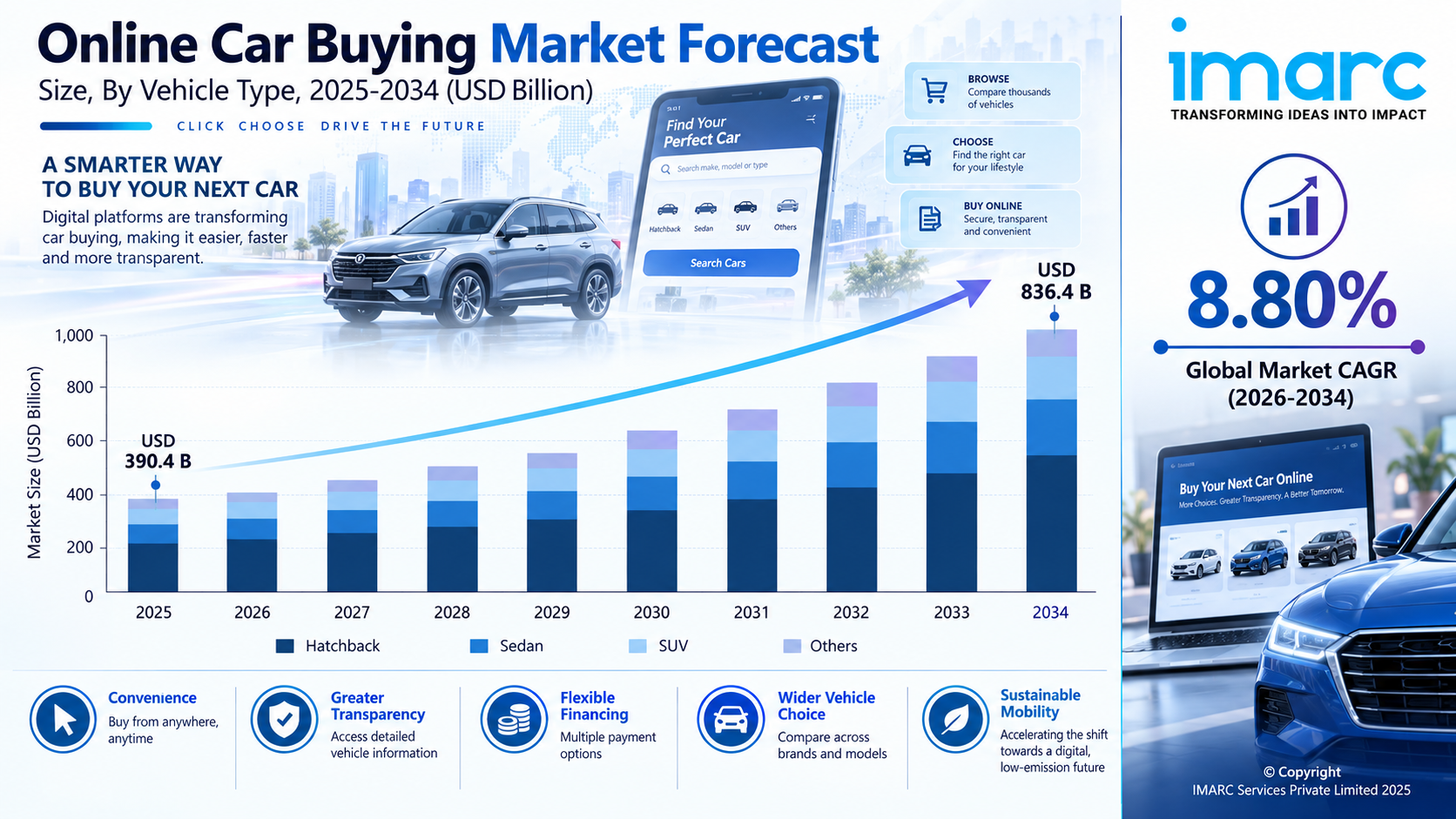
The global online car buying market size reached USD 390.4 Billion in 2025. Looking forward, IMARC Group expects the market to reach USD 836.4 Billion by 2034, exhibiting a growth rate (CAGR) of 8.80% during 2026-2034. The market is experiencing strong growth driven by the convenience and accessibility offered by online platforms, increasing transparency and information availability, rapid digitalization of the automotive industry, changing consumer preferences and behavior, and cost-efficiency and competitive pricing.
Online Car Buying Market Report: Key Highlights
-
Market Size & Growth: The global online car buying market reached USD 390.4 Billion in 2025 and is projected to reach USD 836.4 Billion by 2034, registering a CAGR of 8.80% during 2026–2034.
-
Major Market Drivers: Convenience and accessibility, greater transparency, increasing digitalization of the automotive industry, changing buyer preferences, and competitive pricing are supporting market expansion.
-
Technological Advancements: Artificial intelligence (AI)-driven chatbots, augmented reality (AR), virtual showrooms, and other digital technologies are improving customer engagement and streamlining the vehicle purchasing journey.
-
Industry Applications: Online car buying platforms increasingly offer complete purchasing solutions, including home delivery, price comparison, financing options, and vehicle research.
-
Regional Leadership: North America accounts for the largest market share, supported by tech-savvy consumers, established automotive e-commerce platforms, extensive vehicle selections, and increasing adoption of digital purchasing tools.
-
Vehicle Type: SUVs represent the largest vehicle type segment, supported by their versatility, spaciousness, and broad consumer appeal.
-
Propulsion Type: Petrol vehicles account for the largest share of the market, supported by their widespread availability, affordability, and established fueling infrastructure.
-
Category: Pre-owned vehicles represent the leading category, driven by affordability, extensive online listings, vehicle-history information, and greater transparency.
-
Key Challenges: Concerns surrounding trust, listing legitimacy, and the transition from a virtual buying experience to a real-world vehicle purchase can constrain market adoption.
-
Emerging Opportunities: Expansion of online financing, virtual showrooms, digital research tools, and initiatives focused on building customer confidence are creating new growth opportunities.
Request For a Sample Report: https://www.imarcgroup.com/online-car-buying-market/requestsample
What Is Driving Online Car Buying Market Growth in 2026?
Convenience and Accessibility Offered by the Platform
The convenience and accessibility offered by online car buying platforms represent major factors fueling market growth. Online purchasing helps buyers avoid frequent visits to physical dealerships, saving considerable time and effort. Customers can research vehicle specifications, compare prices, examine reviews, and explore a wide variety of automobiles from the comfort of their homes.
Unlike traditional dealerships that operate within fixed business hours, online platforms allow users to conduct research and make purchasing decisions at their own pace. Buyers can also explore vehicles offered by dealerships outside their immediate geographical areas, significantly increasing the range of available options.
Online platforms can further improve accessibility for consumers living in remote locations where physical dealerships may be limited or unavailable. This combination of convenience, flexibility, and broader vehicle access is strengthening the adoption of online car buying.
Transparency and Information Availability
Increasing demand for transparency is another major factor supporting the online car buying market. Consumers are increasingly seeking detailed information before making significant purchases, and digital platforms provide access to extensive information regarding vehicle features, prices, specifications, reviews, and ratings.
Online tools enable buyers to quickly compare vehicle features and pricing across different models and dealerships, helping them make more informed purchasing decisions. Many platforms also provide calculators for monthly payments, total cost of ownership, and financing options.
The availability of comprehensive information allows consumers to evaluate vehicles and financial commitments more effectively, improving confidence during the purchasing process and supporting continued market growth.
Digitalization of the Automotive Industry
The rapid digitalization of the automotive industry is creating a favorable online car buying market outlook. Automakers and dealerships are increasingly adopting digital technologies to improve customer engagement and operational efficiency.
The development of user-friendly websites and mobile applications is making online automobile sales increasingly accessible. Virtual showrooms and augmented reality (AR) technologies are also enhancing the digital purchasing experience by allowing buyers to examine vehicles virtually and visualize how different vehicles, colors, and configurations may fit their preferences.
Furthermore, artificial intelligence (AI)-powered chatbots and virtual assistants are becoming increasingly common. These tools can answer customer questions, support purchasing decisions, and guide users through financing options, helping streamline the overall buying journey.
Changing Preferences and Behavior
Changing consumer preferences and behavior are playing a pivotal role in driving online car buying market demand. Younger consumers are increasingly accustomed to digital experiences and online purchasing. Convenience, transparency, and the ability to research and compare products and services online are particularly important to this demographic.
The COVID-19 pandemic further accelerated this shift toward digital purchasing. Lockdowns and social-distancing measures reduced in-person dealership visits, encouraging consumers to explore online alternatives. Many buyers who had previously been hesitant about purchasing a high-value product online became more comfortable with the process after experiencing the convenience and safety of digital transactions.
The growing demand for seamless, end-to-end digital experiences is consequently encouraging the development of online car-buying platforms that accommodate evolving consumer habits.
Cost Efficiency and Competitive Pricing
Cost efficiency and competitive pricing are important factors propelling the online car buying industry. Online platforms can offer attractive pricing structures compared with traditional dealership environments, partly because online operations can reduce certain physical showroom-related overhead costs.
Digital platforms also allow buyers to compare prices across multiple dealerships and vehicle models, helping them identify competitive offers. Some platforms provide tools that enable users to receive offers from different dealerships, increasing competition and pricing transparency.
Financing calculators and other digital tools further help consumers understand the overall cost of vehicle ownership, including interest rates, monthly payments, and additional expenses. This transparency enables buyers to identify financing solutions that align with their budgets.
Online Car Buying Market Trends
Growing Adoption of Digital Vehicle Purchasing
The rising inclination toward online transactions is one of the major trends shaping the online car buying market. Consumers are increasingly comfortable researching, comparing, financing, and purchasing vehicles through digital channels.
The continued expansion of online platforms is allowing consumers to complete more stages of the vehicle-buying journey digitally, reducing dependence on traditional dealership visits.
Integration of AI, AR, and Virtual Showrooms
Technological advancements are transforming the online car buying experience. AI-driven chatbots and virtual assistants are helping customers obtain information and navigate purchasing decisions, while AR tools can enable users to visualize different vehicle configurations.
Virtual showrooms are also allowing customers to examine vehicles in digital environments, improving engagement and providing a more immersive alternative to conventional online listings.
Expansion of End-to-End Online Services
Online car buying is expanding beyond vehicle listings and transactions. Platforms are increasingly integrating services such as home delivery, financing, price comparison, vehicle research, and other purchasing tools.
This development is helping transform online car buying platforms into comprehensive automotive purchasing solutions, improving convenience for consumers.
Increasing Focus on Transparency and Trust
Transparency and customer confidence remain important factors shaping the development of online car buying. Platforms are increasingly providing detailed vehicle information, pricing data, reviews, ratings, and vehicle-history information to reduce uncertainty.
Building trust is particularly important for pre-owned vehicle transactions, where buyers may have concerns regarding vehicle condition, mileage, accident history, service records, and ownership details.
Online Car Buying Market Segmentation Analysis
IMARC Group provides an analysis of the key trends in each segment of the market, along with forecasts at the global, regional, and country levels for 2026-2034. The market has been categorized based on vehicle type, propulsion type, and category.
By Vehicle Type
-
Hatchback
-
Sedan
-
SUV
-
Others
SUVs Account for the Majority of the Market Share
The SUV segment represents the largest vehicle type segment in the online car buying market. SUVs have become a major part of the automotive industry due to their versatility, rugged exterior, increased ground clearance, and availability with two-wheel or all-wheel drive configurations.
SUVs appeal to a broad range of consumers because they provide substantial space for passengers and cargo. This makes them particularly attractive to families, outdoor enthusiasts, and buyers seeking versatile vehicles.
The SUV category also includes compact, midsize, and full-size models, allowing consumers to select vehicles according to their specific requirements and preferences.
Hatchbacks
Hatchbacks represent a significant segment of the automotive market and are recognized for their compact dimensions and versatile design. Their rear doors open upward to provide access to the cargo area, which is generally integrated with the passenger compartment.
Hatchbacks are particularly popular among urban consumers and younger drivers because of their practicality, maneuverability, and affordability. The segment is also increasingly incorporating fuel-efficient and environmentally friendly options, including hybrid and electric hatchbacks.
Sedans
Sedans have traditionally represented an important segment of the automotive industry, featuring a separate trunk compartment and a comfortable passenger interior. They are available in compact, midsize, and full-size configurations, serving a broad range of consumer requirements.
The segment has increasingly incorporated advanced technology and safety features, including advanced driver-assistance systems (ADAS) and infotainment systems. Despite increasing SUV popularity, sedans continue to attract consumers seeking a smooth and refined driving experience.
By Propulsion Type
-
Petrol
-
Diesel
-
Others
Petrol Holds the Largest Share in the Industry
The petrol segment accounts for the largest share of the online car buying market. Petrol-powered vehicles use internal combustion engines fueled by gasoline, which remains a widely available and established fuel source.
Petrol engines are recognized for smooth and responsive performance and rapid acceleration, making them suitable for diverse driving conditions ranging from urban commuting to highway travel. Their relatively lower upfront purchase costs compared with certain alternative propulsion technologies also make them attractive to budget-conscious consumers.
The widespread use of gasoline in the transportation sector and the established infrastructure supporting petrol vehicles continue to contribute to their strong market position.
Diesel
Diesel-powered vehicles represent another important segment of the automotive market. Diesel engines are particularly recognized for their fuel efficiency and higher torque at lower engine speeds.
These characteristics make diesel vehicles attractive for applications requiring strong towing capabilities and for consumers prioritizing fuel savings. Diesel-powered trucks, SUVs, commercial vehicles, and long-haul applications therefore continue to represent important areas of demand.
By Category
-
Pre-Owned Vehicle
-
New Vehicle
Pre-Owned Vehicles Represent the Leading Market Segment
The pre-owned vehicle segment represents the leading category in the online car buying market. A major factor supporting its growth is the affordability of used vehicles compared with new automobiles, making them attractive to budget-conscious buyers.
Online platforms have simplified access to extensive pre-owned vehicle inventories while providing detailed information regarding vehicle history, condition, mileage, and ownership.
Transparency is particularly important within this segment. Digital platforms can provide vehicle-history reports containing accident records, service history, and ownership information. User-generated reviews and ratings can further support purchasing decisions and reduce concerns regarding undisclosed vehicle issues.
New Vehicles
The new vehicle segment is also experiencing substantial growth as consumers increasingly use digital platforms to research and purchase the latest vehicle models and technologies.
Online platforms allow customers to explore automaker lineups, compare specifications and features, review pricing, and configure vehicles according to their preferences. Buyers can select options, accessories, colors, and trim levels without requiring multiple visits to physical dealerships.
This convenience and customization capability are supporting the continued adoption of online purchasing for new vehicles.
By Region
-
North America
-
United States
-
Canada
-
-
Asia Pacific
-
China
-
Japan
-
India
-
South Korea
-
Australia
-
Indonesia
-
Others
-
-
Europe
-
Germany
-
France
-
United Kingdom
-
Italy
-
Spain
-
Russia
-
Others
-
-
Latin America
-
Brazil
-
Mexico
-
Others
-
-
Middle East and Africa
North America Leads the Market, Accounting for the Largest Online Car Buying Market Share
North America, comprising the United States and Canada, represents the largest regional market. The region has experienced significant growth in online vehicle purchasing, supported by tech-savvy consumers who place high value on convenience and transparency.
In the United States, online platforms provide extensive selections of new and used vehicles, while consumers increasingly use digital tools for vehicle research and purchases. The presence of established automotive e-commerce platforms and home delivery options has further supported the expansion of online car buying.
The COVID-19 pandemic accelerated this trend as consumers sought safer alternatives to traditional dealership visits, further strengthening the adoption of digital purchasing channels.
Europe
Europe represents another major market for online car buying, with countries such as Germany, the United Kingdom, and France witnessing substantial growth in digital vehicle sales.
European consumers demonstrate strong interest in environmentally friendly vehicles, and online platforms increasingly provide access to electric and hybrid vehicle options. The European Union's focus on digitalization and e-commerce regulations has also contributed to a favorable environment for online car buying.
In addition to new vehicles, Europe maintains a strong used-car market, with digital platforms offering certified pre-owned vehicles and comprehensive information to consumers.
Asia Pacific
The Asia Pacific region, including China, India, Japan, and South Korea, is experiencing rapid online car buying market growth. The region's large population, increasing disposable incomes, and expanding middle class are contributing to rising demand.
China has demonstrated strong consumer interest in online vehicle purchases, with numerous digital platforms providing access to a broad range of vehicles, including electric cars and luxury brands.
In India, online car buying is gaining momentum, particularly among urban consumers seeking convenient transportation solutions. Japan and South Korea are also witnessing a shift toward digital vehicle purchases as automakers and online platforms expand their presence.
Latin America
Latin America is gradually adopting online car buying, although growth has historically been slower than in some other regions. Brazil and Mexico are witnessing increasing interest in digital vehicle purchases as internet accessibility improves and e-commerce becomes more established.
Online platforms provide consumers with convenient access to vehicle information, pricing comparisons, and a broader range of options. However, concerns regarding security and trust remain challenges in some markets.
As internet infrastructure continues to improve and consumers become increasingly familiar with digital transactions, the region is expected to offer additional growth opportunities.
Middle East and Africa
The Middle East and Africa region is gradually adopting online car buying, with adoption levels varying significantly between countries.
The United Arab Emirates and Saudi Arabia have demonstrated greater interest in digital vehicle purchasing, supported by relatively high income levels and tech-savvy populations. Meanwhile, online car buying remains at an earlier stage across many African countries due to infrastructure limitations and lower internet penetration.
Nevertheless, increasing internet access and the expansion of e-commerce, particularly in urban areas, are expected to create opportunities for digital automotive platforms.
Key Regional Insight: North America's Leadership
North America's leading position in the global online car buying market is supported by widespread digital adoption, tech-savvy consumers, established automotive e-commerce platforms, extensive vehicle inventories, and home delivery services.
The region's mature digital ecosystem enables consumers to conduct vehicle research, compare prices, access financing information, and complete significant portions of the purchasing process online. The accelerated adoption of digital purchasing during the COVID-19 pandemic further strengthened consumer acceptance of online vehicle transactions.
Competitive Landscape in the Online Car Buying Industry
The online car buying market is highly competitive, with established automakers, automotive dealership groups, and specialized digital marketplaces competing to strengthen their positions and improve customer experiences.
Established automakers such as Toyota, Ford, and Volkswagen have entered the digital automotive space through proprietary online platforms or partnerships with existing e-commerce platforms. These companies leverage their brand recognition, broad vehicle portfolios, and dealership networks to attract online buyers.
At the same time, specialized online marketplaces are focusing on extensive vehicle listings, pricing transparency, user-friendly interfaces, and digital purchasing tools. Many platforms are incorporating virtual showrooms, augmented reality tools, and AI-driven chatbots to improve customer engagement.
This competitive environment is contributing to improved digital services, greater pricing transparency, and broader vehicle choices for consumers.
Leading Key Players in the Online Car Buying Industry
Some of the major players in the online car buying market include:
-
Asbury Automotive Group
-
AutoNation
-
CarGurus, Inc.
-
CarMax Enterprise Services, LLC
-
Cars and Bids LLC
-
Cars.com
-
CarsDirect.com
-
Carvana
-
Group 1 Automotive, Inc.
-
Hendrick Automotive Group
-
Lithia Motors
-
Miami Lakes Automall
-
TrueCar, Inc.
Please note that this is only a partial list of the key players, and the complete list is provided in the report.
Recent Developments in the Online Car Buying Market
-
December 2, 2020: Asbury Automotive Group Inc. unveiled Clicklane, a communication technology ecosystem designed to facilitate a complete online car purchasing and selling experience. Asbury collaborated with Gubagoo to develop the digital platform and enhance the car-buying process across its existing store network.
-
November 15, 2022: AutoNation Inc. announced its acquisition of approximately 6.1% of TrueCar. TrueCar operates as a digital automotive marketplace connecting car buyers and sellers through a network of Certified Dealers. The investment reflected AutoNation's focus on emerging technologies and customer experience.
-
November 7, 2023: CarGurus Inc. reached an agreement to complete the acquisition of CarOffer. The transaction supported CarGurus' strategy to expand its presence and capabilities within the automotive market, while CarOffer contributed technology solutions designed to facilitate vehicle buying and selling processes.
Market Drivers, Challenges & Opportunities
Major Market Drivers
-
Convenience and Accessibility: Online platforms enable consumers to research, compare, and purchase vehicles without frequent visits to physical dealerships.
-
Transparency and Information Availability: Detailed specifications, pricing, reviews, ratings, vehicle-history reports, and financing information help consumers make informed decisions.
-
Automotive Digitalization: Websites, mobile applications, virtual showrooms, AR, AI chatbots, and virtual assistants are streamlining the vehicle purchasing experience.
-
Changing Consumer Preferences: Younger, digitally accustomed consumers increasingly value convenient, transparent, and seamless online purchasing experiences.
-
Cost Efficiency and Competitive Pricing: Online platforms facilitate price comparison and competition between dealerships while potentially reducing certain dealership overhead costs.
Key Challenges
-
Trust and Legitimacy Concerns: Consumers may remain concerned about the authenticity of online vehicle listings and the accuracy of information provided.
-
Virtual-to-Physical Transition: Creating a smooth transition from the online purchasing experience to physical vehicle delivery, inspection, or ownership remains an important challenge.
-
Security Concerns: Concerns surrounding the security of online transactions can limit adoption, particularly in developing markets.
-
Infrastructure Limitations: Lower internet penetration and developing digital infrastructure can slow market adoption in certain regions.
Emerging Opportunities
-
Online Financing Services: Integration of financing tools and solutions can make online vehicle purchasing more comprehensive and convenient.
-
Virtual Showrooms and AR: Immersive technologies can improve vehicle visualization and customer engagement.
-
AI-Powered Customer Assistance: AI chatbots and virtual assistants can help consumers with research, decision-making, and financing queries.
-
Building Consumer Confidence: Transparent pricing, detailed vehicle information, vehicle-history reports, and open transactions can help strengthen buyer trust.
-
End-to-End Digital Purchasing: Combining research, price comparison, financing, customization, and home delivery can create a seamless online vehicle-buying experience.
Online Car Buying Market FAQs
1. What is the current size of the online car buying market?
The global online car buying market share reached USD 390.4 Billion in 2025 and is expected to reach USD 836.4 Billion by 2034, expanding at a CAGR of 8.80% during 2026–2034.
2. What is driving the growth of the online car buying market?
The market is primarily driven by the convenience and accessibility of online platforms, increasing transparency and information availability, rapid automotive digitalization, changing consumer behavior, and cost efficiency and competitive pricing.
3. Which region dominates the online car buying market?
North America accounts for the largest market share, supported by tech-savvy consumers, established automotive e-commerce platforms, extensive vehicle selections, home delivery services, and strong adoption of digital purchasing tools.
4. Which vehicle type represents the largest segment?
SUVs represent the largest vehicle type segment, supported by their versatility, spacious interiors, increased ground clearance, and broad appeal among families and other consumer groups.
5. Which propulsion type holds the largest market share?
Petrol-powered vehicles account for the largest share of the market, supported by their widespread availability, smooth performance, relatively lower upfront costs, and established fueling infrastructure.
About the Author
IMARC Group is a leading global market research company providing data-driven insights and strategic consulting services across diverse industries. The company delivers comprehensive research reports covering automotive, technology, healthcare, chemicals, packaging, food & beverages, consumer goods, and industrial sectors, helping organizations make informed business decisions and identify emerging growth opportunities.
Media & Sales Contact
IMARC Group
United States: +1-201-971-6302
India: +91-120-433-0800
United Kingdom: +44-753-714-6104
