

United States Cosmetics Market Size, Share, Trends, Industry Analysis, Report 2026-2034

IMARC Group has recently released a new research study titled "United States Cosmetics Market Size, Share, Trends and Forecast by Product Type, Category, Gender, Distribution Channel, and Region, 2026-2034", offering a detailed analysis of the market drivers, segmentation, growth opportunities, trends, and competitive landscape to understand the current and future market scenarios.
United States Cosmetics Market Size & Share 2026-2034
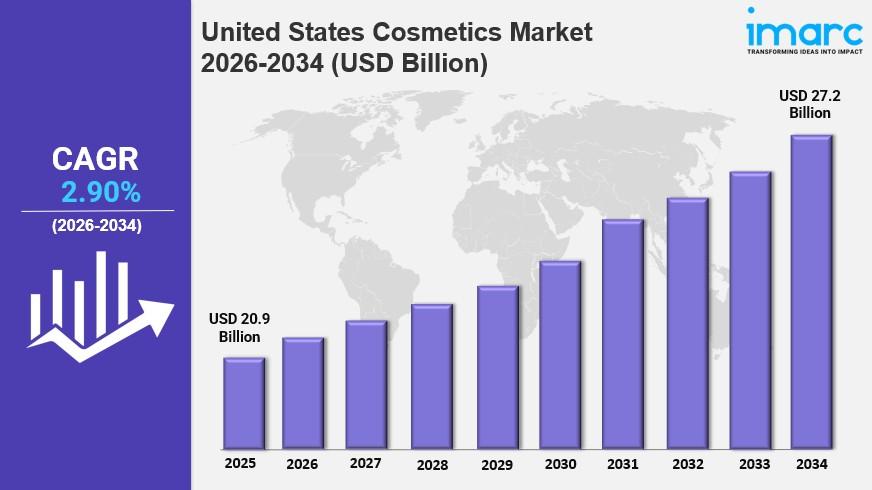
The United States cosmetics market grew from USD 20.9 Billion in 2025 to USD 21.6 Billion in 2026 and is projected to reach USD 27.2 Billion by 2034, exhibiting a CAGR of 2.90% during 2026-2034. The shift towards sustainability, with consumers increasingly preferring eco-friendly and cruelty-free products, is a key driver.
Technological advancements in personalized beauty, along with the growing influence of social media and digital platforms, are also augmenting the United States cosmetics market share and shaping consumer purchasing behaviors.
Key Market Statistics at a Glance
- Base Year: 2025
- Historical Years: 2020-2025
- Forecast Period: 2026-2034
- Market Size (2025): USD 20.9 Billion
- Market Size (2026): USD 21.6 Billion
- Projected Market Size (2034): USD 27.2 Billion
- Growth Rate: CAGR of 2.90% (2026-2034)
Explore Opportunities in the United States Cosmetics Market: Download the IMARC Sample Report: https://www.imarcgroup.com/united-states-cosmetics-market/requestsample
Key Growth Drivers and Trends in the United States Cosmetics Market
Growth in the United States cosmetics market is being driven by rising demand for sustainable and clean beauty products, as environmentally conscious consumers increasingly prioritize vegan, cruelty-free, and eco-friendly formulations. On June 25, 2024, Herbivore Botanicals announced a strategic shift to prioritize clinical efficacy and sustainability, moving beyond its traditional focus on clean beauty, aligning with a 2024 McKinsey report revealing that 50% of U.S. and U.K. consumers consider clinical effectiveness a top purchasing factor, while about 20% prioritize natural or clean ingredients.
One of the leading United States cosmetics market trends is strong holiday season growth, as the prestige beauty segment expanded by 7% to reach USD 22.8 Billion during the November 2024 holiday season, while the mass market reported a 2% increase in sales compared to the previous year. Within the prestige sector, makeup sales rose by 5% in both dollar and unit terms, with the lip category standing out through a notable 21% increase in dollar sales, driven by demand for tinted lip balms and oils.
Another key factor supporting United States cosmetics market growth is the influence of digital platforms and e-commerce, as U.S. consumers spent a record USD 1.3 Trillion online in 2023, with USD 389.2 Billion in the fourth quarter alone, and online spending on apparel and accessories reaching USD 204 Billion. Social media platforms significantly impact consumer behavior through tutorials, reviews, and influencer recommendations, while integration of augmented reality (AR) tools for virtual try-ons continues to improve online shopping experiences.
United States Cosmetics Industry Segmentation Insights
Breakup by Product Type:
- Skin and Sun Care Products: Driven by rising skincare routine awareness and sun protection needs, catering to demand for solutions targeting aging, hydration, and skin sensitivity.
- Hair Care Products: Supported by diverse consumer needs for hair health and styling, including personalized solutions for hair loss, scalp care, and texture-specific products.
- Deodorants and Fragrances: Caters to personal hygiene and self-expression, with fragrances increasingly viewed as lifestyle accessories reflecting individuality and mood.
- Makeup and Color Cosmetics: Benefits from social media trends and celebrity endorsements driving product visibility and consumer engagement.
- Others: Includes additional personal care and beauty product categories.
Breakup by Category:
- Conventional: Continues to dominate due to wide availability, long-standing consumer trust, and extensive research and development ensuring effective, competitively priced formulations.
- Organic: Rapidly gaining traction as consumers prioritize natural, eco-friendly ingredients free from harmful toxins and synthetic additives, aligning with the growing wellness movement.
Breakup by Gender:
- Women: Remains the largest and most dominant segment, driving a significant portion of overall sales across skincare, makeup, and haircare, with growing focus on natural and cruelty-free formulations.
- Men: Rapidly expanding as societal norms around grooming evolve, with a survey finding 72% of U.S. male consumers aged 18-34 incorporate makeup into their grooming routines.
- Unisex: Gaining traction as consumers move towards inclusive, gender-neutral products, particularly among Gen Z and Millennials prioritizing versatility.
Breakup by Distribution Channel:
- Supermarkets and Hypermarkets: Offers wide accessibility and variety, providing both premium and affordable options in a single location supported by in-store promotions and discounts.
- Specialty Stores: Provides a curated selection of high-quality, niche beauty products with personalized shopping experiences and expert recommendations.
- Pharmacies: Serves as a trusted environment for over-the-counter skincare and dermatologically tested beauty solutions.
- Online Stores: Growing rapidly through e-commerce platforms, AR-enabled virtual try-ons, and digital-first beauty brands.
- Others: Includes additional distribution formats supporting cosmetics market reach.
Breakup by Region:
- Northeast: Benefits from high population density and strong consumer spending power, with metropolitan cities like New York, Boston, and Philadelphia serving as influential fashion and beauty hubs.
- Midwest: Growing segment driven by expanding consumer base and rising disposable income, with cities like Chicago emerging as key retail and distribution hubs.
- South: Witnessing significant demand surge driven by cultural diversity and a growing interest in beauty and self-care, with states like Texas, Florida, and Georgia serving as important market drivers.
- West: Holds commanding influence, particularly California, driven by trendsetting culture and health-conscious beauty focus, with Los Angeles considered a global beauty capital.
Key Challenges and Growth Opportunities in the United States Cosmetics Market
The United States cosmetics market faces challenges including high competition, regulatory issues, increasing raw material prices, fake goods, and changing consumer demands for transparency and sustainability that continue to test cosmetic companies.
Despite these challenges, the market offers considerable growth opportunities driven by AI-driven personalization, sustainable packaging, and direct-to-consumer (D2C) business models. Men's grooming segment extension and catering to Gen Z through affordable, sustainable, technologically enabled products represent major opportunities for United States cosmetics brands.
Competitive Landscape
The competitive landscape of the United States cosmetics market is characterized by intense competition across skincare, makeup, haircare, and fragrance categories, with companies investing in clean beauty, cruelty-free, and sustainable product lines. Key players include Beiersdorf, Coty Inc., Estée Lauder Companies, Godrej, Kao Corporation, L'Oréal, Procter & Gamble, Revlon, Shiseido Company, and Unilever. On November 12, 2024, L'Oréal USA celebrated the 2024 For Women in Science winners, providing USD 60,000 grants to five female postdoctoral scientists in collaboration with the American Association for the Advancement of Science.
Recent Developments in the United States Cosmetics Market
- April 9, 2024: Dove commemorated 20 years of its Real Beauty campaign, pledging to never use artificial intelligence to depict real women in its advertising, reaffirming its commitment to authentic beauty representation.
- August 8, 2024: The Estée Lauder Companies announced the launch of Smashbox Cosmetics in the U.S. Amazon Premium Beauty Store, aiming to enhance the brand's digital presence and accessibility.
- March 27, 2024: Clinique debuted in the U.S. Amazon Premium Beauty store, becoming the first brand from The Estée Lauder Companies' portfolio to launch a storefront there, offering greater access to its clinically validated skincare and makeup products.
Author IMARC Group
IMARC Group is a leading global market research company providing data-driven insights and expert consulting services to businesses seeking to achieve their strategic objectives. With a multidisciplinary team of industry experts, IMARC delivers reliable market intelligence across sectors including Chemicals and Materials, Healthcare, Technology, Agriculture, and Retail.
Contact Us:
IMARC Group
Email: [email protected]
United States: +1-201-971-6302
