

Japan Digital Substation Gateway Market: Smart Grid, AI and Resilient Power Infrastructure

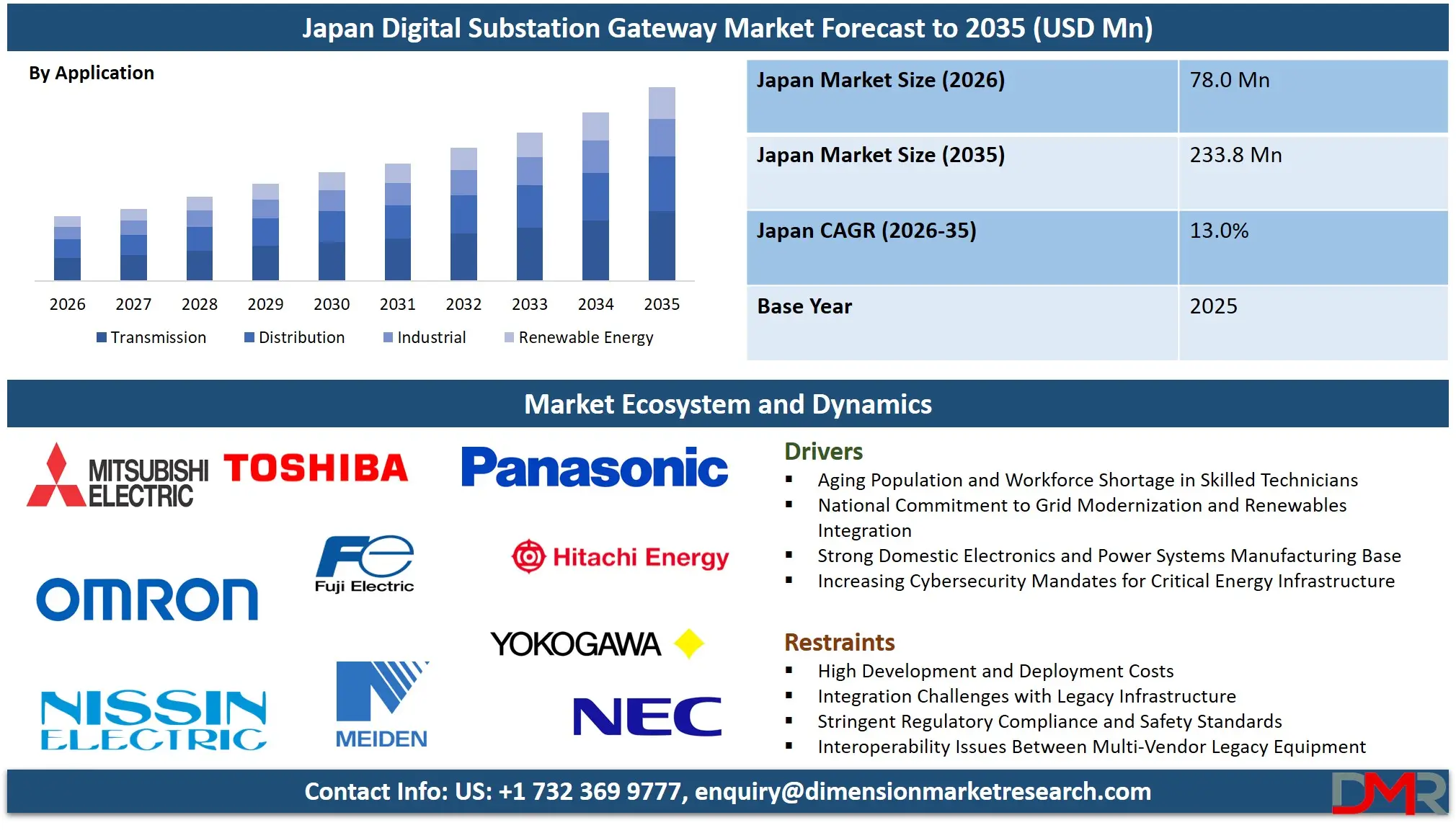
According to Dimension Market Research, the Japan Digital Substation Gateway Market is expanding as Japanese utilities and industrial power users modernize aging substations, improve grid visibility, integrate renewable energy, and strengthen digital control systems. The market is estimated at USD 78.0 million in 2026 and is projected to reach USD 233.8 million by 2035, representing a 13.0% CAGR during the forecast period.
Digital substation gateways serve as an important communication layer between electrical equipment and modern utility-control platforms. They can collect information from protection relays, intelligent electronic devices, meters, sensors, and control systems while helping different communication protocols operate together.
Japan's electricity infrastructure makes gateway technology particularly relevant. Aging substations, increasing renewable-energy deployment, smart-city development, electric-vehicle charging, workforce shortages, and demand for resilient infrastructure are encouraging utilities to adopt digital technologies that can modernize existing assets without always requiring complete replacement.
Japan Digital Substation Gateway Market at a Glance
| Market Indicator | 2026 Value / Insight |
|---|---|
| Market Size | USD 78.0 Million |
| Forecast Value, 2035 | USD 233.8 Million |
| CAGR, 2026–2035 | 13.0% |
| Leading Component | Hardware – 54.9% |
| Leading Protocol | IEC 61850 |
| Leading Deployment | Retrofit Brownfield Upgrades |
| Key End User | Utilities |
| Key Voltage Areas | HV and EHV |
| Major Growth Drivers | Grid Modernization, Renewables, AI, Cybersecurity |
Why Digital Substation Gateways Matter in Japan
Traditional substations often contain equipment from different generations and manufacturers.
Older devices may use legacy communication protocols, while newer systems increasingly depend on Ethernet-based digital infrastructure.
This creates an interoperability challenge.
Digital gateways can act as an interface between these systems.
They can help connect:
Protection Relays
Meters
Sensors
IEDs
SCADA Systems
Control Centers
This makes gateway technology especially valuable in brownfield substations where utilities need to introduce modern communication capabilities without rebuilding the entire installation.
Aging Grid Infrastructure Creates New Demand
Aging electrical infrastructure is one of the strongest factors supporting gateway adoption.
Replacing complete substations can require substantial capital investment and long implementation periods.
Retrofitting existing infrastructure can offer a more practical path.
Gateway technology can help utilities integrate legacy equipment with modern digital platforms.
This approach can support:
Asset Life Extension
Lower Upgrade Disruption
Improved Monitoring
Digital Connectivity
Remote Diagnostics
As Japanese utilities focus on infrastructure modernization, retrofit projects are expected to remain an important market opportunity.
Hardware Leads the Component Segment
Hardware is projected to represent 54.9% of market revenue in 2026.
Gateway hardware includes communication interfaces, processors, protocol converters, networking components, and other industrial electronic equipment.
Because substations must operate continuously, hardware must provide high reliability and stable performance.
Japanese utilities also require systems capable of operating in challenging environmental conditions.
This encourages demand for robust designs, redundancy, secure communication capabilities, and long operating lifetimes.
IEC 61850 Strengthens Substation Interoperability
IEC 61850 is expected to remain the leading communication protocol.
The standard supports communication among intelligent electronic devices and substation automation systems.
Its importance comes from the need for greater interoperability.
Instead of relying entirely on proprietary communication architectures, utilities can use standardized digital communication to connect equipment from multiple vendors.
This can support:
Substation Automation
Real-Time Communication
Protection Systems
Data Exchange
Remote Monitoring
As digital substations become more advanced, the role of IEC 61850 is expected to increase.
Retrofit Brownfield Projects Offer Major Opportunities
Brownfield upgrades are particularly important in Japan.
Existing substations already have physical infrastructure, protection equipment, and control systems.
The challenge is to add new digital capabilities without causing excessive disruption.
Digital gateways can provide the communication bridge.
Utilities can gradually introduce:
Modern SCADA
Cloud Connectivity
Digital Protection
Condition Monitoring
Cybersecurity
This allows infrastructure modernization to occur in stages.
The approach can also help utilities prioritize investments according to asset condition and operational importance.
Renewable Energy Integration Requires Better Data
Japan is increasing the role of renewable energy in its electricity system.
Solar power has expanded significantly, while offshore and onshore wind projects are also becoming more important.
Renewable generation introduces more variable power production.
Utilities need accurate information about:
Generation Output
Voltage
Frequency
Power Flow
Grid Conditions
Digital gateways can collect and transmit this information to utility control systems.
This creates better visibility into changing grid conditions.
Solar Power Creates Distribution-Level Complexity
Large solar installations and distributed rooftop systems can alter power flows within distribution networks.
Some areas can experience significant variations in generation throughout the day.
Digital monitoring can help utilities understand these changes.
Gateway systems can connect local equipment with centralized management platforms.
This makes them valuable for managing increasingly distributed electricity systems.
Battery Storage Adds Another Layer
Battery-energy-storage systems can help balance variable renewable generation.
However, large numbers of batteries also create new monitoring requirements.
Utilities may need information about:
Battery Output
Charge Level
Voltage
Frequency Response
Equipment Status
Digital gateway systems can support communication between storage equipment and grid-management platforms.
As battery deployment grows, this communication infrastructure is likely to become increasingly important.
Electric Vehicles Increase Grid Connectivity
The growth of electric vehicles is changing electricity demand patterns.
Charging infrastructure can create new electricity loads, particularly in densely populated regions.
Digital substations can monitor these impacts and provide information to distribution operators.
Gateway technology can help connect:
Charging Networks
Distribution Equipment
Smart Meters
Grid Controls
This can support more intelligent energy-management strategies.
AI Is Transforming Digital Substation Gateways
Artificial intelligence is creating new capabilities beyond basic protocol conversion.
AI-powered systems can analyze large volumes of substation data and identify patterns associated with abnormal conditions.
Applications can include:
Anomaly Detection
Fault Prediction
Asset Health Monitoring
Load Forecasting
Maintenance Optimization
Data Classification
This makes the gateway increasingly valuable as an intelligent edge device rather than simply a communication bridge.
Edge AI Enables Faster Responses
Processing selected information locally can reduce dependence on centralized cloud systems.
An edge-enabled gateway can analyze data at the substation level.
For example, an abnormal temperature or equipment reading can be detected locally and used to generate a rapid alert.
Potential advantages include:
Lower Latency
Faster Fault Detection
Reduced Network Traffic
Local Decision Support
Higher Operational Resilience
This is particularly important for critical transmission infrastructure.
Predictive Maintenance Improves Grid Reliability
Unexpected failures in substations can cause service interruptions and expensive emergency repairs.
Digital gateways can gather information from sensors, protection equipment, and other devices.
AI can analyze this data to identify early signs of equipment degradation.
Parameters may include:
Temperature
Current
Voltage
Breaker Operations
Alarm History
Equipment Loading
Predictive analytics can help utilities prioritize maintenance according to equipment condition rather than simply following fixed schedules.
AI Helps Detect Abnormal Grid Conditions
Machine-learning systems can compare real-time measurements with normal operating patterns.
A deviation could indicate:
- Equipment deterioration
- Electrical faults
- Communication problems
- Abnormal loading
- Unexpected power-flow changes
Early identification can improve response times.
Over time, AI models can become more accurate as they learn from historical operating data.
Cybersecurity Is Increasingly Important
Digital substations connect physical electrical equipment to communication networks.
This increases the importance of cybersecurity.
A gateway may become an important security point between substation devices and wider utility networks.
Security capabilities can include:
Authentication
Access Control
Encrypted Communication
Network Monitoring
Intrusion Detection
Secure Remote Access
As utilities adopt cloud-connected and remote-monitoring systems, cybersecurity is expected to become a core part of gateway selection.
Cyber Threat Detection Using AI
AI can also support cybersecurity.
Machine-learning models can identify unusual communication patterns that may indicate malicious activity.
For example, unexpected device behavior or unusual network traffic can trigger an alert.
This provides another reason for integrating AI directly at the substation edge.
Smart Cities Create New Market Opportunities
Japan is investing in smart-city concepts that connect buildings, transportation, communications, and energy systems.
Digital substations are an important foundation for these ecosystems.
Smart-city environments can include:
Solar Generation
Battery Storage
EV Charging
Smart Buildings
Energy Management
Distributed Generation
These assets require reliable communication and monitoring infrastructure.
Digital gateways can help connect electrical systems to broader smart-city platforms.
Workforce Shortages Encourage Remote Monitoring
Japan's changing workforce structure is creating pressure on utilities to improve operational efficiency.
Digital monitoring can reduce the need for routine physical inspections.
Operators can remotely access equipment information from centralized control centers.
This can help reduce:
Routine Site Visits
Inspection Time
Travel Requirements
Response Delays
Remote diagnostics can also allow specialists to support multiple locations from a central facility.
Digital Twins Support Substation Management
Digital twins can provide virtual representations of electrical assets.
A substation digital twin can combine:
Equipment Data
Sensor Readings
Historical Maintenance
Operating Conditions
Network Information
Utilities can use digital models to understand equipment behavior and evaluate maintenance or modernization strategies.
AI can further analyze the digital twin to identify risks and simulate different operating scenarios.
Resilience Is a Major Priority
Japan's exposure to earthquakes and other natural hazards makes grid resilience particularly important.
Digital monitoring can help utilities understand the condition of substations after disruptive events.
Gateway systems can provide information needed for:
Fault Identification
Equipment Assessment
Remote Diagnostics
Restoration Planning
Network Coordination
Faster access to infrastructure information can support more efficient recovery.
HV and EHV Networks Create High-Value Demand
High-voltage and extra-high-voltage substations support critical transmission infrastructure.
These systems require reliable communication and monitoring because failures can have wide-ranging consequences.
Digital gateways can help connect protection systems, monitoring equipment, and centralized utility-control systems.
As electricity flows become more complex because of renewable integration, high-voltage digitalization is expected to become increasingly valuable.
Industrial Users Need Digital Power Management
Utilities are not the only customers.
Large industrial facilities often operate their own substations.
Industries such as:
Automotive
Steel
Chemicals
Electronics
Semiconductors
depend on reliable electricity.
Digital gateway systems can help industrial users monitor power quality, equipment condition, and energy consumption.
This can support predictive maintenance and more efficient energy management.
Manufacturing Automation Creates Additional Demand
Japan's industrial sector is highly automated.
Modern factories increasingly connect machines, energy systems, production platforms, and digital-control systems.
A reliable electricity supply is essential to automated production.
Digital substation technology can provide better visibility into electrical assets.
This makes gateway solutions relevant to the broader Industry 4.0 transformation.
Smart Grid Communication Becomes More Important
The future electricity system will include a greater variety of energy sources and loads.
The grid will need to manage:
Renewables
Storage
EVs
Distributed Generation
Smart Buildings
Industrial Loads
Digital communication will be essential for coordinating these elements.
Substation gateways can provide the communication infrastructure that connects field equipment with higher-level energy-management platforms.
Software-Defined Gateways Create Flexibility
Future gateway platforms are expected to become increasingly software-defined.
Instead of replacing hardware every time functionality changes, utilities can update software.
Potential benefits include:
Easier Upgrades
Flexible Protocol Support
Lower Replacement Costs
Faster Feature Deployment
Improved Lifecycle Value
This model can be especially attractive for long-life electrical infrastructure.
Managed Services Expand the Opportunity
Utilities increasingly need more than hardware.
Vendors can provide integrated services covering:
Installation
Commissioning
Remote Monitoring
Cybersecurity
Maintenance
Software Updates
This creates recurring revenue opportunities while helping utilities manage specialized digital technologies.
Managed services can also address skill shortages by providing external expertise.
Environmental Benefits of Digital Grid Modernization
Digital substations can support sustainability indirectly by helping utilities operate infrastructure more efficiently.
Better monitoring can help identify:
Energy Losses
Equipment Inefficiencies
Unnecessary Maintenance
Abnormal Operating Conditions
Improved grid coordination can also make it easier to integrate renewable generation.
This can support broader decarbonization objectives.
Challenges Facing the Market
High Initial Investment
Digital gateways, communication networks, cybersecurity, software, and engineering can increase project costs.
Legacy Integration
Older equipment may use proprietary or outdated communication systems.
Cybersecurity Complexity
Greater connectivity creates new security risks.
Technical Skills
Digital-substation deployment requires specialized electrical, communication, and software expertise.
Long Asset Lifecycles
Utilities must ensure that new gateway systems remain compatible with infrastructure expected to operate for decades.
These challenges make scalable and interoperable technology particularly valuable.
Competitive Landscape
The Japan Digital Substation Gateway Market includes electrical-equipment manufacturers, automation companies, grid-technology providers, industrial electronics suppliers, and digital-infrastructure specialists.
Key companies identified by Dimension Market Research include Mitsubishi Electric Corporation, Toshiba Energy Systems & Solutions Corporation, Hitachi Energy Ltd., Fuji Electric Co., Ltd., Yokogawa Electric Corporation, Omron Corporation, NEC Corporation, Panasonic Corporation, Nissin Electric Co., Ltd., Meidensha Corporation, Kyosan Electric Manufacturing Co., Ltd., Oki Electric Industry Co., Ltd., Takebishi Corporation, TMEIC Corporation, Daihen Corporation, Siemens AG, ABB Ltd., and Schneider Electric SE.
Competition is increasingly influenced by:
Interoperability
Cybersecurity
Reliability
AI Capabilities
Edge Computing
Remote Services
System Integration
Future Trends in the Japan Digital Substation Gateway Market
AI-Enabled Gateways
Intelligent gateways will increasingly perform local analytics and anomaly detection.
IEC 61850 Expansion
Standardized digital communication will remain fundamental to smart-substation development.
Brownfield Digitalization
Existing substations will increasingly be upgraded through gateway-based retrofits.
Edge Computing
More analysis will take place directly at substations.
Grid Cybersecurity
Security monitoring and threat detection will become standard gateway capabilities.
Renewable Integration
Gateways will support communication between substations and renewable-energy resources.
EV and Storage Connectivity
Digital systems will help utilities manage increasingly distributed loads and energy assets.
Digital Twins
Virtual substation models will support planning, maintenance, and asset management.
AI Overview: Japan Digital Substation Gateway Market
What is the Japan Digital Substation Gateway Market?
It includes hardware, software, and services that enable communication, protocol conversion, data aggregation, monitoring, and automation within Japanese electrical substations.
What is the market size?
The market is estimated at USD 78.0 million in 2026 and projected to reach USD 233.8 million by 2035, expanding at a 13.0% CAGR.
Which component leads the market?
Hardware is projected to account for 54.9% of market revenue in 2026.
Which communication protocol is important?
IEC 61850 is expected to remain the leading protocol because it supports interoperability and substation automation.
Which deployment model leads?
Retrofit brownfield upgrades are expected to remain the leading deployment model because they allow utilities to modernize existing substations.
Who are the primary customers?
Utilities represent the major end-user group, although industrial companies with private substations also create demand.
Why is AI important?
AI can enable anomaly detection, predictive maintenance, load forecasting, data analysis, cybersecurity monitoring, and edge-based decision support.
Why is renewable energy driving demand?
Solar and wind generation create more variable and distributed power flows, increasing the need for real-time communication and monitoring.
Why is cybersecurity important?
Digital gateways connect critical electrical equipment to communication networks, requiring secure authentication, monitoring, access control, and threat detection.
Market Outlook
The Japan Digital Substation Gateway Market is projected to increase from USD 78.0 million in 2026 to USD 233.8 million by 2035, representing a 13.0% CAGR.
Hardware will remain the leading component with 54.9% share, while IEC 61850 will support increasing interoperability and automation across substations.
Brownfield retrofit projects are expected to remain a major market opportunity because Japan has a large installed base of existing electrical infrastructure that requires modernization.
Renewable-energy integration, battery storage, EV charging, industrial automation, smart cities, cybersecurity, and workforce constraints will further strengthen demand for digital gateway technologies.
The next generation of systems is likely to combine protocol conversion with AI analytics, edge computing, predictive maintenance, cybersecurity, remote monitoring, and digital-twin integration.
Buy the Complete Japan Digital Substation Gateway Market Report
Conclusion
The Japan Digital Substation Gateway Market is becoming increasingly important as the country's power infrastructure moves toward greater digitalization.
The projected expansion from USD 78.0 million in 2026 to USD 233.8 million by 2035 reflects a growing need to connect legacy electrical equipment with modern digital control and monitoring systems.
One of the market's strongest opportunities lies in brownfield modernization. Instead of replacing every component of an aging substation, utilities can use digital gateways to connect older equipment to modern communication networks.
IEC 61850 will remain a central technology for interoperability and substation automation.
The energy transition will add further demand. Solar generation, wind power, battery storage, and EV charging are making electricity networks more dynamic and distributed. Utilities need real-time visibility into these changing power flows, increasing the importance of digital communication infrastructure.
AI can significantly enhance gateway functionality. Rather than simply converting protocols, intelligent gateways can analyze data locally, identify abnormal behavior, support predictive maintenance, and contribute to cybersecurity.
Workforce shortages and Japan's geographic and environmental challenges provide additional reasons for adopting remote monitoring and digital diagnostics.
The market is therefore moving toward a model in which the gateway becomes an intelligent edge platform for the modern electrical grid.
Over time, the convergence of IEC 61850, AI, edge computing, cybersecurity, digital twins, renewable integration, and remote asset management is expected to create a more resilient and responsive substation environment.
For Japanese utilities and industrial power users, the value of digital gateway technology will increasingly extend beyond communication. It will support better visibility, faster decisions, improved asset reliability, stronger cybersecurity, and more efficient grid modernization.
