

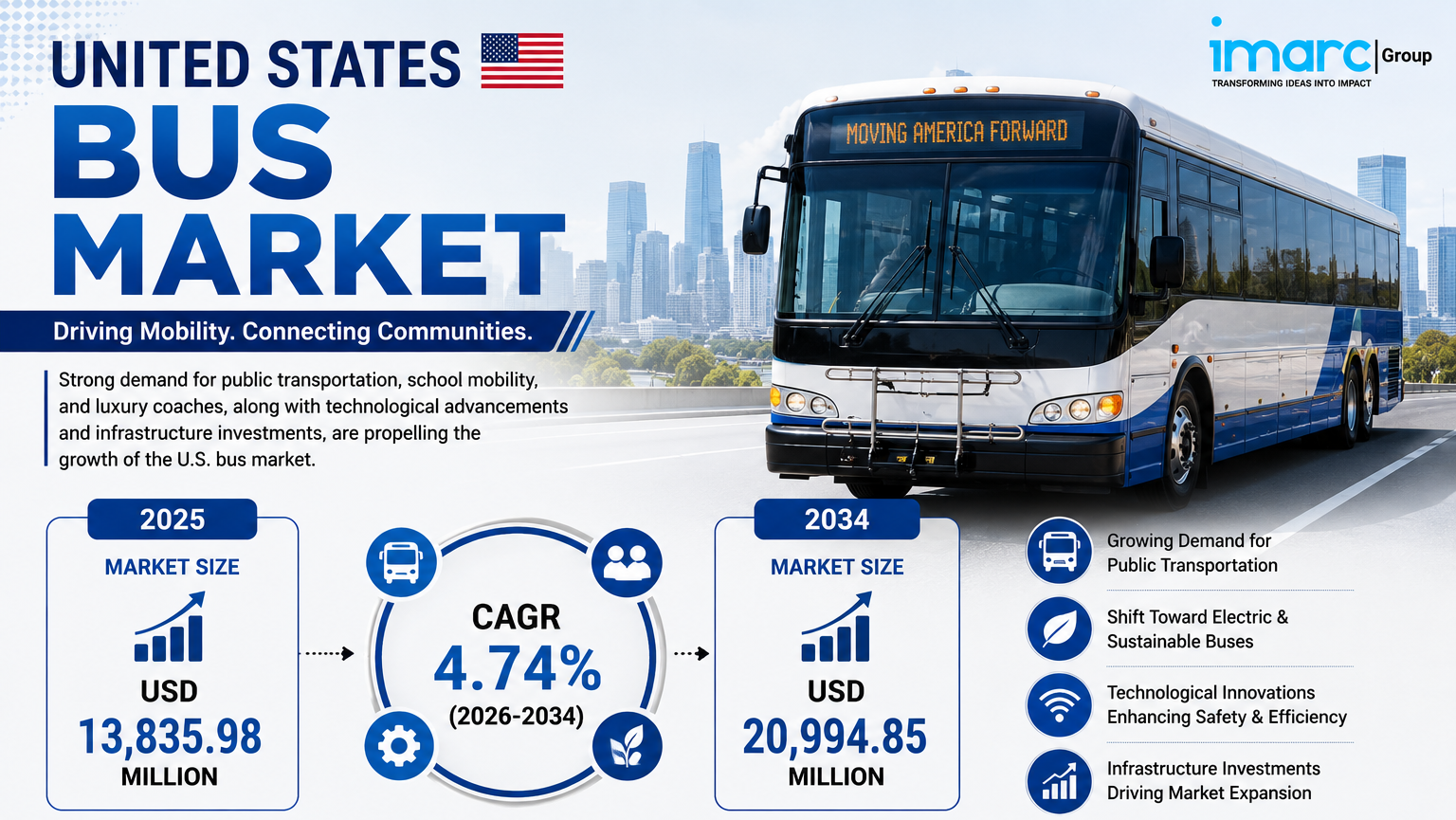
United States Bus Market Size Projected to Reach USD 20,994.85 Million by 2034 with a CAGR of 4.74%

IMARC Group has recently released a new research study titled “United States Bus Market Size, Share, Trends and Forecast by Type, Fuel Type, Seat Capacity, Application, and Region, 2026-2034,” offers a detailed analysis of the market drivers, segmentation, growth opportunities, trends and competitive landscape to understand the current and future market scenarios.
United States Bus Market Size, Growth, and Forecast (2026-2034)
The united states bus market size was valued at USD 13,835.98 Million in 2025 and is projected to reach USD 20,994.85 Million by 2034, growing at a CAGR of 4.74% during 2026-2034. This united states bus market forecast is driven by accelerating fleet electrification initiatives, expanding public transportation infrastructure, and robust federal funding programs supporting zero-emission vehicle adoption.
Rising urbanization patterns and enhanced interstate connectivity requirements propel demand for modern bus configurations across the us buses and coaches market. Technological integration, including advanced driver assistance systems, telematics platforms, and passenger connectivity features, is transforming fleet modernization strategies, while school transportation electrification programs and metropolitan transit system upgrades continue to contribute significantly to overall demand.
In November 2025, the Federal Transit Administration awarded USD 2 Billion to 165 transit systems nationwide to modernize infrastructure and add approximately 2,400 new buses, strengthening service reliability and clean transit efforts, underscoring the scale of public investment shaping the united states bus market forecast through 2034.
Explore Growth Opportunities in the United States Bus Market – Grab Your Sample Report for Evaluation: https://www.imarcgroup.com/united-states-bus-market/requestsample
Key Trends Driving the United States Bus Market
Fleet electrification acceleration and infrastructure development: Transportation agencies are transitioning toward battery-electric and hydrogen fuel cell technologies at unprecedented rates. In 2025, the Central Midlands Regional Transit Authority (The COMET) deployed two battery-electric and two hydrogen fuel cell buses funded by a USD 2.9 Million FTA grant, integrating them into daily service as part of its sustainable transit initiative.
Advanced technology integration and connected fleet management: Modern bus platforms increasingly incorporate telematics systems, AI-driven route optimization, and predictive maintenance capabilities. New York City Transit's bus fleet was recognized with a Special Recognition distinction at the UITP Awards for using AI-powered predictive maintenance across more than 1,500 buses, significantly boosting reliability across the us buses and coaches market.
Sustainable transportation policies and regulatory evolution: In June 2025, California awarded USD 500 Million to 133 educational agencies for 1,000 electric school buses and charging infrastructure under the ZESBI program, prioritizing rural and disadvantaged districts and reinforcing zero-emission procurement across the sector.
United States Bus Market Report Segmentation:
The United States Bus Market report provides a detailed segmentation analysis to help businesses identify key growth segments and evolving industry dynamics. The market is categorized based on type, fuel type, seat capacity, application, and region.
Type Insights:
- Single Deck (92.8% share in 2025): Single deck configurations dominate through exceptional versatility addressing interstate, intercity, and urban transportation requirements, supported by manufacturing economies of scale and accessibility features complying with federal disability requirements.
- Double Deck: Double deck configurations serve niche applications concentrated in high-capacity intercity corridors and premium tourism services, constrained by bridge clearances and maintenance facility limitations.
Fuel Type Insights:
- Diesel (43% share in 2025): Diesel maintains a substantial position leveraging comprehensive refueling infrastructure and proven reliability, with NJ Transit approving a USD 500 Million fleet modernization to purchase 260 clean diesel buses alongside 26 battery-electric buses.
- Electric and Hybrid: Electric and hybrid propulsion continues to gain share as battery technology advances extend operational range and reduce lifecycle costs relative to diesel alternatives.
- Others: Alternative fuel types, including natural gas and biodiesel-compatible systems, serve specific regional and operational requirements across the us buses and coaches market.
Seat Capacity Insights:
- 15-30 Seats: Smaller-capacity buses serve neighborhood routes, corporate shuttles, and low-density corridors requiring flexible, compact solutions.
- 31-50 Seats (55% share in 2025): This range dominates through an optimal balance between operational flexibility and passenger accommodation, favored by school transportation services and suburban feeder routes.
- More than 50 Seats: Larger-capacity buses serve high-volume transit corridors and intercity coach routes requiring maximum passenger throughput.
Application Insights:
- Transit Bus (60% share in 2025): Transit bus applications dominate through metropolitan authority deployments and suburban networks, driven by urban mobility requirements and sustainable transportation mandates.
- Intercity/Coaches: Intercity and coach applications serve regional connectivity and tourism markets, benefiting from highway infrastructure revitalization projects.
- Others: Additional applications include paratransit services providing federally mandated transportation for individuals unable to utilize fixed-route services.
Regional Insights:
- Northeast: Dense urban populations and extensive transit networks, supported by progressive state climate policies, accelerate zero-emission adoption.
- Midwest: The Midwest balances traditional diesel reliance with emerging electrification, supported by manufacturing heritage and expanding federal programs for rural districts.
- South: Robust growth is driven by population expansion and metropolitan development, with natural gas infrastructure and school transportation electrification programs advancing.
- West: The West leads national electrification trends, with California maintaining dominance through ambitious zero-emission mandates and dedicated funding.
United States Bus Market: Recent News and Developments
- October 2025: Miami-Dade County inaugurated the 20-mile Metro Express Bus Rapid Transit system, the longest BRT route in the U.S., featuring all-electric buses, 14 modern stations, dedicated lanes, and real-time arrival displays, supporting sustainable, efficient urban transit and regional mobility.
- November 2025: The Federal Transit Administration awarded USD 2 Billion to 165 transit systems nationwide to modernize infrastructure and add approximately 2,400 new buses, strengthening service reliability and clean transit efforts across the country.
Challenges Impacting the United States Bus Market
High initial capital investment requirements for zero-emission vehicles create immediate budget challenges for transit agencies operating under fiscal constraints, as battery-electric buses typically cost multiples of diesel equivalents.
Range limitations and charging infrastructure constraints, along with supply chain vulnerabilities affecting battery materials and semiconductor components, continue to disrupt production schedules and extend delivery timelines across the us buses and coaches market.
Investment Opportunities in the United States Bus Market
The united states bus market presents compelling investment opportunities supported by its projected growth from USD 13,835.98 Million in 2025 to USD 20,994.85 Million by 2034. Battery-electric and hydrogen fuel cell technologies represent a high-value opportunity as transit agencies and school districts pursue zero-emission fleet transitions.
Charging infrastructure development, fleet management software, and predictive maintenance platforms represent a growing investment frontier. Companies that combine reliable vehicle technology with strong dealer networks and service capabilities can build strong competitive positions across the us buses and coaches market.
Outlook of the United States Bus Market (2026-2034)
The outlook for the united states bus market is positive, supported by sustained federal funding for zero-emission procurement, advancing battery technologies, and metropolitan transit expansion addressing urbanization trends.
The market is projected to grow from USD 13,835.98 Million in 2025 to USD 20,994.85 Million by 2034 at a CAGR of 4.74%, with school transportation modernization and total cost of ownership advantages continuing to shape the united states bus market forecast through 2034.
Key Players in the United States Bus Market
The us buses and coaches market shows moderate competition, with established manufacturers maintaining production and dealer networks, while emerging EV specialists focus on battery-electric technologies, integrated charging solutions, and innovation in compliance and distribution systems. Some of the key players operating in the market include AB Volvo, Blue Bird Corporation, BYD Co. Ltd., Gillig LLC, GreenPower Motor Company Inc., NFI Group Inc., and The Lion Electric Company.
Blue Bird Corporation: A leading U.S. manufacturer of school buses, Blue Bird Corporation continues to expand its zero-emission product lineup, supporting educational institutions transitioning away from diesel fleets under federal Clean School Bus Program funding.
NFI Group Inc.: Through its New Flyer brand, NFI Group Inc. maintains a significant transit bus manufacturing presence in the United States, supplying single-deck transit buses across diverse propulsion types to metropolitan transit authorities nationwide.
Frequently Asked Questions (FAQs): United States Bus Market
1. How big is the United States bus market?
The United States bus market size was valued at USD 13,835.98 Million in 2025.
2. What is the united states bus market forecast for the coming years?
The United States bus market is expected to grow at a CAGR of 4.74% from 2026-2034 to reach USD 20,994.85 Million by 2034.
3. Which type held the largest United States bus market share?
Single deck held the largest market share at 92.8% in 2025, driven by operational versatility, infrastructure compatibility, and manufacturing standardization benefits across the us buses and coaches market.
4. What are the key factors driving market growth?
Key factors include unprecedented federal infrastructure funding supporting fleet modernization, stringent environmental regulations mandating zero-emission adoption, advancing battery technologies, metropolitan transit expansion, and total cost of ownership advantages favoring advanced propulsion systems.
5. Who are the key players in the us buses and coaches market?
Key players include AB Volvo, Blue Bird Corporation, BYD Co. Ltd., Gillig LLC, GreenPower Motor Company Inc., NFI Group Inc., and The Lion Electric Company.
Author IMARC Group
IMARC Group is a global management consulting firm that helps the world's most ambitious changemakers to create a lasting impact. The company provide a comprehensive suite of market entry and expansion services. IMARC offerings include thorough market assessment, feasibility studies, company incorporation assistance, factory setup support, regulatory approvals and licensing navigation, branding, marketing and sales strategies, competitive landscape and benchmarking analyses, pricing and cost research, and procurement research.
Contact Us
IMARC Group,
134 N 4th St. Brooklyn, NY 11249, USA,
Email: [email protected],
United States: +1-201971-6302
