


Molecular Cytogenetics Market Size, Share, Growth Factors, Latest Insights and Forecast 2026-2034
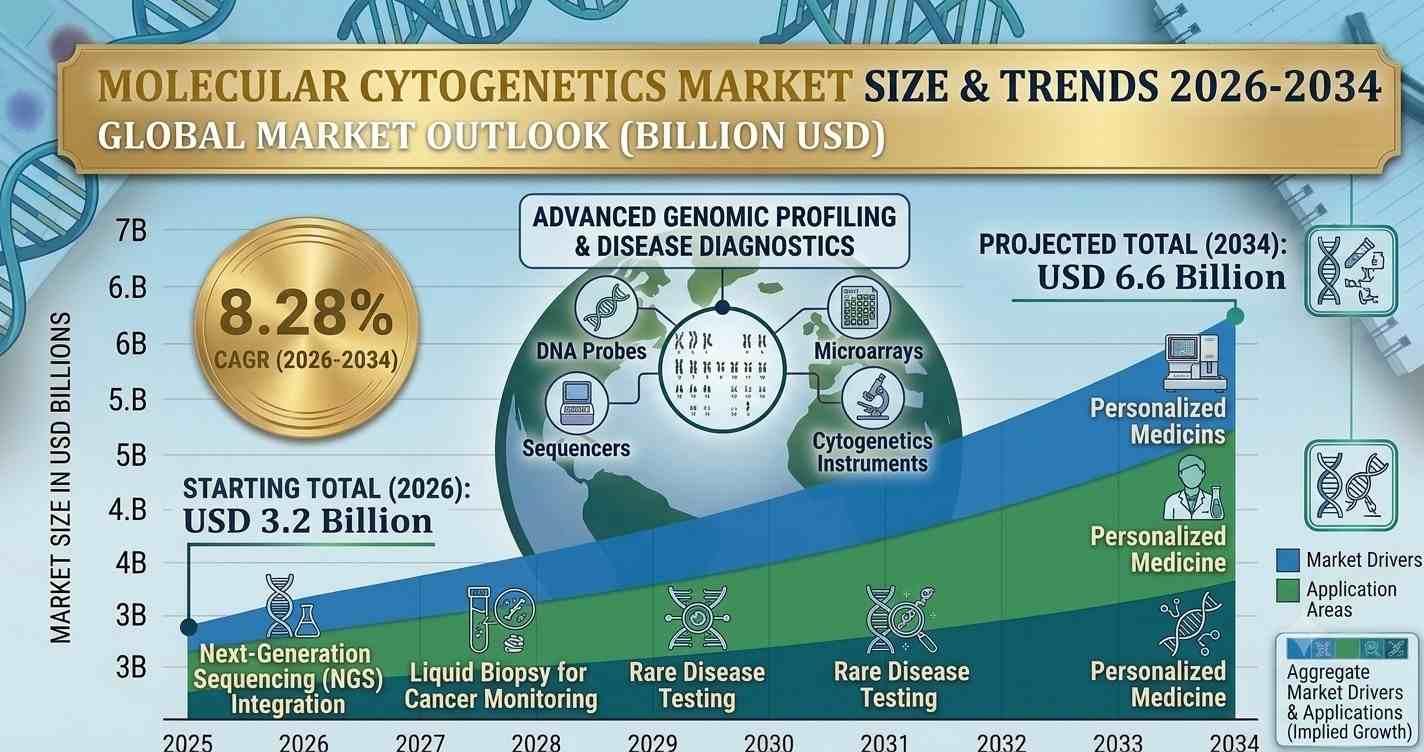
According to IMARC Group, the global Molecular Cytogenetics Market Size reached USD 3.2 Billion in 2025 and is projected to reach USD 6.6 Billion by 2034, expanding at a CAGR of 8.28% during 2026–2034. This strong growth trajectory is underpinned by the increasing prevalence of cancer and genetic disorders, widespread adoption of molecular diagnostics in clinical practice, and continuous technological advancements in cytogenetic instruments, consumables, and software.
Molecular Cytogenetics Industry Overview
Molecular cytogenetics refers to the biomedical research of deoxyribonucleic acid (DNA) mechanisms to investigate genetic mutations and disorders. It studies the structural and functional organization of chromosomes and their nucleus, encompassing genomic variations, expression, evolution, and abnormalities — particularly in medicinal and cancer-related genetics. By using DNA probes to visualize and label the genome or its targeted regions, molecular cytogenetics enables highly accurate identification of chromosomal abnormalities at the molecular level.
Core techniques driving the molecular cytogenetics market analysis include DNA amplification, DNA isolation, gene screening, virtual karyotyping, and Fluorescence In Situ Hybridization (FISH). These methodologies are highly beneficial in the diagnosis and treatment of various malignant tumors, hematological malignancies, and congenital genetic conditions — forming the diagnostic backbone of modern precision oncology and reproductive medicine.
Key technology and product categories shaping the molecular cytogenetics market share include:
• Instruments: Automated imaging systems, fluorescence microscopes, and cytogenetic analysis platforms essential for high-throughput genomic analysis
• Consumables: The largest product type segment — encompassing DNA probes, reagents, kits, microarrays, and hybridization buffers critical for day-to-day molecular cytogenetic testing
• Software and Services: Bioinformatics platforms, image analysis software, and laboratory information management systems enabling accurate interpretation and reporting of cytogenetic data
• Comparative Genomic Hybridization (CGH): The leading technology segment used for whole-genome copy number variation analysis across cancer and genetic disorder applications
• Fluorescence In Situ Hybridization (FISH): A widely adopted technique for detecting chromosomal abnormalities in hematological malignancies and solid tumors
• Karyotyping & Immunohistochemistry: Complementary techniques supporting conventional and molecular chromosomal analysis across clinical and research settings
Global Market Overview & Molecular Cytogenetics Market Statistics
Below are the key molecular cytogenetics market statistics drawn from IMARC Group's comprehensive market analysis:
|
Base Year |
2025 |
|
Historical Period |
2020–2025 |
|
Forecast Period |
2026–2034 |
|
Market Size in 2025 |
USD 3.2 Billion |
|
Market Forecast in 2034 |
USD 6.6 Billion |
|
Market Growth Rate (2026–2034) |
8.28% CAGR |
|
Largest Region |
North America |
|
Leading Product Type |
Consumables (largest segment) |
|
Leading Technology |
Comparative Genomic Hybridization (CGH) |
|
Leading Application |
Oncology (largest market share) |
|
Leading End User |
Clinical and Research Laboratories |
Request for a Sample Report for Detailed Molecular Cytogenetics Market Insights: https://www.imarcgroup.com/molecular-cytogenetics-market/requestsample
Key Market Drivers & Molecular Cytogenetics Market Trends in 2026
Several powerful forces are shaping molecular cytogenetics market growth and driving expansion across global healthcare and life sciences markets:
1. Rising Prevalence of Cancer and Genetic Disorders
The increasing global burden of cancer and hereditary genetic conditions is a primary catalyst for molecular cytogenetics market growth. Cancer remains one of the leading causes of mortality worldwide, with the WHO reporting millions of new cases annually across oncology sub-types including hematological malignancies, breast cancer, lung cancer, and colorectal cancer. Molecular cytogenetics techniques — particularly FISH and CGH — are pivotal in identifying chromosomal abnormalities, gene fusions, and copy number variations that drive cancer progression. This growing oncology demand is a defining molecular cytogenetics market trend, reinforcing sustained investment in cytogenetic instrumentation, consumables, and specialized laboratory services.
2. Growing Adoption for Developing Predictive Disease Models and Targeted Therapies
Molecular cytogenetics is increasingly being used to develop predictive models of disease traits and guide the development of effective targeted treatment strategies. FISH and Comparative Genomic Hybridization (CGH) are widely employed for pharmacogenomic biomarker studies to analyze cancer progression stages and deliver personalized treatment protocols. The ability to identify specific chromosomal targets for therapeutic intervention is accelerating the integration of molecular cytogenetics into oncology drug development pipelines — representing a key molecular cytogenetics market trend that is reshaping both diagnostics and treatment paradigms across precision medicine.
3. Technological Advancements in Instruments, Consumables, and Software
Continuous innovation across cytogenetic technologies is a major growth driver in the molecular cytogenetics market analysis. Developments in improved consumables, reagents, software platforms, and diagnostic kits are enabling more accurate, reproducible, and reliable clinical-pathological test results. Advanced cytogenetic imaging systems with automated analysis capabilities, next-generation array CGH platforms, and sophisticated bioinformatics tools for variant interpretation are significantly expanding the clinical utility and throughput of molecular cytogenetics laboratories — enhancing the overall molecular cytogenetics market share of technology-driven players.
4. Expanding Geriatric Population Driving Genetic Disorder Diagnosis
The growing global elderly population is a significant structural driver for the molecular cytogenetics market. Age-related genetic disorders — including various forms of dementia, chromosomal instability syndromes, and late-onset hereditary conditions — are increasingly prevalent among older individuals. As life expectancy rises, the demand for comprehensive genetic profiling and chromosomal analysis expands correspondingly. Healthcare systems worldwide are scaling up geriatric genomic diagnostic capabilities, amplifying demand for molecular cytogenetics techniques and creating new growth opportunities across clinical laboratory and hospital end-user segments.
5. Improvements in Healthcare Infrastructure and R&D Investments
Significant improvements in global healthcare infrastructure — combined with extensive research and development (R&D) activities in biomedical sciences — are driving molecular cytogenetics market growth across both developed and emerging regions. Governments, academic research institutions, and private sector organizations are channeling increasing resources into genomic research programs, clinical diagnostic laboratories, and precision medicine initiatives. New hospital construction, expansion of pathology and cytogenetics laboratory capabilities, and growing clinical research activity are creating robust demand for advanced molecular cytogenetics instruments and consumables.
6. Integration with Personalized Medicine and Next-Generation Sequencing
The convergence of molecular cytogenetics with next-generation sequencing (NGS) and personalized medicine is one of the most transformative molecular cytogenetics market trends shaping the industry's future. Integrated diagnostic approaches — combining traditional karyotyping with NGS-based chromosomal microarray analysis and liquid biopsy platforms — are expanding diagnostic resolution and enabling earlier, more accurate detection of genetic abnormalities. Personalized medicine initiatives in oncology, reproductive genetics, and rare disease diagnosis are accelerating adoption of advanced molecular cytogenetics workflows in both clinical and pharmaceutical research settings.
Key Market Segmentation
By Product Type
Consumables — Largest Segment
Consumables represent the largest product type segment within the molecular cytogenetics market share landscape, driven by their recurring, high-volume utilization across every diagnostic and research workflow. DNA probes, hybridization reagents, microarray kits, culture media, and staining buffers are consumed continuously across clinical and research laboratories — generating predictable, high-frequency revenue streams for reagent and consumable manufacturers. The growing throughput of cytogenetics laboratories and the expanding test menu across oncology, prenatal diagnosis, and rare genetic disease applications are reinforcing consumables' market leadership.
Instruments
Advanced cytogenetics instruments — including fluorescence microscopy systems, automated imaging platforms, array scanners, and flow cytometers — represent a significant and growing product type segment. Equipment upgrades driven by technological innovation and the adoption of digital pathology workflows are stimulating capital expenditure cycles across hospital and clinical laboratory segments.
Software and Services
Bioinformatics software, image analysis platforms, and laboratory information management systems (LIMS) are fast-growing segments as laboratories digitize and automate cytogenetic analysis workflows. Regulatory requirements for audit trails, data integrity, and clinical reporting are accelerating software adoption across both clinical and pharmaceutical end-user segments.
By Technology
Comparative Genomic Hybridization (CGH) — Leading Technology
Comparative Genomic Hybridization currently exhibits the clearest dominance in the molecular cytogenetics market share by technology. CGH and its array-based variant (aCGH) enable comprehensive, whole-genome copy number variation analysis without requiring prior knowledge of target chromosomal regions — making it the preferred technology for cancer genomics, prenatal diagnosis, and rare genetic disorder identification. Its ability to detect gains and losses across the entire genome simultaneously at high resolution positions CGH as the backbone of modern molecular cytogenetics diagnostics.
Fluorescence In Situ Hybridization (FISH)
FISH remains a cornerstone technology in hematological oncology diagnostics — widely adopted for detecting chromosomal translocations, gene amplifications, and deletions in conditions such as chronic myelogenous leukemia (CML), acute lymphoblastic leukemia (ALL), and multiple myeloma. Its targeted, single-probe sensitivity and compatibility with routine pathology workflows sustain strong ongoing demand across hospital pathology laboratories.
Karyotyping & Immunohistochemistry
Conventional karyotyping remains clinically significant for constitutional cytogenetics — particularly in prenatal diagnosis and developmental delay evaluation. Immunohistochemistry complements molecular techniques in tissue-based cancer diagnosis, protein expression profiling, and biomarker validation — bridging molecular cytogenetics with traditional histopathology workflows.
By Application
Oncology — Largest Application Segment
Oncology represents the leading application segment in the molecular cytogenetics market, accounting for the majority of global market share. The growing prevalence of hematological malignancies, solid tumors, and rare cancers — combined with the critical role of chromosomal analysis in cancer subtyping, prognostication, and targeted therapy selection — ensures sustained demand for molecular cytogenetics across the oncology care pathway. Companion diagnostic applications linking specific chromosomal biomarkers to targeted drug eligibility represent a high-growth frontier driving expanded oncology molecular cytogenetics utilization.
Genetic Disorders
Genetic disorders represent a major application segment encompassing constitutional chromosomal abnormalities including Down syndrome, Turner syndrome, and other aneuploidies — as well as rare hereditary conditions requiring molecular characterization. Prenatal cytogenetics, neonatal screening, and carrier testing programs are expanding access and volume of genetic disorder-related cytogenetic testing globally.
Personalized Medicine
Personalized medicine applications represent a rapidly growing frontier for molecular cytogenetics, as genomic profiling becomes central to treatment selection, drug response prediction, and clinical trial eligibility determination. The integration of molecular cytogenetics into tumor molecular profiling panels and pharmacogenomics programs is expanding this application segment's contribution to overall market share.
By End User
Clinical and Research Laboratories — Largest End User
Clinical and research laboratories hold the largest end-user share in the molecular cytogenetics market, driven by their central role as the primary sites for diagnostic testing and biomedical research. Reference laboratories, academic medical centers, and specialized cytogenetics core facilities collectively process the highest volumes of chromosomal analysis, gene expression profiling, and oncology molecular diagnostic tests. Growing demand for outsourced specialized diagnostic testing is further reinforcing clinical laboratory dominance across the end-user landscape.
Hospitals and Pathology Laboratories
Hospitals and pathology laboratories represent a significant and growing end-user segment — particularly as integrated cancer center models expand and hospital-based molecular pathology services mature. In-house cytogenetics capabilities within large academic medical centers and comprehensive cancer centers are being upgraded with advanced array CGH, FISH, and NGS-integrated workflows, contributing meaningfully to molecular cytogenetics market growth in this segment.
Pharmaceutical and Biotechnology Companies
Pharmaceutical and biotechnology companies represent a high-value end-user segment, utilizing molecular cytogenetics for drug development — including target identification, biomarker qualification, companion diagnostic development, and clinical trial patient stratification. Growing pipeline activity in oncology, rare disease, and gene therapy is amplifying demand for molecular cytogenetics services within pharma and biotech organizations.
Regional Market Analysis
|
Region |
Key Highlights |
|
North America — Largest |
United States & Canada; dominant molecular cytogenetics market share globally; advanced genomic research infrastructure, high concentration of leading industry players, substantial NIH and NCI funding for cancer genomics and precision medicine initiatives; strong FDA regulatory framework for cytogenetic diagnostic devices and companion diagnostics. |
|
Europe |
Germany, France, UK, Italy, Spain, Russia; second-largest market; robust clinical cytogenetics tradition; EU Horizon funding for genomic medicine research; growing adoption of array CGH in prenatal and oncology diagnostics; expanding rare disease genomics programs under European Reference Networks (ERNs). |
|
Asia Pacific |
China, Japan, India, South Korea, Australia, Indonesia; fastest-growing regional market; rising cancer incidence and expanding genetic testing infrastructure; growing government investment in precision medicine; increasing clinical trial activity in oncology driving demand for molecular biomarker testing; growing domestic cytogenetics reagent and equipment manufacturing in China. |
|
Latin America |
Brazil, Mexico; Brazil leads LatAm molecular cytogenetics market driven by expanding oncology programs, rising government healthcare investment, and growing private diagnostic laboratory sector; increasing adoption of molecular diagnostic technologies in reference laboratory networks. |
|
Middle East & Africa |
UAE, Saudi Arabia, South Africa; growing molecular diagnostics investment as part of broader healthcare modernization programs; rising cancer awareness and screening initiatives; increasing foreign direct investment in hospital and clinical laboratory infrastructure stimulating molecular cytogenetics equipment demand. |
Connect for Detailed Segmentation Analysis – Speak to an Analyst: https://www.imarcgroup.com/request?type=report&id=2623&flag=C
Leading Players in the Molecular Cytogenetics Industry
The global molecular cytogenetics market features established life sciences conglomerates alongside specialized genomic technology companies and diagnostic reagent manufacturers. Key companies profiled in the IMARC Group report include:
• Abbott Laboratories
• Agilent Technologies Inc.
• Applied Spectral Imaging Inc.
• Biological Industries
• Bio-Rad Laboratories Inc.
• BioView Inc.
• Danaher Corporation
• F. Hoffmann-La Roche AG
• Illumina Inc.
• Oxford Gene Technology
• PerkinElmer Inc.
• Quest Diagnostics Incorporated
Key players are actively engaged in R&D investments, technology platform expansions, strategic acquisitions, and clinical partnership programs to advance their molecular cytogenetics portfolios and capture growing market share across oncology diagnostics, genetic disorder testing, and personalized medicine applications.
Latest Industry Developments
Illumina – Ongoing Expansion: Illumina continues to expand its next-generation sequencing platform capabilities with integrations targeting chromosomal microarray analysis and whole-genome copy number profiling — driving convergence between NGS and traditional molecular cytogenetics workflows across clinical laboratory and research settings globally.
Agilent Technologies – Array CGH Platform Advances: Agilent Technologies has consistently upgraded its SurePrint CGH microarray platforms with enhanced probe designs, improved sensitivity, and expanded bioinformatics capabilities — reinforcing its competitive position in the comparative genomic hybridization segment of the molecular cytogenetics market.
Danaher Corporation – Integrated Genomics Strategy: Danaher continues to leverage its portfolio of life sciences companies — including Leica Biosystems and Beckman Coulter — to offer integrated molecular cytogenetics and pathology workflow solutions spanning instruments, reagents, imaging systems, and laboratory automation, targeting comprehensive clinical laboratory partnerships.
About Us
IMARC Group is a leading global market research company providing data-driven insights and expert consulting services to businesses seeking to achieve their strategic objectives. With a multi-disciplinary team of industry experts, IMARC delivers thorough, reliable market intelligence across sectors including Healthcare, Technology, Chemicals and Materials, Agriculture, Food & Beverages, and more.
Contact Us
IMARC Group
United States: +1-201-971-6302
India: +91-120-433-0800
United Kingdom: +44-753-714-6104
Email: [email protected]

 Bangla