

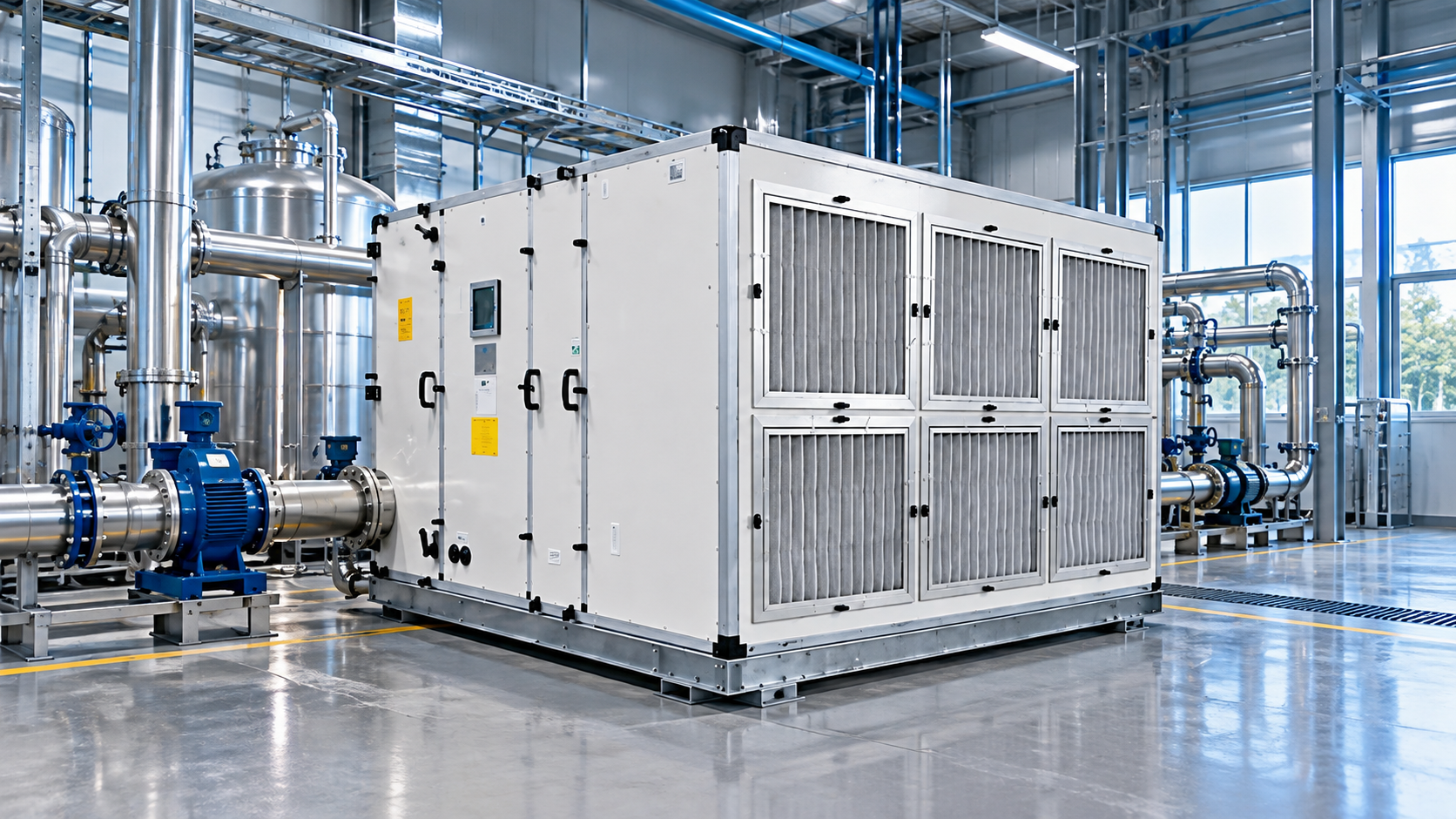

A production line doesn't stop because of a machine failure. It stops because the water got warm. That's the reality behind most unplanned downtime in Indian manufacturing plants, and it's why chillers matter more than most procurement teams admit until the day their process temperature drifts three degrees and a whole batch is scrapped. Chillers aren't a support system. They're the thing keeping your core process alive. Buyers treat them like a line item on a purchase order. Plant managers treat them like the reason they still have a job. Aquatech Plus has spent years sitting between both groups, and the gap between what a spec sheet promises and what a factory floor needs is where most bad purchases happen.
The Spec Detail Most Buyers Skip
There are two main families of chillers to decide between, air-cooled or water-cooled. However, this isn‘t simply an assessment between being cooler in the room.
Air-Cooled Chillers
Suited to plants without a dedicated cooling tower or where water availability is restricted. Lower installation complexity, higher energy draw in peak summer months.
Water-Cooled Chillers
Improved efficiency in large scale, typical for pharma, chemical and big food processing installations. Requires a cooling tower and water treatment plan, which is however the part most offers won‘t include as standard.
Here's the detail buyers skip: condenser fouling rate. A chiller rated at 50 TR loses real capacity within 8–14 months if the water treatment isn't matched to the local water hardness. Nobody asks about this at the negotiation table. Everybody asks about it during the first monsoon season.
Benefits That Actually Protect Your Margin
-
Lower energy cost per ton of refrigeration — a properly sized chiller cuts kWh/TR by roughly 15–20% versus an oversized unit running at partial load.
-
Fewer unplanned shutdowns — matched capacity and load profiling reduce compressor cycling stress.
-
Extended compressor life — proper water treatment alone can add 3–4 years to service life.
-
Predictable maintenance spend — AMC contracts with fixed SLAs remove the guesswork from annual budgeting.
-
Compliance readiness — pharma and food buyers need documented temperature logs; a well-integrated chiller system makes audits faster, not scarier.
-
Resale and scrap value — a chiller maintained on schedule holds resale value; a neglected one becomes landfill in under a decade.
None of this is about "quality." It's about what breaks your P&L and what protects it.
Why Location is a supply chain decision, and not simply an address
Being based in India isn't a footnote — it changes your spare parts timeline. When a compressor fails on a chiller sourced from an overseas chiller exporter, the replacement part can sit in customs for weeks. As chiller manufacturers in India, we hold critical spares — control boards, expansion valves, compressor kits — in regional stock, which is the actual difference between a 2-day fix and a 3-week production freeze.
We work across India's major industrial belts, which matters more in this sector than most buyers realize, because commissioning support for a 200 TR turnkey chiller plant isn't something you outsource to a courier. As one of the established chiller dealers in India, we've also seen the cost of skipping local support — buyers who go with the cheapest overseas chiller suppliers often end up paying more in downtime than they saved on the invoice.
About Us
We've been building industrial cooling and water treatment systems since 2013. We're not a trading company that added chillers to a catalog — we design, fabricate, and commission the systems ourselves, and our engineers are the ones who show up when something goes wrong at 2 a.m. during a summer production run. We stopped recommending a particular gasket material in 2019 after two clients in coastal plants reported early corrosion; we switched suppliers within that quarter. That's the kind of correction you only make when you're the one who has to answer the phone when a client's line goes down.
Conclusion
Chillers aren't a commodity purchase, even when they're priced like one. The plants that treat sourcing seriously — checking manufacturing depth, water treatment compatibility, and local spares support — are the ones that avoid the summer shutdown everyone else scrambles through. That's the difference between buying a chiller and buying uptime.
FAQs
What's the difference between a chiller manufacturer and a chiller dealer?
‘Manufacturer’ refers to the company who designed and built the unit; while a ‘dealer’ is simply a reseller who is selling a build designed by someone else with little or no technical support. Your supplier won‘t be able to answer many questions about the compressor make, or the refrigerant circuit layout, if he‘s a dealer.
How long does a turnkey chiller plant installation take?
For a standard 100–150 TR system, 6 to 10 weeks from approved drawing to commissioning, assuming site readiness. Larger custom systems from a chiller turnkey contractor can run 4–5 months — and yes, that's longer than most buyers expect.
Do chiller exporters in India offer international compliance certification?
Reputable ones do, but not automatically — you have to ask for it and specify the destination country's standard upfront. We've seen shipments held at port because the buyer assumed CE marking was included by default. It wasn't.
What water treatment is required alongside a chiller?
At minimum, a side-stream filtration and chemical dosing system to control scale and biological growth in the condenser loop. Skipping this is the single biggest cause of early capacity loss we see in the field.
Are Aquatech Plus chiller machine manufacturers or just system integrators?
Both — we manufacture the core units and also integrate them into full water treatment and cooling systems for clients who need a single point of accountability.
