

Companion Diagnostics Market Size, Share, Latest Insights and Forecast 2026-2034

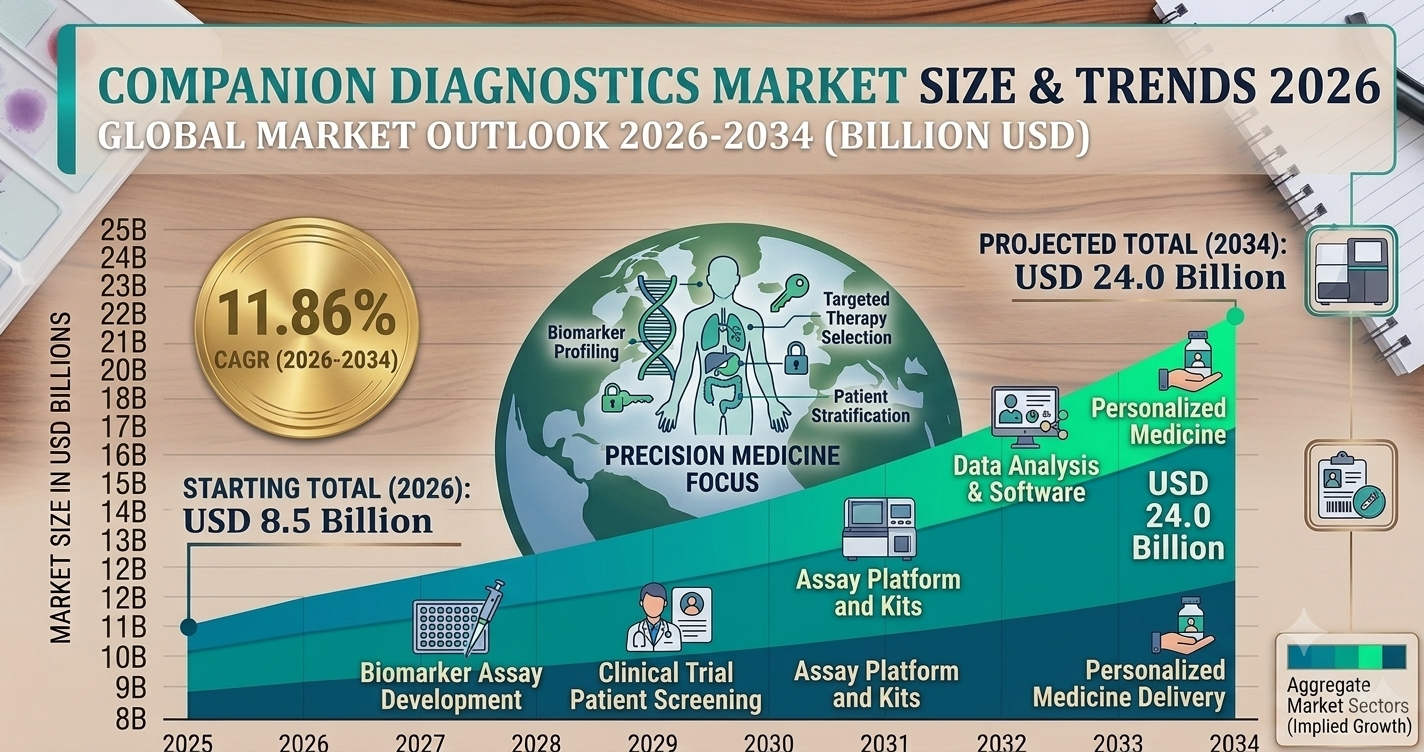
According to IMARC Group, the global companion diagnostics market size reached USD 8.5 Billion in 2025 and is projected to reach USD 24.0 Billion by 2034, expanding at a CAGR of 11.86% during 2026–2034. This robust companion diagnostics market growth trajectory reflects the rising global cancer burden, accelerating adoption of personalized medicine, continuous advances in next-generation sequencing (NGS), and deepening collaboration between pharmaceutical developers and diagnostic manufacturers.
Companion Diagnostics Industry Overview
A companion diagnostic is a medical test that provides information essential to the safe and effective use of a corresponding drug or biological product. Rather than functioning as a standalone laboratory tool, it is developed and validated alongside a specific therapy, helping clinicians confirm the presence of a biomarker, genetic mutation, or protein expression pattern before treatment begins. This tight linkage between diagnosis and therapy is what distinguishes companion diagnostics from conventional laboratory testing.
Companion diagnostics are deployed across a broad continuum of clinical use cases:
- Oncology treatment selection: Identifying actionable mutations and biomarkers in lung, breast, colorectal, gastric, and other cancers to match patients with targeted therapies
- Neurological and cardiovascular applications: Supporting biomarker-guided treatment decisions as precision medicine expands into new therapeutic areas beyond oncology
- Drug development and clinical trials: Enabling pharmaceutical companies to stratify trial populations and demonstrate therapeutic efficacy within biomarker-defined subgroups
- Gene therapy enablement: Screening patients for pre-existing antibodies or genetic markers that determine eligibility for advanced gene therapies
- Infectious disease management: Guiding treatment protocols where pathogen-specific markers influence therapeutic response
Global Companion Diagnostics Market Size & Key Statistics
Below are the key companion diagnostics market statistics drawn from IMARC Group's comprehensive market analysis:
|
Report Attribute |
Key Statistics |
|
Base Year |
2025 |
|
Historical Period |
2020–2025 |
|
Forecast Period |
2026–2034 |
|
Companion Diagnostics Market Size in 2025 |
USD 8.5 Billion |
|
Market Forecast in 2034 |
USD 24.0 Billion |
|
Market Growth Rate (2026–2034) |
11.86% CAGR |
|
Largest Region |
North America |
|
Leading Technology Segment |
Polymerase Chain Reaction (PCR) |
|
Leading Product & Service Segment |
Assays, Kits and Reagents |
|
Leading Indication |
Cancer |
|
Leading End-Use Segment |
Pharmaceutical & Biopharmaceutical Companies |
Request for a Sample Report for Detailed Companion Diagnostics Market Share Evaluation: https://www.imarcgroup.com/companion-diagnostics-market/requestsample
Key Market Drivers & Companion Diagnostics Market Trends in 2025
Several powerful forces are shaping companion diagnostics market Trends and fuelling sustained growth expectations across global oncology and precision-medicine markets:
- Advancements in Gene Therapy and Rare Disease Diagnostics
The growing use of gene therapies for genetic disorders is fuelling demand for diagnostic tools that confirm safe and effective treatment eligibility. Companion diagnostics play a central role in identifying which patients qualify for gene therapy, particularly in rare disorders where outcomes hinge on specific biomarkers. Regulatory approvals for assays tied to gene-therapy products, such as tests confirming the absence of pre-existing antibodies, illustrate how central these diagnostics have become to advanced treatment rollout.
- Integration of Artificial Intelligence in Diagnostics
AI-powered tools are improving the speed, accuracy, and consistency of biomarker detection by analyzing large genetic and clinical datasets. These algorithms help forecast patient response to specific therapies and support more precise patient selection for clinical trials, particularly in oncology. Strategic collaborations between diagnostics companies and AI specialists are accelerating the pace at which these capabilities reach clinical use.
- Rising Healthcare Investment in Precision Medicine
Healthcare systems worldwide are channeling greater investment into personalized and precision medicine, an area in which companion diagnostics play a foundational role. By helping clinicians identify the most effective therapy for a given patient, these tests reduce trial-and-error prescribing and support value-based care models that tie reimbursement to outcomes rather than treatment volume, reinforcing Companion Diagnostics Market Growth.
- Rising Aging Population and Chronic Disease Burden
The expanding global population of older adults is driving up the prevalence of cancer, cardiovascular disease, and neurological conditions that benefit from genetically guided treatment. As the elderly population climbs worldwide, demand for diagnostic tools that tailor therapy to individual genetic profiles continues to strengthen.
- Strategic Partnerships Between Diagnostics and Pharmaceutical Companies
Collaborations between diagnostic manufacturers and pharmaceutical developers are accelerating the creation of end-to-end companion diagnostic solutions, from exploratory biomarker panels through FDA-approved test kits. These partnerships combine drug-development expertise with diagnostic technology to speed regulatory clearance and broaden access to personalized treatment options.
- Improving Regulatory Pathways for Diagnostic Approval
Regulatory authorities are streamlining approval frameworks for companion diagnostics in recognition of their essential role in precision medicine. Clearer guidelines and faster review timelines are encouraging innovation and giving diagnostics developers more defined routes to market, further supporting the overall Companion Diagnostics Market Analysis.
Key Market Segmentation
IMARC Group provides an analysis of the key trends in each sub-segment of the global companion diagnostics market, along with forecasts at the global, regional, and country level from 2026–2034. The report categorizes the market based on product & service, technology, indication, end user, and region.
By Product & Service
Assays, Kits and Reagents – Largest Segment: These consumables are essential for identifying the genetic biomarkers, protein expression patterns, and mutations that determine treatment eligibility. Because every diagnostic run requires a fresh set of reagents, this segment benefits from recurring, volume-driven demand across clinical and research settings, particularly in oncology.
Software and Services: This segment covers data-analysis platforms, bioinformatics support, and managed services that help laboratories interpret complex genomic and biomarker data alongside their diagnostic workflows.
By Technology
Polymerase Chain Reaction (PCR) – Largest Segment: PCR's sensitivity and its ability to amplify minute quantities of DNA or RNA make it the leading technology for detecting genetic mutations and biomarkers linked to disease, especially cancer. Its accessibility and well-established clinical validation reinforce its dominance in this Companion Diagnostics Market Analysis.
Immunohistochemistry (IHC): A widely used technique for visualizing protein expression directly in tissue samples, particularly relevant for confirming biomarker status ahead of targeted cancer therapy.
In-situ Hybridization (ISH) and Real-time PCR (RT-PCR): These techniques support gene amplification and expression analysis, often used alongside IHC and PCR for confirmatory testing.
Gene Sequencing and Others: Next-generation sequencing (NGS) platforms are expanding the scope of companion diagnostics by enabling broader, multi-gene panels rather than single-biomarker tests.
By Indication
Cancer – Largest Segment: Lung, breast, colorectal, gastric, melanoma, and other cancers collectively account for the majority of companion diagnostics demand, driven by the growing use of targeted oncology therapies and continuous new product approvals aligned with specific tumor biomarkers.
Neurological Diseases, Infectious Diseases, and Cardiovascular Diseases: Companion diagnostics are steadily expanding into these areas as biomarker-guided treatment approaches gain traction beyond oncology.
By End User
Pharmaceutical & Biopharmaceutical Companies – Largest Segment: These companies rely on companion diagnostics throughout drug development to ensure their therapies are matched to the right patient populations, supporting more tailored, efficient, and safer treatment outcomes.
Reference Laboratories: Centralized laboratories performing high-volume biomarker testing on behalf of hospitals and clinics.
Contract Research Organizations: CROs supporting biomarker validation and trial-stage diagnostic development on behalf of pharmaceutical sponsors.
Others: Includes academic and specialty research settings engaged in companion diagnostic innovation.
By Region
- North America – United States, Canada
- Asia-Pacific – China, Japan, India, South Korea, Australia, Indonesia, Others
- Europe – Germany, France, United Kingdom, Italy, Spain, Russia, Others
- Latin America – Brazil, Mexico, Others
- Middle East and Africa
Regional Companion Diagnostics Market Analysis
North America and Asia-Pacific represent the most significant regional dynamics shaping the global Companion Diagnostics Market Share:
|
Region |
Key Highlights |
|
North America |
United States and Canada; advanced healthcare infrastructure, high adoption of personalized medicine, strong regulatory support, and a dense concentration of biotechnology and pharmaceutical companies driving demand |
|
Europe |
Germany, France, UK, Italy, Spain, Russia; growing adoption of biomarker-guided therapy, an evolving IVDR regulatory framework, and strong pharmaceutical R&D activity |
|
Asia-Pacific |
China, Japan, India, South Korea, Australia, Indonesia; expanding healthcare infrastructure, rising cancer incidence, and growing regulatory support for precision diagnostics |
|
Latin America |
Brazil, Mexico; expanding private healthcare investment and growing adoption of targeted cancer therapies |
|
Middle East and Africa |
Healthcare modernization initiatives and rising investment in oncology diagnostics infrastructure |
North America leads the global Companion Diagnostics Market Share, anchored by the United States' advanced clinical and research infrastructure, high adoption of personalized medicine, and the presence of leading diagnostic manufacturers. Asia-Pacific represents the fastest-growing regional market, supported by expanding healthcare access, rising cancer prevalence, and growing government focus on precision medicine across China, Japan, and India.
Connect for Detailed Companion Diagnostics Market Share Segmentation Analysis – Speak to an Analyst: https://www.imarcgroup.com/request?type=report&id=2548&flag=C
Leading Players in the Global Companion Diagnostics Industry
The competitive landscape of the companion diagnostics industry features a mix of diversified diagnostics multinationals and specialized biomarker-testing innovators. Key companies covered in the IMARC Group report include:
- Abbott Laboratories
- Agilent Technologies
- BioMerieux
- Danaher Corporation
- Roche Holding AG
- Myriad Genetics Inc.
- Siemens Healthcare
- Thermo Fisher Scientific Inc.
Latest Companion Diagnostics Market Industry Developments
July 2025 – Thermo Fisher Scientific
Thermo Fisher Scientific announced FDA approval of its Oncomine Dx Express Test for use as a companion diagnostic alongside a non-small cell lung cancer therapy, helping identify patients with EGFR exon 20 insertion mutations. Delivering genomic results within 24 hours, the approval supports faster, more decentralized tumor profiling in clinical settings.
May 2025 – Roche
Roche received FDA approval for its VENTANA MET (SP44) RxDx Assay, the first companion diagnostic designed to identify non-squamous non-small cell lung cancer patients eligible for a MET-targeted therapy. The assay detects MET protein expression, supporting more customized treatment decisions for advanced lung cancer patients.
May 2025 – NeoGenomics
NeoGenomics launched a c-MET companion diagnostic assay for advanced non-small cell lung cancer, offering a 48-hour turnaround for detecting c-Met protein overexpression to guide treatment decisions, including eligibility for newly approved targeted therapies.
March 2025 – Agilent Technologies
Agilent Technologies announced that its PD-L1 IHC 28-8 pharmDx kit received EU IVDR certification for use as a companion diagnostic test in early-stage non-small cell lung cancer and untreated advanced melanoma, expanding the kit's indications across nine cancer types in Europe.
Report Coverage
|
Report Features |
Details |
|
Base Year of the Analysis |
2025 |
|
Historical Period |
2020–2025 |
|
Forecast Period |
2026–2034 |
|
Units |
Billion USD |
|
Segment Coverage |
Product & Service, Technology, Indication, End User, Region |
|
Region Covered |
Asia Pacific, Europe, North America, Latin America, Middle East and Africa |
|
Countries Covered |
United States, Canada, Germany, France, United Kingdom, Italy, Spain, Russia, China, Japan, India, South Korea, Australia, Indonesia, Brazil, Mexico |
|
Companies Covered |
Abbott Laboratories, Agilent Technologies, BioMerieux, Danaher Corporation, Roche Holding AG, Myriad Genetics Inc., Siemens Healthcare and Thermo Fisher Scientific Inc. |
|
Customization Scope |
10% Free Customization |
|
Post-Sale Analyst Support |
10-12 Weeks |
|
Delivery Format |
PDF and Excel through Email |
About Us
IMARC Group is a leading global market research company providing data-driven insights and expert consulting services to businesses seeking to achieve their strategic objectives. With a multi-disciplinary team of industry experts, IMARC delivers thorough, reliable market intelligence across sectors including Healthcare, Technology, Chemicals, Energy, Food & Beverages, and more.
Contact Us
IMARC Group
United States: +1-201-971-6302
India: +91-120-433-0800
United Kingdom: +44-753-714-6104
