

The Plant Selection Problem Starts Before the Quotation
A steel, glass, chemical, paper, or wastewater facility rarely has an oxygen problem until the supply becomes unreliable. A delayed tanker, rising cylinder logistics, or an undersized generator can turn a routine production day into an expensive interruption.
That is why selecting a VPSA oxygen generation system should begin with oxygen demand—not with a catalogue or the lowest quotation.
Specification: What Actually Defines a VPSA Plant?
How the separation cycle works
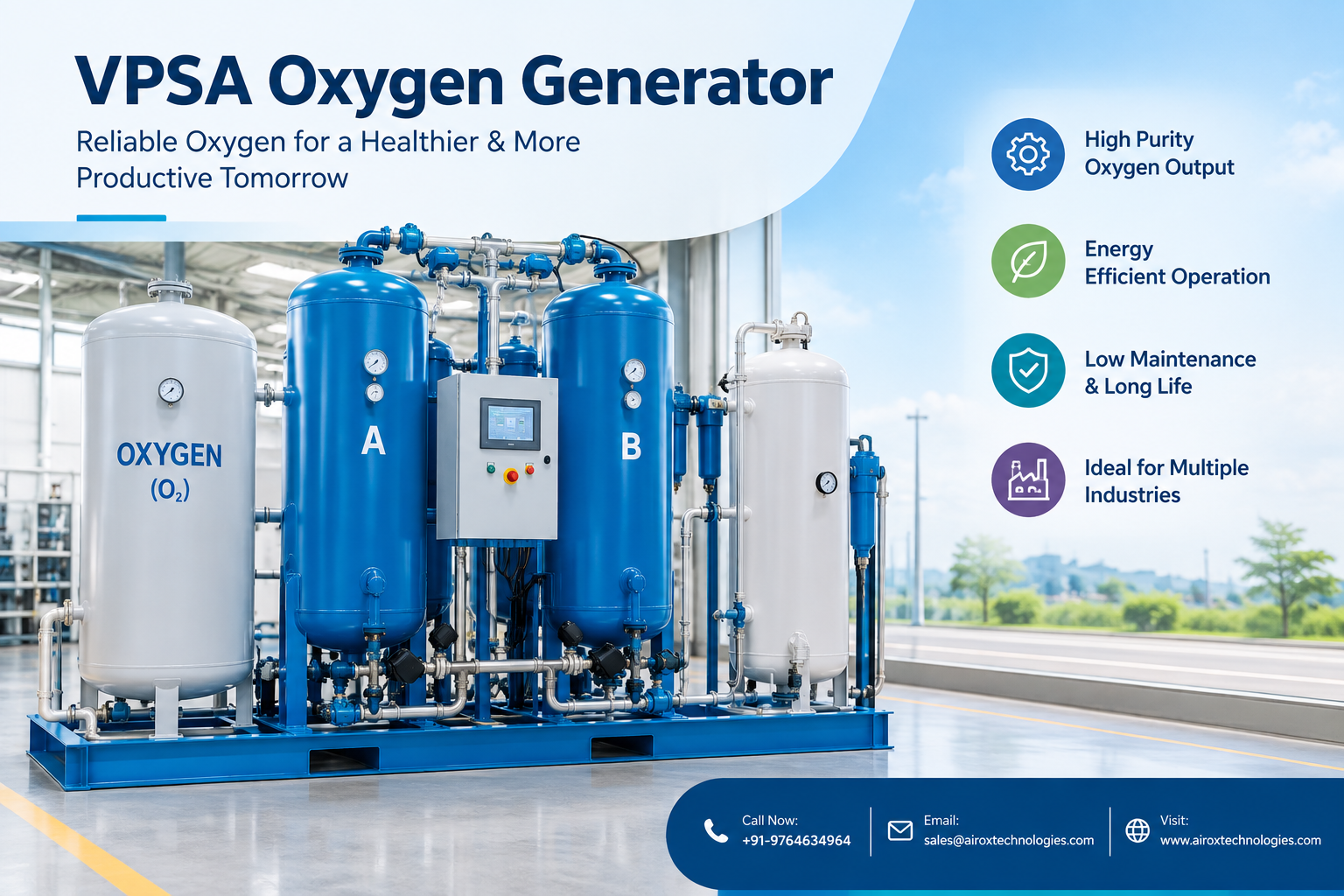
A typical VPSA cycle alternates between adsorption and regeneration. Ambient air enters the system, nitrogen and other components are preferentially adsorbed, and an oxygen-rich stream leaves the adsorption vessel. The saturated bed is then regenerated under vacuum before returning to production.
That cycling is what allows continuous oxygen production from multiple adsorption vessels operating in sequence. Linde describes VPSA as a periodic adsorption process in which pressurized air is fed to the adsorbent and vacuum is subsequently used for regeneration.
The specifications buyers should put on paper
For an industrial project, the basic specification should include:
-
Required oxygen flow in Nm³/hr
-
Required oxygen purity
-
Delivery pressure
-
Expected operating hours
-
Minimum and maximum operating load
-
Power consumption
-
Cooling arrangement
-
Control and monitoring system
-
Installation configuration
-
Site conditions and available utilities
Airox's current VPSA product page lists systems up to 5,000 Nm³/hr, oxygen purity up to 95%, PLC-based automatic control and skid-mounted or containerized installation, with final specifications dependent on client requirements.
Objective: Tests for Evaluating VPSA Oxygen Generator Manufacturers
1. Can they size the plant from your actual load?
A good engineering discussion starts with consumption data.
A bad answer is: “Tell us the capacity and we will quote.”
Ask for an analysis of average demand, peak demand, future expansion and operating pattern. VPSA performance is a process-design question, not simply a nameplate-capacity question.
2. Do they specify purity and flow together?
A quoted oxygen flow without the corresponding purity is incomplete.
Research shows that VPSA performance involves trade-offs between oxygen purity, recovery, productivity and specific energy consumption.
A bad answer is any quotation that highlights a maximum flow while leaving the guaranteed purity condition vague.
3. Can they explain power consumption?
Power is an operating cost, not a footnote.
Published industrial VPSA research has reported specific energy figures around 0.289–0.324 kWh/Nm³ O₂ under particular process conditions, demonstrating that operating strategy affects the balance between productivity and power.
If a supplier gives you one attractive number without stating the design conditions, ask for the assumptions.
Benefits: Where VPSA Can Protect Operating Margins
Lower dependence on delivered oxygen
Producing oxygen at the point of use reduces exposure to cylinder or liquid-oxygen logistics. That matters most where transportation delays can interrupt production.
Continuous on-site availability
For operations consuming oxygen continuously, on-site generation can reduce dependence on external deliveries. Airox positions its VPSA systems for continuous industrial applications including steel, glass, chemical, paper and other oxygen-intensive operations.
Better control over operating costs
Instead of treating oxygen as a recurring delivered commodity, the buyer can evaluate electricity and maintenance as core production costs.
Flexible operation
Modern VPSA designs can accommodate changing oxygen requirements. Linde, for example, describes VPSA plants capable of responding to load changes and operating efficiently at partial loads.
Availability: Choosing VPSA Oxygen Generator Manufacturers in India
India's industrial geography makes serviceability a procurement issue, not merely an address on a quotation.
For buyers comparing VPSA Oxygen Generator Manufacturers in India, look beyond manufacturing capability and check installation coverage, commissioning expertise, spare-parts availability and after-sales support.
Airox states that it has a pan-India service network and offers VPSA systems for industrial applications. Its published product information also identifies applications across steel, glass, chemical, paper and other oxygen-intensive industries.
About Airox Technologies
We design and supply on-site oxygen generation systems for industrial and healthcare requirements, with VPSA included in our product portfolio.
Airox's published company information reports more than 1,000 installations in India, while its current website states that the business was founded in 2011 and has more than a decade of experience in oxygen generation.
We approach VPSA projects around the actual application: oxygen flow, purity, pressure, operating pattern, site conditions and future demand. Our current VPSA product information lists capacities up to 5,000 Nm³/hr and turnkey project execution as part of our offering.
One operational lesson is worth stating plainly: oxygen plants should be specified around the process they serve, not around a convenient catalogue capacity.
Send the Demand Data Before Asking for VPSA Oxygen Generator Price
We can assess your requirement for a VPSA oxygen generation system based on the information that actually affects plant selection.
Send us your required oxygen flow in Nm³/hr, target purity, delivery pressure, daily operating hours, load pattern, application and installation location. If available, include your present oxygen consumption and future expansion requirement.
MOQ and project lead time vary according to capacity, configuration and site requirements, so these should be confirmed against the final technical specification rather than guessed from a generic product listing.
Conclusion
Choosing a VPSA oxygen generation system is fundamentally a demand-matching exercise. Flow, purity, turndown, energy consumption, serviceability and site conditions should all be evaluated before comparing quotations. With the right engineering basis, VPSA can give oxygen-intensive operations a dependable on-site supply and greater control over long-term operating costs. The next step is to turn your actual oxygen-demand data into a plant specification.
FAQs
1. What is a VPSA oxygen generation system?
A VPSA system produces oxygen from atmospheric air using Vacuum Pressure Swing Adsorption. Nitrogen is preferentially adsorbed while oxygen becomes enriched, and vacuum is used during regeneration.
2. How is VPSA different from PSA?
PSA generally relies on compressed air at higher adsorption pressure, while VPSA uses a blower and vacuum pump arrangement with lower-pressure adsorption and vacuum regeneration. The Ministry of Health and Family Welfare identifies this equipment difference directly.
3. What capacity can an industrial VPSA oxygen generator provide?
Capacity depends on the process requirement and plant design. Airox currently lists VPSA oxygen flow capacity up to 5,000 Nm³/hr, subject to client requirements.
4. What affects VPSA oxygen generator price?
Capacity, oxygen purity, pressure, automation, cooling arrangement, site conditions, installation scope and supporting equipment can all affect the final price. A low quotation should not be compared without matching the technical specification.
5. Which industries use VPSA oxygen systems?
Steel, glass, chemical processing, paper and pulp, wastewater treatment and industrial combustion are among the applications associated with VPSA oxygen generation.
