

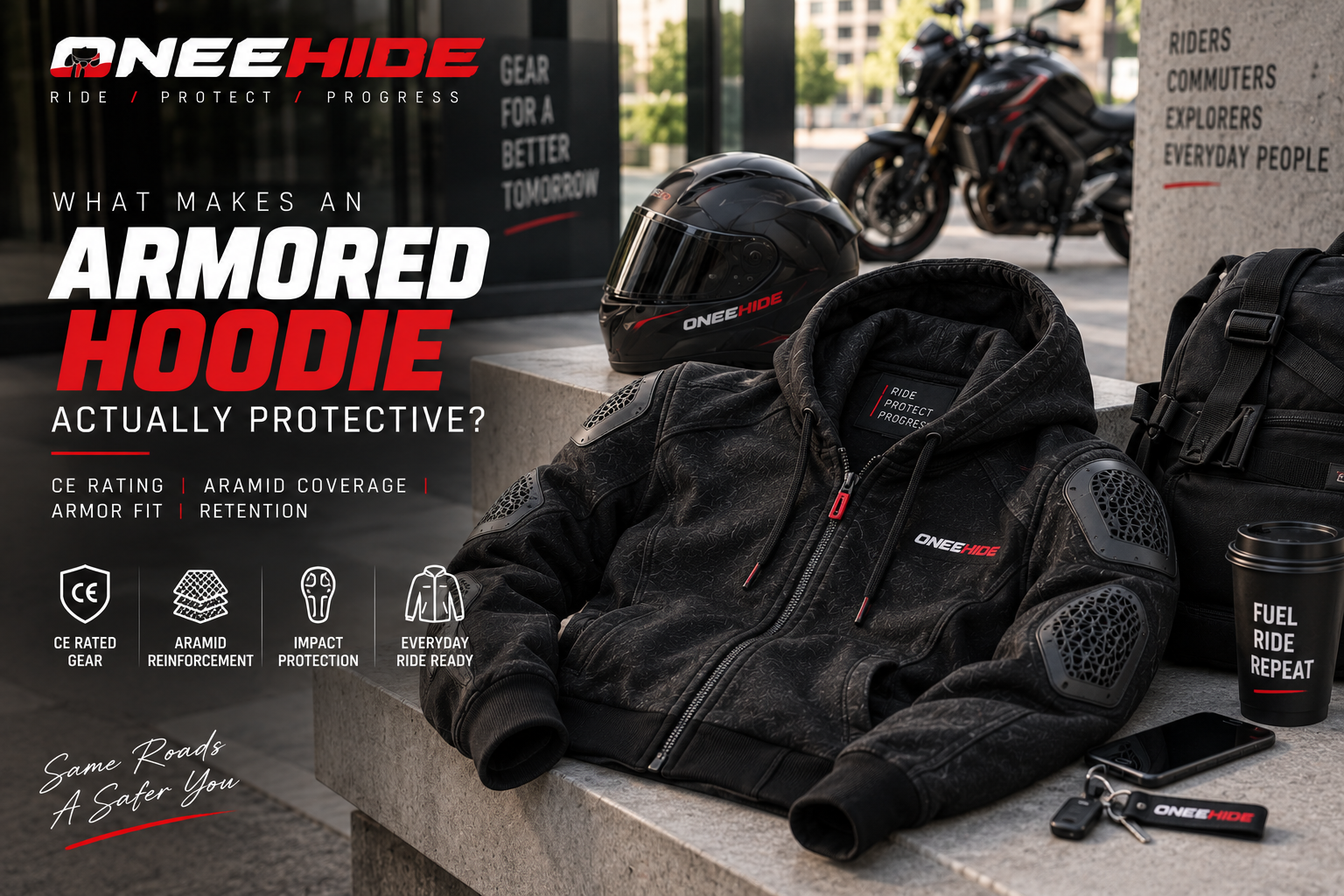
What Makes an Armored Hoodie Actually Protective? CE Rating, Aramid Coverage, Armor Fit and Retention

An armored motorcycle hoodie can look almost identical to ordinary streetwear, yet two visually similar garments can offer very different levels of protection. The difference is not just whether a hoodie contains aramid fabric or removable pads. Protection depends on how the entire garment performs as a system, including abrasion resistance, seam strength, impact protection, fit, and the ability to keep armor over the intended body areas during a crash.
That makes the buying question more specific than “Does it have armor?” Riders should ask what standard the complete garment meets, where the abrasion-resistant material is used, which protectors are included, how those protectors are positioned, and whether the hoodie stays secure when the rider moves or slides.
Start With the Garment Certification, Not the Marketing Claims
When comparing protective riding hoodies, start with the certification of the complete garment rather than a claim that the included armor is “CE approved.” A hoodie may contain certified shoulder and elbow protectors while the garment itself has not been tested as motorcycle protective clothing. Those are different claims.
Under EU Regulation 2016/425 on personal protective equipment, PPE placed on the EU market is subject to requirements covering its design, manufacture, and conformity. For motorcycle garments, EN 17092 separates protective clothing into Classes AAA, AA, A, B, and C. AAA is the highest class within this series for full protective garments, followed by AA and A. Class B provides abrasion protection equivalent to Class A but without the required impact protectors, while Class C is intended primarily to hold impact protection and does not provide the same minimum abrasion protection as Classes A, AA, or AAA.
This is why the phrase “CE rated hoodie” can be imprecise. CE marking relates to conformity with the applicable European PPE framework, while A, AA, or AAA describes a performance class under EN 17092. A useful product description should make clear which standard and class apply to the garment itself.
What EN 17092 Actually Tests
EN 17092 testing for motorcycle protective garments is more informative than a simple fabric claim because it evaluates several parts of the protective system. Testing covers impact abrasion resistance, tear strength, seam and closure strength, protector positioning, dimensional stability, fit, and ergonomics.
For abrasion testing, specimens are brought into contact with a concrete surface under controlled conditions. To pass the applicable requirement, the layer closest to the body must not develop a hole with an opening of 5 mm or more. The standard also evaluates seams and structural closures because strong fabric alone cannot protect effectively if a seam separates and exposes the rider.
Fit is part of the assessment as well. The garment is expected to match its stated sizing and allow essential rider movements. This matters for hoodies because an overly loose garment can allow armor to move away from the elbow or shoulder, while an excessively tight garment may restrict movement or interfere with correct protector positioning.
Aramid Coverage Matters More Than the Word “Aramid”
Aramid fibers are commonly incorporated into protective motorcycle garments as part of abrasion-resistant constructions. But the material name by itself does not tell a rider how much protection the finished hoodie provides.
The first question is coverage. Some hoodies reinforce higher-risk areas such as the shoulders and elbows, while others use a broader protective lining or integrate strong fibers through more of the garment. Those constructions should not be assumed to offer equal performance simply because both product descriptions mention aramid.
The second question is how the layers work together. An armored hoodie may combine an outer textile, reinforcement layer, comfort liner, protector pockets, seams, and closures. During a slide, those components experience stress together. If an outer layer tears, the protective layer still needs to remain where it is required. If a structural seam fails, even strong material may be displaced.
EN 17092 uses different risk zones for motorcycle protective clothing, with testing requirements reflecting areas at higher, moderate, and lower risk of damage. It also evaluates material combinations, seams, tear resistance, and garment integrity rather than relying on the reputation of one fiber.
For the buyer, the practical rule is simple: treat “aramid lined” as a construction detail, not as proof of overall protection. Look for the garment class, identify where reinforcement is actually located, and check whether the completed hoodie has been tested in the configuration being sold.
Armor Certification Is Only Part of Impact Protection
Impact protectors are separate protective components from the hoodie shell. Shoulder and elbow armor is commonly assessed under EN 1621 motorcycle impact-protector standards, specifically EN 1621-1 for limb-joint protection. Motorcycle back protectors are covered by EN 1621-2.
Shoulder and Elbow Protectors
EN 1621-1 evaluates limb-joint protectors by measuring how much impact force passes through the protector. Lower transmitted force indicates greater impact attenuation. Two performance levels are specified, with Level 2 providing increased protection relative to Level 1.
SATRA summarizes the standard's pass threshold as a mean maximum transmitted force below 35 kN, with no individual result above 50 kN. Optional tests can also assess protector performance at high and low temperatures, including +40°C and -10°C conditions.
A rider therefore should not stop at the phrase “CE armor.” Check the marking on the protectors and identify the standard, stated protection level, size, and intended body location.
Back Protectors
Back protection is covered separately under EN 1621-2. The standard recognizes full-back, central-back, and lower-back or lumbar protector configurations and specifies two performance levels.
SATRA states that the mean maximum transmitted force must be below 18 kN for the basic pass threshold, with no individual value above 24 kN. Level 2 is intended to provide greater protection than Level 1, although greater protection can involve trade-offs in thickness, weight, restriction, or ventilation depending on protector design.
A thin foam insert that merely fills a back pocket should not automatically be treated as a certified motorcycle back protector. The relevant standard and performance information should be supported by markings or certification documentation.
Armor Fit and Retention Can Decide Whether the Protector Is Useful
Certified armor is designed to cover a defined body area. On the road, it can only perform its intended role if it remains over that area when the rider moves or the garment is placed under crash forces.
This is where casual-looking motorcycle hoodies can vary substantially. A loose sleeve may allow an elbow protector to rotate toward the inside or outside of the arm. A shoulder protector may sit too far down the upper arm if the hoodie is oversized. A back protector pocket can also sit incorrectly when the torso length or cut does not match the rider.
The fit check should be performed in a riding position, not only while standing in front of a mirror. Bend the elbows, reach forward as if holding the handlebars, rotate the shoulders, and move through the normal riding range of motion. The protectors should remain centered over their intended areas rather than noticeably sliding away from them.
Retention also depends on the garment itself. Secure protector pockets, sleeve fit, cuff adjustment, waistband construction, and the overall cut can influence movement. EN 17092 includes sleeve-restraint testing. SATRA describes the procedure as applying a circumferential force of 50 N for 30 seconds and checking that the sleeve remains satisfactorily retained.
For riders whose arm length, shoulder width, or torso proportions do not work well with standard sizing, a custom armored motorcycle hoodie may help achieve better protector placement. Custom sizing is useful only when the protective construction remains technically sound. A tailored fit should complement appropriate protective materials and certified protectors, not replace them.
The Hoodie Must Stay on the Body During a Slide
A protective hoodie should not be evaluated like an ordinary sweatshirt. In a crash, the hem, sleeves, seams, and closures can experience forces they rarely encounter during normal use.
If the lower edge rides substantially upward, areas that were covered while sitting on the motorcycle can become exposed. If a sleeve pulls back or rotates, the arm may lose both abrasion coverage and correct armor alignment. This is why restraint and structural integrity deserve attention alongside material choice.
Look closely at how the garment closes at the front, how securely the cuffs fit, whether the waist can be adjusted or retained, and whether the garment incorporates features intended to limit excessive movement. The exact solution varies by design, but the protective objective remains the same: keep the tested materials and protectors covering the rider when the garment is under load.
Comfort Is a Safety Factor, but It Is Not a Certification Level
There is a legitimate reason armored hoodies exist. Many riders want a garment that is easier to wear away from the motorcycle than a heavy touring jacket or leather suit. Reduced bulk, flexible materials, ventilation, and a casual appearance can make protective clothing more practical for everyday riding.
Those benefits involve trade-offs. SATRA notes that Class AAA garments can provide the highest level of protection under EN 17092 while potentially creating greater weight, thermal, and ergonomic penalties for some riding activities.
A rider choosing between A, AA, and AAA garments should therefore consider the expected riding environment rather than chasing a label without context. An urban commuter may prioritize a certified garment that is comfortable enough for regular use. Someone spending long periods at higher speeds may reasonably prefer a more substantial garment with a higher protection class and more secure construction.
Neither decision should be based on appearance alone.
How to Evaluate an Armored Hoodie Before Buying
A useful evaluation can be done by checking a small number of details rather than relying on broad marketing language:
-
Confirm whether the complete hoodie is certified to EN 17092 and identify its class, such as A, AA, or AAA.
-
Check the shoulder and elbow protector markings for EN 1621-1 and their stated protection level.
-
Determine whether a certified back protector is included, optional, or replaced by a non-certified comfort insert.
-
Find out where the abrasion-resistant reinforcement is located and whether the construction uses partial or broader coverage.
-
Inspect protector-pocket security, sleeve fit, cuffs, waist fit, main closures, and seam construction.
-
Try the hoodie in a riding posture and verify that shoulder, elbow, and back protection remains correctly positioned through normal movement.
-
Follow the care instructions because EN 17092 also considers dimensional changes associated with cleaning, with SATRA noting a permitted dimensional change of no more than ±5 percent in the relevant test.
This process also helps expose vague product listings. If a seller repeatedly says “Kevlar,” “aramid,” or “CE armor” but does not identify the garment standard, protection class, protector standard, or supporting certification information, the buyer still lacks important evidence needed to compare protective performance.
Choose the Whole Protective System, Not a Single Feature
An armored hoodie becomes meaningfully protective when its components work together. Abrasion-resistant material needs appropriate coverage and structurally sound seams. Certified armor needs correct sizing and stable positioning. The garment needs to remain on the rider while still allowing normal motorcycle movements.
That is why the most useful question is not whether a hoodie contains aramid or includes armor. It is whether the complete product has been designed, tested, fitted, and retained as motorcycle protective equipment.
A sound buying decision therefore starts with the garment's EN 17092 classification, continues with the EN 1621 markings on its protectors, and ends with a physical fit check in riding posture. Those checks reveal far more about real protective intent than a material name printed prominently on a product page.
