

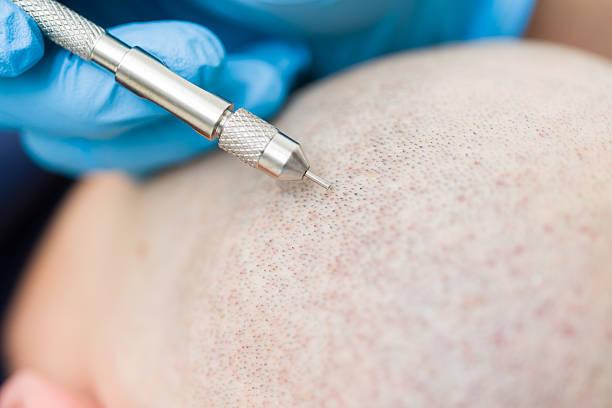
Hair Transplant in Abu Dhabi can be considered when a scalp scar has created a visible area of permanent hair loss and the surrounding tissue is suitable for follicular implantation. Scar tissue requires more careful planning than ordinary hair loss because its thickness, flexibility, vascularity, and follicle-free surface can influence how grafts are placed and how naturally the restored area blends with existing hair.
Why Scalp Scars Need Different Transplant Planning
A typical hair transplant treats an area affected primarily by follicular miniaturization or permanent pattern hair loss. A scarred scalp is different because the original injury may have altered the underlying skin structure.
Trauma, burns, surgical procedures, accidents, or previous scalp injuries can destroy follicles permanently. When this happens, hair cannot simply be encouraged to regrow from the damaged area. Follicular grafts may instead be used to introduce new growth into selected portions of the scar.
The objective is not necessarily to cover every millimeter with maximum density. The more important goal is to reduce the visual contrast between the scar and surrounding hair while protecting the available donor supply.
Hair Transplant in Abu Dhabi and Scar Tissue Assessment
Before graft numbers are calculated, the scar itself needs to be evaluated.
A consultation may consider:
- Scar size and shape
- Cause of the scalp injury
- Age of the scar
- Skin thickness and flexibility
- Degree of fibrosis
- Blood supply to the recipient area
- Existing hair around the scar
- Donor hair availability
- Hair caliber and texture
- Direction of surrounding growth
- Whether the scar has remained stable over time
A narrow linear scar can require a very different strategy from a broad irregular burn scar. Similarly, a small surgical defect may need relatively few grafts, while a large traumatic area may require staged restoration.
Scar Age Can Influence Planning
A recently injured scalp is not automatically suitable for transplantation. Tissue may continue changing during the healing process, and the final characteristics of a scar can take time to become established.
For established scars, the clinician can more accurately assess the boundary between normal scalp and damaged tissue. This makes it easier to determine where grafts should be introduced and where existing hair can provide camouflage.
The important distinction is between a scar that is stable and one that is still undergoing significant change. Transplant planning should account for the condition of the tissue rather than relying only on how long ago the injury occurred.
Matching Grafts to the Surrounding Hair
Natural restoration depends heavily on donor-recipient compatibility.
Hair surrounding a scar may have a particular thickness, curl pattern, growth direction, and density. Grafts that closely complement these characteristics can make the transition less noticeable.
For example, a scar hidden within relatively coarse hair may not require the same graft strategy as a scar surrounded by fine, straight hair. Fine hair can provide less visual coverage, while thicker hair may camouflage irregularities more effectively.
The donor area therefore needs to be evaluated not only for quantity but also for the quality and characteristics of its follicles.
Hair Transplant in Abu Dhabi for Linear Surgical Scars
Linear scars can appear after certain surgical procedures or scalp injuries. They may be narrow but highly visible when surrounding hair is short or styled away from the scalp.
In these cases, graft placement can be planned along the scar rather than treating a large surrounding area.
The surgeon may assess the scar's width at different points because a scar is not always uniform. Some sections may require greater density, while other sections can be covered through existing hair.
The transition zone is especially important. Abruptly placing dense grafts only inside the scar can create an artificial boundary. Gradual integration with the neighboring hair may produce a more convincing result.
Hair Transplant in Abu Dhabi for Traumatic Scalp Defects
Traumatic hair loss can produce irregular areas rather than clean lines.
An injury may damage follicles in an uneven pattern, leaving a combination of normal scalp, weakened follicles, and scar tissue. The restoration plan therefore needs to follow the actual defect instead of assuming that the entire affected region is identical.
This can make graft distribution more important than simply calculating the total bald surface area.
A useful strategy may involve prioritizing the most visible portions first, particularly areas exposed when the patient's normal hairstyle is worn.
Burn Scars Require Conservative Expectations
Burn-related scalp scars can present additional challenges because the tissue may be substantially different from normal scalp.
Depending on the severity of the original injury, scar tissue can be fibrotic, less flexible, or irregularly vascularized. These characteristics can affect recipient-site creation and graft placement.
For this reason, a scar restoration procedure should not be approached as though it were an ordinary transplant into unaffected scalp.
The realistic objective may be camouflage rather than complete restoration to the density of untouched scalp.
Graft Density Should Follow the Scar
One of the most common planning mistakes is assuming that more grafts automatically produce better scar coverage.
The recipient tissue has practical limitations. Attempting excessive density in a restricted scarred area may not be appropriate and can increase the complexity of the procedure.
A better approach is to determine where grafts provide the greatest cosmetic benefit.
| Scar characteristic | Planning consideration | Potential restoration approach |
|---|---|---|
| Narrow linear scar | Width and visibility | Concentrated graft placement |
| Irregular traumatic scar | Uneven follicle loss | Variable graft distribution |
| Broad scar | Limited donor-to-recipient ratio | Strategic coverage or staged treatment |
| Scar beside existing hair | Direction and transition | Blended placement |
| Highly visible scar | Hairstyle exposure | Prioritize visible zones |
| Small stable defect | Localized hair loss | Targeted graft restoration |
The exact graft requirement should therefore be based on scar dimensions, donor capacity, hair characteristics, and the desired degree of camouflage.
Hair Direction Is Critical for Scar Camouflage
A transplanted follicle must grow in a direction that makes sense alongside the surrounding hair.
Hair emerging from a scar at an unnatural angle can remain noticeable even when the graft survives. This is particularly important along the hairline, temples, parting areas, and regions where the surrounding hair lies relatively flat.
Recipient sites should follow the natural orientation of nearby follicles as closely as practical.
The angle, depth, spacing, and direction of implantation all contribute to how the restored hair eventually merges with the surrounding growth.
Existing Hair Can Reduce the Graft Requirement
A scar does not always represent a completely empty surface.
Some patients have healthy follicles immediately beside the damaged area. These hairs can act as natural camouflage, allowing grafts to be concentrated where the scar remains most visible.
Preserving this surrounding hair is therefore an important part of planning.
If native follicles are already growing close to the scar, indiscriminate implantation can be unnecessary. The restoration strategy should work with the existing hair rather than treating every nearby centimeter as a bald area.
Donor Supply Determines the Scope of Restoration
Scalp scars can vary dramatically in size, but donor hair is always a finite resource.
The surgeon needs to consider how many follicles can be safely harvested while preserving the appearance of the donor region. This becomes particularly important when a patient has extensive scarring or additional pattern hair loss.
Using too much donor hair for scar camouflage can compromise future treatment options.
A long-term plan may therefore prioritize the most visible scar sections instead of attempting maximum coverage during one session.
When Staged Grafting May Make Sense
Large or complex scars may not be suitable for aggressive single-session coverage.
Staged treatment can allow restoration to be approached progressively. The first session may focus on the most visible portion, while later planning can consider how well the area blends with surrounding hair.
This approach may also be useful when donor availability is limited.
The number of sessions should not be determined solely by scar size. Tissue condition, graft availability, patient goals, and the desired level of coverage all influence the treatment plan.
Hair Transplant in Abu Dhabi and Recovery Considerations
Recovery after scar-focused transplantation can involve temporary redness, swelling, tenderness, crusting, or itching around the treated area. The appearance of the scar may also look different during the early healing period before the transplanted follicles begin their longer growth cycle.
Patients should follow the clinic's postoperative instructions carefully.
Typical planning considerations include:
- Keeping the recipient area protected during early healing
- Avoiding unnecessary touching or scratching
- Following recommended washing instructions
- Limiting strenuous activity during the initial recovery period
- Protecting the scalp from strong sunlight
- Attending recommended follow-up appointments
- Reporting unusual or persistent changes to the treating medical team
The visible result develops gradually rather than immediately after implantation.
Abu Dhabi Sun Exposure and Scar Protection
Strong sunlight deserves particular attention after a scalp procedure.
A newly treated scalp can be more sensitive, and prolonged direct exposure can interfere with comfortable healing. Patients should follow the treating clinician's specific instructions regarding sun protection and when hats or other protective measures can safely be used.
This becomes especially relevant for people who spend considerable time outdoors in Abu Dhabi.
Work schedules, commuting, outdoor activities, and travel should be considered when selecting the procedure date.
How Results Should Be Judged
Scar transplantation should be evaluated by camouflage quality rather than by graft survival alone.
Useful indicators include:
- Reduced visibility of the scar
- Better integration with neighboring hair
- Natural growth direction
- Appropriate hairline or scalp contour
- Improved appearance under normal lighting
- Greater flexibility in hairstyle
- Preservation of donor hair for future needs
A scar may remain structurally visible on close inspection even when the surrounding hair makes it much less noticeable in everyday situations.
That distinction is important when establishing expectations before treatment.
When Scalp Scar Transplantation May Need More Evaluation
Not every scar is an immediate candidate for follicular implantation.
Additional evaluation may be appropriate when the area is changing, unusually inflamed, severely contracted, extensively damaged, or associated with another unresolved scalp problem.
Patients with large defects may also need a broader reconstructive assessment rather than assuming that transplantation alone will provide complete coverage.
The consultation should establish whether the tissue can reasonably support the intended restoration and what limitations should be expected.
Hair Transplant in Abu Dhabi With a Long-Term Strategy
Scalp scar camouflage should be planned alongside the patient's broader hair-loss pattern.
A person may have a stable traumatic scar today but develop pattern hair loss around it later. If donor follicles are used without considering future progression, the result may eventually look less integrated.
A long-term strategy can account for:
- Current donor density
- Potential future hair loss
- Scar dimensions
- Existing native hair
- Hair characteristics
- Possible future procedures
- Desired hairstyle
- Available donor reserve
This approach helps prevent the scar from being treated as an isolated cosmetic problem when the surrounding scalp may also change.
Choosing a Clinical Setting for Scar Restoration
The technical demands of scar restoration make individualized assessment particularly important. The clinician needs to understand both the defect and the surrounding hair architecture before deciding how many grafts should be harvested.
For patients exploring hair restoration treatment in Dubai, the same principle applies when considering a scar-focused procedure in Abu Dhabi: graft quantity should follow the anatomy and long-term objective rather than a fixed package.
The Strategic Investment
A Hair Transplant in Abu Dhabi for scalp scars is fundamentally a camouflage and tissue-planning procedure. The strongest results depend on selecting suitable donor follicles, respecting scar characteristics, matching surrounding hair direction, distributing grafts strategically, and maintaining realistic expectations about density.
Whether the scar resulted from trauma, burns, surgery, or another permanent scalp injury, successful planning begins with understanding the defect rather than treating it like ordinary baldness. A carefully designed restoration can make a visible scar substantially less apparent while preserving donor resources for the future.
For patients considering individualized assessment and hair restoration planning, Tajmeels Clinic can provide a clinical setting in which donor availability, scar characteristics, graft requirements, and the overall restoration objective can be evaluated together.
