

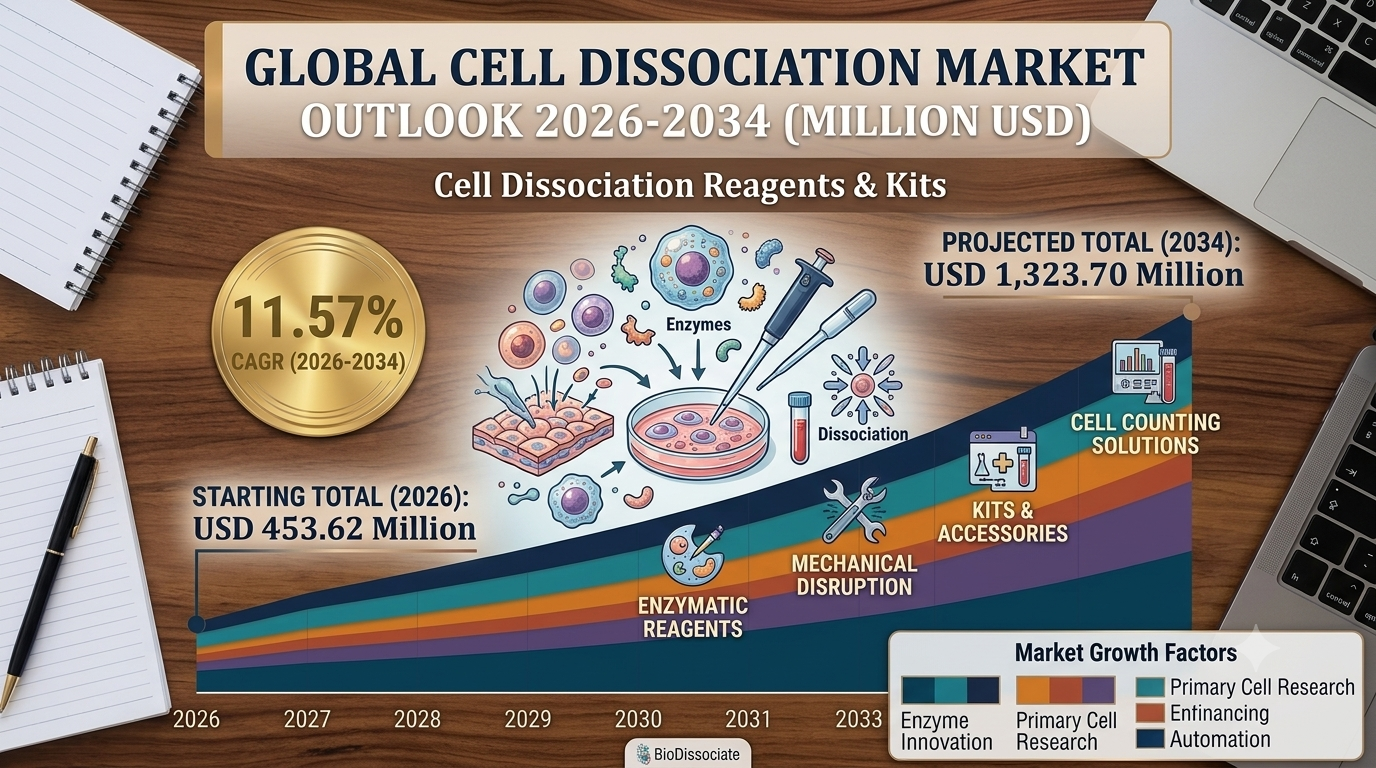

According to IMARC Group, the global Cell Dissociation Market Size reached USD 453.62 Million in 2025 and is projected to reach USD 1,323.70 Million by 2034, expanding at a CAGR of 11.57% during 2026–2034. This robust growth trajectory reflects rising biopharmaceutical R&D investment, growing cell and gene therapy adoption, and expanding single-cell genomics research across global research and manufacturing settings.
Cell Dissociation Industry Overview
Cell dissociation refers to the controlled separation of cells from tissues or culture substrates using enzymatic, mechanical, or chemical means. The industry encompasses enzymatic reagents such as trypsin, collagenase, dispase, and papain; non-enzymatic solutions including EDTA-based buffers and chelating agents; and instruments ranging from tissue dissociators to cell strainers and dissociation kits.
Cell dissociation solutions are deployed across a broad continuum of use cases:
- Cell and gene therapy manufacturing: CAR-T, NK cell, and TCR-T cell processing requiring scalable, reproducible dissociation at multiple manufacturing steps
- Single-cell multi-omics research: scRNA-seq sample preparation requiring highly viable, non-clumped single-cell suspensions
- Oncology and immunology research: Patient-derived tumor model development and primary immune cell isolation
- Stem cell and organoid workflows: Gentle non-enzymatic dissociation for iPSC passaging and 3D culture systems
- Biopharmaceutical R&D: Primary cell model generation for oncology biologics and personalized medicine research
Global Cell Dissociation Market Size & Key Statistics
Below are the key Cell Dissociation Market statistics drawn from IMARC Group's comprehensive market analysis:
|
Report Attribute |
Key Statistics |
|
Base Year |
2025 |
|
Historical Period |
2020–2025 |
|
Forecast Period |
2026–2034 |
|
Cell Dissociation Market Size in 2025 |
USD 453.62 Million |
|
Market Forecast in 2034 |
USD 1,323.70 Million |
|
Market Growth Rate (2026–2034) |
11.57% CAGR |
|
Largest Region |
North America (41.0% share, 2025) |
|
Fastest Growing Region |
Asia Pacific |
|
Leading Product Segment |
Enzymatic Dissociation (62.5%, 2025) |
|
Leading Type Segment |
Tissue Dissociation (58.7%, 2025) |
|
Leading End-Use Segment |
Pharmaceutical and Biotechnology Companies |
Request for a Sample Report for Detailed Cell Dissociation Market Share Evaluation: https://www.imarcgroup.com/cell-dissociation-market/requestsample
Key Market Drivers & Cell Dissociation Market Trends in 2026
Several powerful forces are shaping Cell Dissociation Market Trends and fuelling sustained growth expectations across global life sciences and biopharmaceutical manufacturing markets:
1. Expanding Cell and Gene Therapy Pipelines
The global CAR-T, NK cell, and TCR-T therapy pipeline has grown to include over a thousand active clinical trials, each requiring scalable and reproducible cell dissociation at multiple manufacturing steps, driving significant demand for reagents and instruments across the industry.
2. Surging Biopharmaceutical R&D Investment
The top 50 pharmaceutical companies alone are estimated to have spent a total of USD 167 billion on R&D in 2022. Increasing focus on oncology biologics, mRNA therapeutics, and personalized medicine is expanding the use of primary cell models, reinforcing steady Cell Dissociation Market Growth.
3. Single-Cell Multi-Omics Adoption
Single-cell RNA sequencing workflows, now widely adopted across major academic research institutions globally, require high-viability single-cell suspensions. This need directly drives demand for premium enzymatic dissociation products, representing a significant portion of industry demand.
4. Automation and GMP Manufacturing Standardization
GMP-grade cell therapy manufacturing is increasingly automated, with platforms enabling reproducible, operator-independent tissue processing. This represents one of the most influential drivers, reflecting a structural shift toward closed-system bioprocessing.
5. Rise of GMP-Grade and Xeno-Free Dissociation Reagents
Regulatory pressure and clinical manufacturing standards are driving rapid adoption of GMP-certified, animal-component-free (ACF) dissociation reagents. Products such as TrypLE and Accutase are replacing traditional porcine trypsin in stem cell and CAR-T manufacturing workflows.
6. Organoid and Tumoroid Workflow Specialization
Patient-derived tumor organoid (PDO) models are emerging as the preferred preclinical screening platform for oncology drug discovery. These workflows require tailored enzymatic cocktails, with market leaders launching organoid-specific dissociation kits to capture this high-value segment.
7. AI Protocol Optimization and Closed-System Processing
AI-driven reagent selection platforms and smart dissociation instruments with feedback control loops are emerging to optimize enzyme concentration, incubation time, and mechanical agitation parameters in real time, converging cell dissociation with downstream bioreactor workflows.
Key Market Segmentation
By Product
Enzymatic Dissociation – Largest Segment (62.5% share, 2025): Trypsin, collagenase, dispase, and papain remain the foundational tools for primary tissue processing, organoid generation, and cell therapy manufacturing. The segment is benefiting from growing adoption of recombinant, animal-component-free formulations priced at significant premiums over conventional options.
Non-Enzymatic Dissociation (21.0% share, 2025): Gaining momentum in sensitive applications such as iPSC passaging, organoid culture, and single-cell sequencing where traditional enzymatic agents risk receptor cleavage and surface antigen loss.
Instruments and Accessories (16.5% share, 2025): Automated tissue dissociators and gentleMACS-type platforms are expanding lab throughput across academic and industrial environments.
By Type
Tissue Dissociation – Largest Segment (58.7% share, 2025): Demand is driven by patient-derived tumor model development for precision oncology, primary cell isolation for immunology research, and biobanking programs requiring reproducible tissue-to-cell conversion protocols.
Cell Detachment – Fastest Growing Type (~10.8% CAGR, 2026–2034): Gaining traction in routine cell culture passaging and downstream bioprocessing applications across pharmaceutical and academic settings.
By End Use
Pharmaceutical and Biotechnology Companies – Largest End-Use Segment: Deploy cell dissociation extensively in cell therapy manufacturing, biomarker validation, and drug discovery assays.
Research and Academic Institutes: Represent a significant end-use segment, driving innovation through translational research, assay development, and single-cell analysis studies.
Regional Cell Dissociation Market Analysis
|
Region |
Key Highlights |
|
North America – Largest (41.0% share, 2025) |
United States & Canada; NIH R&D funding exceeding USD 47 Billion in FY2024, FDA-approved CAR-T therapies, dense concentration of biopharma R&D hubs in Boston and San Francisco |
|
Europe (26.4% share) |
Germany, France, UK, Italy, Spain; EU Horizon Europe funding, ATMP regulatory framework, strong biopharma presence across UK, Germany, and Switzerland |
|
Asia Pacific – Fastest Growing (22.8% share) |
China, Japan, India, South Korea, Australia, Indonesia; China's biopharma manufacturing scale-up, South Korea's cell therapy approvals, India's expanding CRO ecosystem |
|
Latin America (5.4% share) |
Brazil, Mexico; growing biotech sector, academic research expansion, expanding pharma outsourcing |
|
Middle East & Africa (4.4% share) |
UAE, Saudi Arabia; life science investment, academic infrastructure development, growing diagnostic demand |
North America leads the global Cell Dissociation Market Share, underpinned by the United States' world-class biopharmaceutical R&D infrastructure, NIH funding exceeding USD 47 Billion in FY2024, and the FDA's approval of six CAR-T cell therapies by 2025.
Asia Pacific represents the fastest-growing regional market, advancing at an estimated CAGR of ~13.5% through 2034, driven by China's National Biotechnology Development Strategy, South Korea's cell therapy commercialization programs, and India's expanding contract research ecosystem.
Connect for Detailed Cell Dissociation Market Analysis Segmentation – Speak to an Analyst: https://www.imarcgroup.com/request?type=report&id=12703&flag=C
Leading Players in the Global Cell Dissociation Industry
The global cell dissociation market is moderately concentrated, featuring a mix of diversified life science multinationals and focused specialty reagent providers. Key companies covered in the IMARC Group report include:
|
Company |
Key Brand / Platform |
Core Strength |
|
Thermo Fisher Scientific Inc. |
TrypLE, Gibco, StemPro Accutase |
Broadest product portfolio, global distribution, GMP-grade reagents |
|
BD |
BD Biosciences, BD IMag |
Flow cytometry integration, cell processing instruments |
|
F. Hoffmann-La Roche Ltd. |
Roche Diagnostics |
Tissue biobanking, oncology-focused dissociation kits |
|
Sartorius AG |
Ambr Multi-Parallel Bioreactors |
GMP bioprocessing integration, single-use systems |
|
Cytiva |
WAVE Bioreactor system |
Bioprocess automation, closed-system cell isolation |
|
Miltenyi Biotec |
gentleMACS Octo Dissociator |
Automated tissue dissociation leadership, CAR-T workflows |
|
STEMCELL Technologies |
EasySep |
Specialty stem cell and organoid dissociation kits |
|
Capricorn Scientific |
Capricorn Scientific |
European specialty reagents, academic focus |
|
PAN-Biotech |
PAN-Biotech |
European GMP-grade cell culture solutions |
|
Vitacyte LLC |
VitaCyte |
Islet isolation enzyme specialist |
Latest Cell Dissociation Market Industry Developments
2026 – Thermo Fisher Scientific
Thermo Fisher Scientific announced the global launch of the Gibco CTS Compleo Fill and Finish System, an automated, functionally closed solution designed to streamline formulation and filling in cell therapy manufacturing.
2024 – Miltenyi Biotec
Miltenyi Biotec launched its first office in India and established a Centre of Excellence (CoE) providing scientists, researchers, and clinicians with training in cell and gene therapy workflows, from proof of concept through commercialization.
2023 – BD
BD introduced the BD FACSDiscover S8 Cell Sorter, featuring BD CellView Image Technology and BD SpectralFX Technology, enabling high-speed, image-based cell sorting and full-spectrum analysis for single-cell research.
About Us
IMARC Group is a leading global market research company providing data-driven insights and expert consulting services to businesses seeking to achieve their strategic objectives. With a multi-disciplinary team of industry experts, IMARC delivers thorough, reliable market intelligence across sectors including Healthcare, Technology, Chemicals, Energy, Food & Beverages, and more.
Contact Us
IMARC Group
United States: +1-201-971-6302
India: +91-120-433-0800
United Kingdom: +44-753-714-6104
