

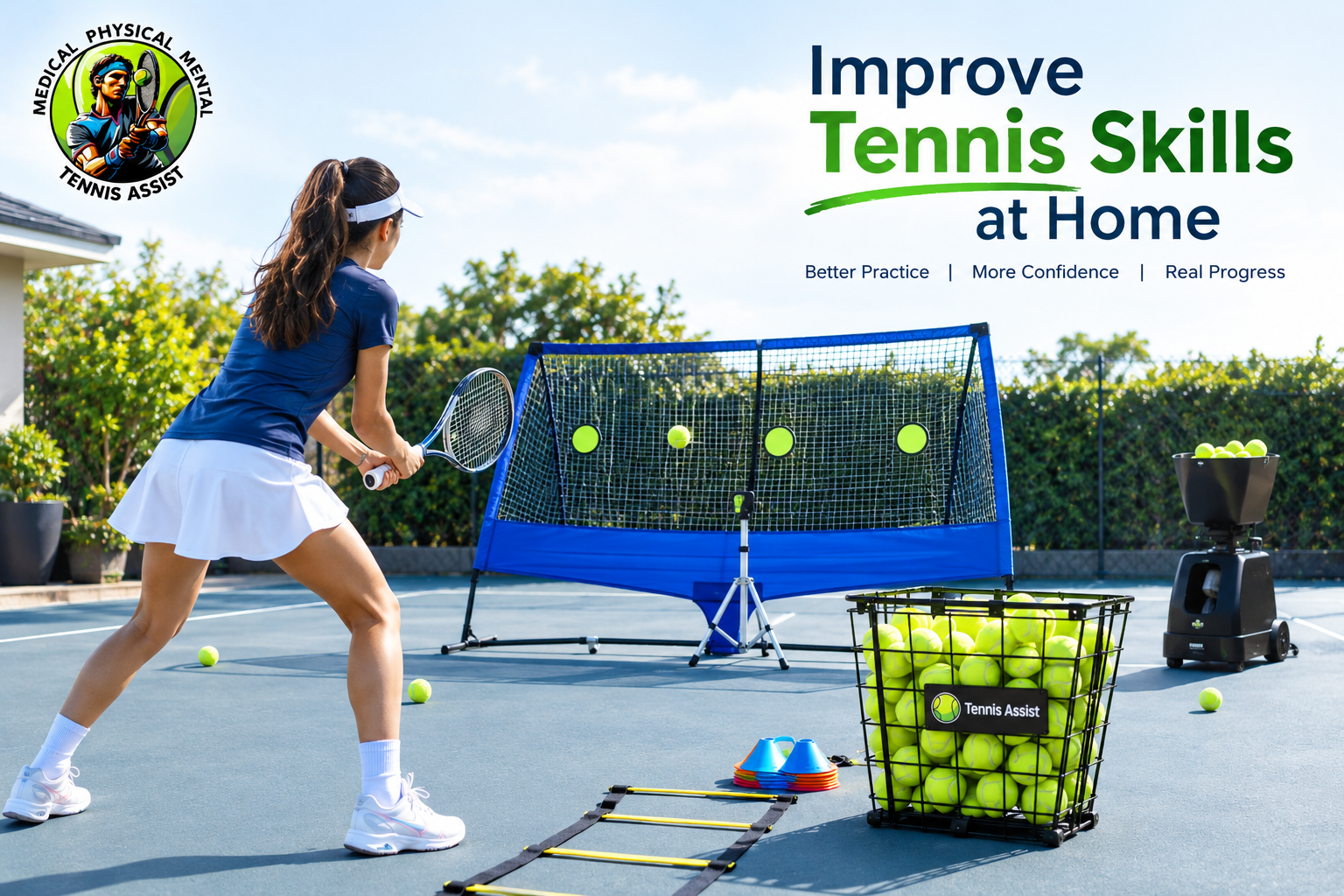

You do not always need a full tennis court or a regular hitting partner to work on your game. With the right routine, players can improve tennis skills at home by focusing on footwork, racket control, timing, coordination, and repeated stroke practice.
Home training is especially useful when court availability, weather, work, school, or busy schedules make regular sessions difficult. A dedicated practice area can provide extra repetitions between coaching and match sessions while helping players stay consistent with their training.
The key is to practise with a clear purpose rather than simply hitting a ball repeatedly.
Why Improve Tennis Skills at Home?
One of the biggest advantages of home practice is convenience. Players can complete a short training session without travelling to a club or waiting for a court.
A home routine can focus on:
-
Forehand and backhand technique
-
Footwork and recovery
-
Hand-eye coordination
-
Reaction speed
-
Ball control
-
Balance
-
Racket preparation
-
Movement patterns
Short, regular sessions can be easier to maintain than occasional long workouts. A structured routine also allows players to concentrate on one specific skill at a time.
Create a Simple Home Tennis Training Area
The first step is choosing a safe practice space. A driveway, backyard, garage, or other suitable area can work depending on its size and surface.
Before starting, remove obstacles such as furniture, vehicles, tools, loose objects, and anything fragile. Players should also make sure balls cannot travel toward roads, neighbouring properties, windows, or other unsafe areas.
For smaller spaces, shadow swings, racket-control exercises, footwork drills, and controlled ball activities can be useful.
Players with more space may be able to add a rebounder, practice net, or ball-feeding system.
Use a Tennis Rebounder Wall for Repeated Practice
A tennis rebounder wall can be useful for players who want repeated ball returns without depending on another player.
A rebound setup can support work on:
-
Timing
-
Stroke consistency
-
Racket preparation
-
Hand-eye coordination
-
Reaction
-
Ball control
-
Footwork
The important thing is to avoid treating rebound practice as a mindless hitting exercise. Players should set a specific goal before each session.
For example, one session could focus entirely on forehand consistency. Another could alternate forehands and backhands while adding lateral movement.
Rebound training is particularly useful for players who want to practice tennis without a partner.
Practice Tennis Without a Partner
Solo practice does not have to be complicated. Players can create several useful drills with basic equipment.
Shadow Swings
Perform forehand, backhand, volley, and serve movements without hitting a ball. Concentrate on preparation, balance, contact position, and recovery.
Racket Ball Control
Bounce a tennis ball repeatedly on the racket strings. Change between the forehand and backhand sides to develop coordination.
Target Practice
Place safe markers in a suitable area and aim toward them. This adds accuracy and purpose to practice.
Footwork Drills
Use cones or markers to practise lateral movement, forward movement, recovery steps, and split-step positioning.
These activities require little space and can be incorporated into short daily sessions.
Tennis Practice With Ball Machine
For players with enough space, tennis practice with ball machine equipment can provide repeated feeds from consistent locations.
A ball-feeding system can help players work on:
-
Stroke repetition
-
Timing
-
Movement
-
Recovery
-
Reaction
-
Shot placement
Start with manageable feeds rather than immediately choosing the fastest or most difficult setting. Once the player can maintain good technique, the speed, direction, or movement challenge can be increased.
Ball-machine practice should complement normal court sessions because match play involves unpredictable shots, decision-making, positioning, and an opponent.
Choose the Right Tennis Practice Gear
The right tennis practice gear depends on the player's goals, age, available space, and training frequency.
A basic home setup could include:
|
Training Goal |
Useful Equipment |
|
Footwork |
Cones or agility markers |
|
Ball control |
Practice balls |
|
Solo hitting |
Rebounder |
|
Repeated feeds |
Ball-feeding equipment |
|
Accuracy |
Target markers |
|
Coordination |
Racket-control equipment |
|
Fitness |
Suitable conditioning equipment |
There is no need to buy every type of equipment. Choose products that directly support the skills you want to practise.
Fast Track Tennis Australia Training Approach
Players searching for fast track tennis australia solutions should focus on efficient repetition rather than trying to rush the learning process.
A useful training cycle is:
Choose one skill → practise it → review your technique → make an adjustment → repeat.
For example, if a player's forehand is inconsistent, they could spend one session focusing on preparation and contact rather than simultaneously changing their grip, swing, stance, and follow-through.
Focused repetition makes it easier to understand what is improving and what still needs work.
Junior Tennis Fitness Training at Home
Junior tennis fitness training should be age appropriate, varied, and enjoyable.
Young players can develop useful athletic skills through:
-
Agility games
-
Balance exercises
-
Coordination drills
-
Reaction activities
-
Short movement challenges
-
Light bodyweight exercises
-
Mobility activities
Tennis balls and cones can be incorporated into games to keep children engaged.
For younger players, the objective should be developing coordination, movement confidence, balance, and basic athletic ability rather than excessive training volume.
Parents should also make sure the practice environment is safe and suitable for the child's age.
How Tennis Training Products Can Support Home Practice
Different tennis training products can support different stages of player development.
A beginner may only need practice balls and basic footwork markers. An intermediate player might benefit from a rebounder or more structured ball-feeding practice. More experienced players may combine several tools to create targeted technical and movement sessions.
When choosing equipment, consider:
-
Available space
-
Player age
-
Skill level
-
Training goal
-
Portability
-
Storage
-
Frequency of use
-
Safety
The most useful product is usually the one that will actually be used consistently.
Best Knee Support for Tennis Players
Players also need to consider physical support and recovery when increasing their training frequency. Those searching for the best knee support for tennis players should consider fit, comfort, flexibility, material, and the intended activity.
Tennis involves repeated running, lunging, stopping, bending, and changes of direction. A support should not unnecessarily restrict normal movement.
Knee support should not replace proper warm-up, strength work, recovery, suitable footwear, or professional assessment. If knee pain persists or is accompanied by swelling, instability, or restricted movement, players should seek advice from an appropriate healthcare professional.
Build a Simple Weekly Home Tennis Routine
A practical weekly routine could look like this:
|
Day |
Focus |
|
Monday |
Footwork and agility |
|
Tuesday |
Forehand and backhand |
|
Wednesday |
Mobility and recovery |
|
Thursday |
Rebounder or solo practice |
|
Friday |
Ball-feeding practice |
|
Saturday |
Court or match practice |
|
Sunday |
Rest |
The schedule can be adjusted according to age, fitness, coaching, competition, and available court time.
The goal is consistency rather than exhausting yourself every day.
Improve Tennis Skills at Home With Purpose
The best home training sessions are structured around a clear objective.
Instead of saying, “I will hit for 30 minutes,” choose a specific goal such as:
-
Complete 20 controlled forehands
-
Maintain 10 consecutive rebound shots
-
Perform five minutes of lateral footwork
-
Practise early racket preparation
-
Complete a controlled ball-feeding sequence
Measurable goals make training easier to track and can keep sessions interesting.
Home practice should complement coaching, match play, fitness, and regular court sessions rather than replace them.
Conclusion
Players can improve tennis skills at home by combining consistent practice with suitable equipment and a clear training plan. A tennis rebounder wall can provide repeated returns, while tennis practice with ball machine sessions can offer controlled feeds for stroke and movement practice.
Simple tennis practice gear such as cones, practice balls, and target markers can also turn a driveway or backyard into a useful training area.
For juniors, junior tennis fitness training can build coordination, agility, balance, and movement confidence when activities are suitable for their age.
The most important factor is consistency. Choose one skill, practise it regularly, review your technique, and gradually increase the challenge. With the right approach, home training can become a valuable part of a player's overall tennis development.
Frequently Asked Questions
Can I improve tennis skills at home without a court?
Yes. Footwork, shadow swings, racket control, coordination, rebound exercises, and selected ball-feeding drills can be practised at home when enough safe space is available.
Is a tennis rebounder wall good for solo practice?
Yes. It can provide repeated ball returns and help players work on timing, coordination, stroke consistency, and movement without requiring a hitting partner.
Can I practice tennis without a partner?
Yes. Rebounders, ball-feeding equipment, target drills, shadow swings, and footwork exercises can all support independent training.
Is tennis practice with ball machine suitable for beginners?
It can be, provided the feed speed and difficulty are appropriate. Beginners should start with controlled feeds and focus on technique before increasing the challenge.
What tennis practice gear should I buy first?
Start with equipment that directly matches your training goal. Practice balls, cones, and simple coordination equipment are useful starting points, while rebounders and ball-feeding systems can be added as training needs develop.
What is fast track tennis Australia training?
It can refer to focused tennis training approaches and equipment intended to make practice more structured and efficient. Tennis improvement still requires consistent repetition, good technique, court experience, and appropriate coaching.
Is junior tennis fitness training important?
Yes. Age-appropriate agility, balance, coordination, reaction, and movement activities can support a young player's overall athletic development.
How do I choose the best knee support for tennis players?
Consider fit, comfort, flexibility, material, and intended use. Anyone experiencing persistent or significant knee symptoms should seek appropriate professional healthcare advice.
Where can I find tennis training products?
Players can explore the Tennis Assist tennis training range for equipment and training options suitable for different practice needs.
