

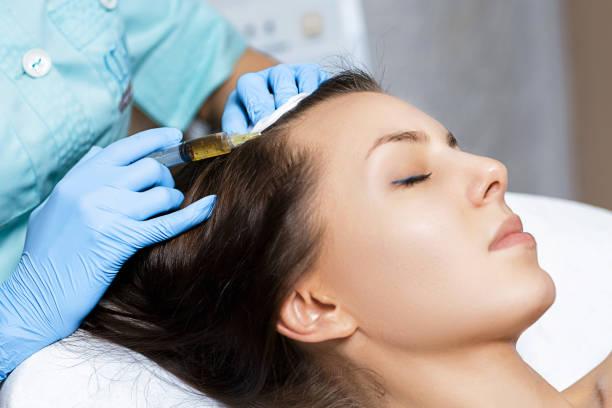

Thinning around the hairline can be an early sign of follicular miniaturization, although changes in styling, natural hairline maturation, shedding, and traction can create a similar appearance. PRP Hair Treatment in Abu Dhabi may support selected patients when examination confirms that viable follicles remain along the frontal scalp.
The hairline requires particularly careful assessment because small changes can alter facial framing. A treatment plan therefore needs to distinguish genuine follicular reduction from a naturally changing hairline before any injections are considered.
Why Hairline Thinning Needs a Different Assessment
The Frontal Hairline Has a Defined Architecture
The frontal hairline is not a straight row of identical follicles. It contains irregular transitions, fine peripheral hairs, different follicular angles, and varying densities that create a natural border between the forehead and scalp.
When these features are assessed properly, clinicians can determine whether apparent thinning represents a pathological change or normal anatomical variation.
Fine Hair Can Make the Hairline Look Weaker
The hairs nearest the front may naturally be finer than those farther behind them.
Progressive miniaturization is different because individual follicles gradually produce smaller-caliber hairs. Comparing the frontal zone with adjacent scalp regions can help identify this distinction.
How Hairline Thinning Can Develop
| Pattern | What may be observed | Clinical consideration |
|---|---|---|
| Frontal miniaturization | Fine hairs become increasingly prominent | Assess follicular viability |
| Temporal recession | Corners gradually move backward | Examine temporal-frontal junction |
| Diffuse frontal thinning | Coverage decreases across the front | Investigate the broader pattern |
| Traction-related thinning | Reduced density along tension points | Review hairstyle and mechanical stress |
| Temporary shedding | Sudden reduction in visible hairs | Assess recent triggers |
| Natural maturation | Hairline changes without progressive miniaturization | Establish an appropriate baseline |
The visual pattern is only one part of the assessment. Timing, hair caliber, scalp condition, and follicular distribution all influence the interpretation.
How PRP May Support the Frontal Scalp
Focusing on Existing Follicles
PRP is designed around the concept of supporting tissue containing existing follicular structures.
For a thinning hairline, the relevant question is therefore whether the affected follicles are still producing hairs and showing signs of miniaturization rather than whether a completely bare region can be repopulated.
Addressing the Follicular Environment
Platelet-derived signaling factors are introduced into the scalp through controlled injections.
The objective is to expose the treated tissue to these biological signals while maintaining an injection pattern appropriate to the patient's anatomy and the distribution of thinning.
Preserving a Natural Transition
The frontal hairline cannot be approached simply as a high-density zone.
Natural hairlines contain variation in density and caliber. Treatment planning should respect that transition rather than attempting to produce an artificially uniform border.
Assessing Hairline Follicle Viability
Examine Hair Diameter
One of the useful indicators is variation in hair shaft diameter.
A frontal region containing both normal-caliber and increasingly fine hairs may indicate miniaturization. This is different from an area that is uniformly sparse because follicles have already disappeared.
Compare Adjacent Zones
The hairline should be assessed alongside the frontal scalp immediately behind it.
This comparison helps reveal whether the reduction is isolated to the edge, extending backward, or part of a broader pattern.
Look for Progression
A single photograph cannot establish whether a hairline is actively changing.
Historical photographs, standardized clinical images, and follow-up examinations can provide stronger evidence of progression.
PRP Hair Treatment in Abu Dhabi for Frontal Thinning
Injection Distribution Matters
The frontal scalp has relatively limited visual tolerance for treatment irregularities because it directly affects facial appearance.
Injection placement should therefore follow a deliberate distribution rather than being performed without reference to the patient's thinning pattern.
Depth and Spacing Require Clinical Control
PRP injections need to be delivered into appropriate scalp tissue.
The technique, spacing, and treatment area should be selected by the clinician according to the patient's anatomy, scalp condition, and treatment objectives.
Treatment Should Follow the Pattern
A patient with isolated frontal miniaturization does not necessarily require identical treatment across the crown or entire scalp.
Mapping the affected zones helps prevent unnecessary treatment of areas that do not show the same clinical pattern.
Hairline Thinning Versus Recession
Recession Changes the Hairline Position
True recession generally involves progressive backward movement of the frontal-temporal border.
The corners can become more prominent, while the central hairline may remain relatively preserved for a period of time.
Miniaturization Can Precede Visible Recession
A hairline can become biologically weaker before a dramatic change in its position becomes obvious.
Finer hairs may provide less coverage even when the visible border has not moved substantially.
This is why assessing hair caliber can be useful when someone notices subtle frontal changes.
Other Causes of Frontal Hairline Thinning
Mechanical Tension
Repeated pulling from tight hairstyles can place chronic stress on follicles around the hairline.
If mechanical tension is contributing to the problem, reducing that stress is part of addressing the underlying cause.
Temporary Shedding
A period of increased shedding can temporarily reduce the number of visible hairs.
The clinical approach differs from progressive miniaturization because the underlying follicular cycle may recover after the trigger is resolved.
Scalp Inflammation
Redness, scaling, itching, tenderness, or other scalp symptoms may indicate a dermatological issue.
These findings should be assessed before assuming that PRP is the appropriate intervention.
Abu Dhabi Factors That Can Affect Hairline Appearance
Heat and Perspiration
High temperatures can increase perspiration around the scalp and forehead.
When fine frontal hairs become wet or clump together, the underlying scalp can appear more visible than it does when the hair is dry and separated.
Strong Sun Exposure
The frontal scalp receives substantial environmental exposure, particularly when hairline coverage decreases.
People who spend considerable time outdoors should discuss suitable scalp-protection measures with their clinician.
Frequent Air Conditioning
Moving repeatedly between outdoor heat and heavily air-conditioned environments can alter scalp comfort and dryness.
A consistent scalp-care routine can help maintain a healthy scalp environment while the hairline is being monitored.
How to Monitor a Changing Hairline
Use Consistent Photography
Hairline photographs should be taken from comparable angles and distances.
Lighting, hair length, styling, and wetness can dramatically change how much scalp is visible, so consistency is important.
Monitor Hair Caliber
Changes in shaft thickness can be more informative than simply counting visible hairs.
A gradual increase in fine hairs along the frontal zone may indicate ongoing miniaturization even before obvious recession occurs.
Record the Frontal-Temporal Corners
The temples and frontal center should be monitored separately.
Some individuals experience greater change at the corners, while others develop more generalized frontal thinning.
When PRP May Be Considered for Hairline Thinning
Viable Follicles Are Still Present
PRP may be considered when examination shows follicles that are producing fine or miniaturized hairs.
This provides a different treatment situation from a completely bare area where follicular units are no longer present.
The Pattern Has Been Properly Identified
Treatment should follow diagnosis rather than simply the patient's perception of reduced density.
Understanding why the hairline is thinning helps determine whether PRP has a meaningful role.
The Patient Can Be Monitored
Because hair growth occurs through a biological cycle, treatment response cannot be judged immediately.
A structured baseline and follow-up schedule allows changes in hair caliber and coverage to be evaluated over time.
When PRP Alone May Not Address the Problem
Established Follicular Loss
PRP cannot recreate follicular units that have been permanently lost.
When a region has substantial structural depletion, other restoration approaches may need to be discussed.
A Receding Hairline With Advanced Loss
If recession has progressed significantly, improving the condition of remaining follicles may not fully address the patient's desired hairline shape.
Hair restoration planning may need to consider the available donor supply and long-term hairline design.
An Untreated Underlying Condition
If thinning is being driven by a scalp disorder, nutritional issue, hormonal factor, medication, or another medical cause, identifying that contributor is essential.
PRP should not replace appropriate evaluation of an unexplained change.
Building a Hairline-Focused Treatment Plan in Abu Dhabi
Map the Frontal and Temporal Zones
The first step is to document exactly where density has changed.
Separating the central hairline from the temples and frontal scalp prevents different patterns from being treated as though they were identical.
Establish What Can Still Be Supported
The presence of fine hairs can indicate that follicles remain active.
A clinician can use examination findings to determine whether the affected region is potentially suitable for supportive treatment.
Define a Measurable Objective
The objective might involve maintaining existing coverage, supporting miniaturized follicles, or improving the appearance of a particular thinning region.
A defined objective makes follow-up assessment more meaningful than relying on a general impression of whether the hair “looks better.”
What Patients in Abu Dhabi Should Do Next
Start With a Frontal Scalp Assessment
Rather than choosing PRP solely because the hairline looks thinner, begin with an examination of the frontal and temporal regions.
The assessment should establish whether the change is due to miniaturization, shedding, traction, scalp health, or established follicular loss.
Match the Treatment to the Hairline Pattern
A suitable plan should account for the location and severity of thinning.
Central frontal thinning, temporal recession, and generalized frontal miniaturization can require different treatment priorities and monitoring methods.
Arrange a Consultation Before Starting Injections
A consultation gives the clinician an opportunity to review the progression of the hairline, examine follicular condition, discuss realistic objectives, and determine whether PRP is appropriate.
For Abu Dhabi patients, arranging the assessment and follow-up plan together can make ongoing monitoring easier and more consistent.
Questions Patients Often Ask
Can PRP Help a Thinning Hairline?
It may support selected thinning follicles when they remain viable. It cannot replace follicular units that have already been permanently lost.
Is Hairline Thinning Always Hair Loss?
No. Natural hairline variation, styling, temporary shedding, traction, and lighting can all affect its appearance. Progressive miniaturization is more suggestive of an active follicular problem.
Can PRP Stop a Receding Hairline?
PRP may be used as supportive treatment in selected cases, but it should not be presented as a guaranteed way to stop progression. The underlying pattern needs to be evaluated first.
Does a Fine Hairline Mean the Follicles Are Dead?
No. Fine hairs can indicate miniaturized but still active follicles. Clinical examination is needed to distinguish miniaturization from permanent follicular absence.
Can PRP Restore a Completely Bare Hairline?
No. PRP cannot create new follicular units in an area where follicles have been permanently lost.
The Strategic Investment
A thinning hairline deserves precise assessment because its appearance depends on follicular caliber, density, natural anatomy, and the position of the frontal-temporal transition. PRP Hair Treatment in Abu Dhabi may be appropriate when viable follicles remain and the treatment objective is clearly defined, but established follicular loss or an untreated underlying condition requires a different strategy.
For patients noticing progressive changes around the hairline, Tajmeels Clinic can provide a structured evaluation of frontal and temporal thinning and help determine an appropriate treatment pathway based on follicular condition, pattern, and long-term restoration goals.
