

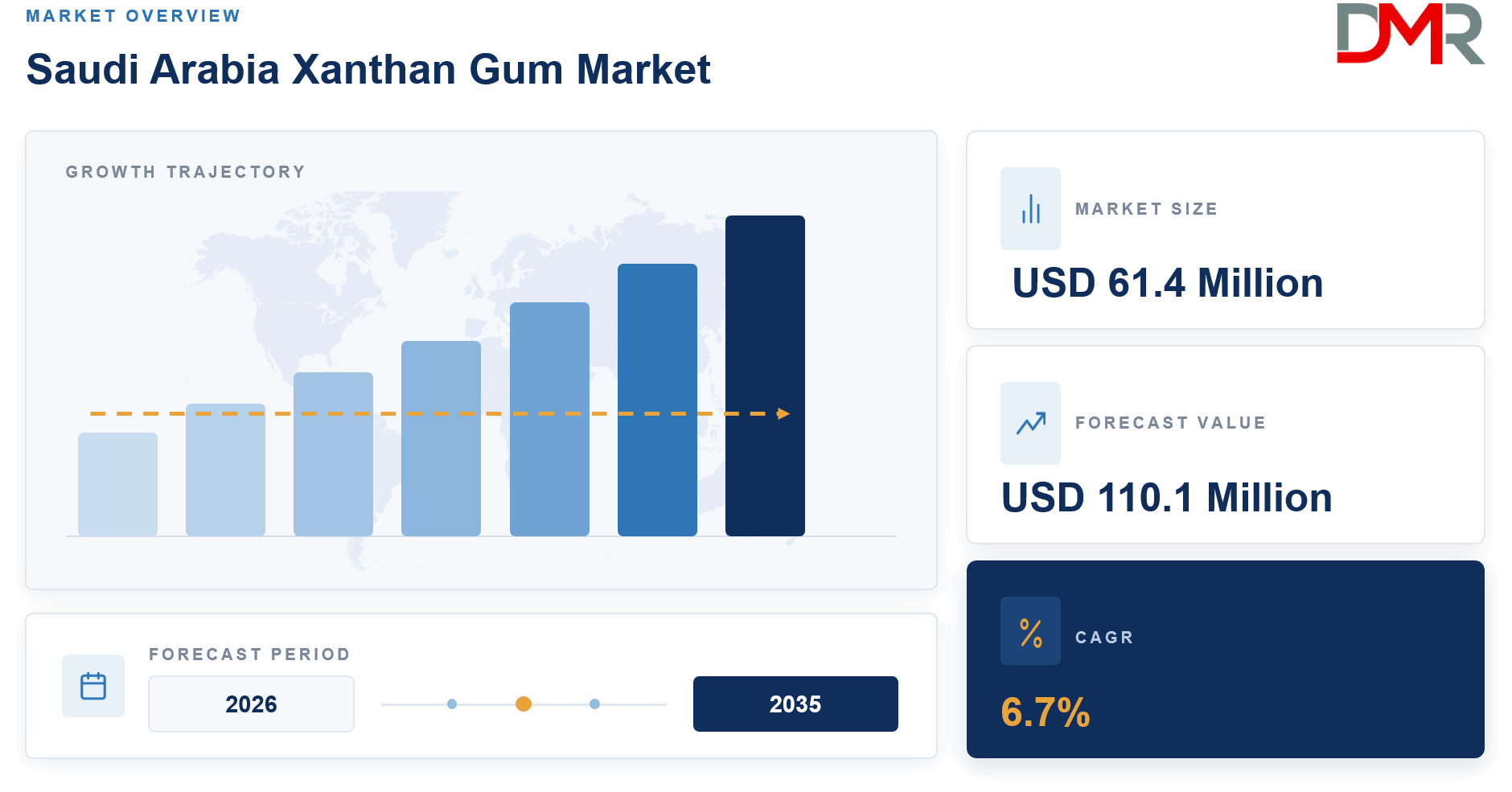

The Saudi Arabia Xanthan Gum Market is expanding as demand for functional ingredients increases across food processing, oilfield services, pharmaceuticals, personal care, and industrial applications. The market is estimated at USD 61.4 million in 2026 and is projected to reach USD 110.1 million by 2035, registering a 6.7% CAGR during the forecast period.
Xanthan gum is a fermentation-derived polysaccharide widely used to control viscosity, stabilize formulations, improve suspension, and modify rheological behavior. In Saudi Arabia, demand is supported by two important consumption bases: oilfield applications and expanding food and beverage manufacturing. The material is used in water-based drilling fluids as well as sauces, dairy products, beverages, bakery products, pharmaceuticals, cosmetics, and other formulated products.
The market is also evolving toward more application-specific supply models. Customers increasingly value consistent specifications, local inventory, technical assistance, documentation, and formulation support rather than purchasing xanthan gum solely on price. This transition is creating opportunities for specialized distributors, local blenders, and suppliers offering customized solutions.
Saudi Arabia Xanthan Gum Market Overview
Xanthan gum is valued for its ability to deliver viscosity and stability at relatively low concentrations. Its performance across different temperatures, pH conditions, salt concentrations, and processing environments makes it useful across multiple industries.
In Saudi Arabia, the market has a diversified demand structure. Oil and gas companies and drilling-fluid suppliers use xanthan gum for rheology control and solids suspension in water-based drilling systems. Food manufacturers use food-grade xanthan gum as a thickener and stabilizer, while pharmaceutical and personal care companies use it for suspension, texture control, and formulation stability.
Key Market Statistics
- Market Size in 2026: USD 61.4 million
- Projected Market Size by 2035: USD 110.1 million
- Forecast CAGR: 6.7%
- Leading Grade: Food Grade, approximately 34.5% share in 2026
- Leading Application: Thickening & Stabilizing, around 40.2% share in 2026
- Leading End-Use Industry: Oil & Gas, approximately 36.8% share in 2026
- Leading Form: Powder, approximately 78.6% share in 2026
- Fast-Growing Form: Premixed Blends, 9.1% CAGR through 2035
Key Drivers of the Saudi Arabia Xanthan Gum Market
Growth of Oilfield Applications
Oil and gas remains a significant demand base for xanthan gum in Saudi Arabia. The ingredient is used in water-based drilling fluids to provide viscosity, suspend drilled solids, and support fluid performance under changing operating conditions.
Oilfield Grade is projected to expand at an 8.2% CAGR through 2035, supported by continued demand from drilling-fluid applications and increasing localization of oilfield chemical supply.
The concentration of energy-related activity in the Eastern Province also supports demand for specialized chemical suppliers and locally available drilling-fluid additives.
Expansion of Food Manufacturing
Food and beverage manufacturing is another important growth engine. Xanthan gum can improve texture, stabilization, suspension, and consistency in sauces, dairy products, beverages, bakery fillings, and convenience foods.
The Food & Beverage end-use industry is projected to grow at an 8.0% CAGR from 2026 to 2035, making it one of the fastest-growing major end-use areas in the market.
Increasing product diversification by Saudi food manufacturers can further expand the range of formulations requiring hydrocolloids.
Increasing Demand for Functional Ingredients
Manufacturers are increasingly seeking ingredients that perform multiple functions within a formulation. Xanthan gum can provide thickening, stabilization, suspension, and rheology modification, making it suitable for complex formulations.
This multifunctionality supports its use across both consumer products and industrial applications.
Expansion of Local Supply and Distribution
The Saudi market is gradually shifting toward supply models that combine product availability with technical support and specification management. Local distributors can provide shorter replenishment times, smaller order quantities, documentation, and formulation assistance.
This trend is particularly relevant for customers that require consistent supply but may not purchase large volumes directly from international producers.
Download a Complimentary PDF Sample Report:
https://dimensionmarketresearch.com/request-sample/saudi-arabia-xanthan-gum-market/
Food Grade Xanthan Gum Maintains a Leading Position
Food Grade xanthan gum is projected to account for approximately 34.5% of market revenue in 2026, making it the leading grade segment. Its broad application base across food and beverage products supports its market position.
Food manufacturers use xanthan gum to manage viscosity, improve product stability, and maintain consistent texture. It can also support formulation performance in products exposed to different processing and storage conditions.
As Saudi food manufacturers expand their product portfolios, demand for consistent food-grade material and technical formulation support is expected to increase.
Thickening and Stabilizing Leads Applications
The Thickening & Stabilizing application is projected to account for approximately 40.2% of market demand in 2026. Xanthan gum is widely used for increasing viscosity and preventing phase separation in formulated products.
The ingredient is especially useful when manufacturers require stable texture across processing, transportation, and storage. Applications include sauces, dressings, dairy beverages, prepared foods, and other formulated products.
Rheology Modification is another important area, with the segment forecast to grow at an 8.4% CAGR through 2035. This reflects demand for controlled flow behavior in food, chemical, and oilfield applications.
Powder Remains the Dominant Form
Powder is expected to account for approximately 78.6% of market demand in 2026. Powdered xanthan gum is convenient to transport, store, measure, and incorporate into dry and liquid formulations.
Its long-term storage characteristics and compatibility with established manufacturing processes make powdered xanthan gum particularly suitable for importers, distributors, food manufacturers, and oilfield chemical suppliers.
However, Premixed Blends are expected to record faster growth, with a projected 9.1% CAGR through 2035. These blends can combine xanthan gum with complementary hydrocolloids or other functional ingredients to deliver application-specific performance.
Oil & Gas Represents a Major End-Use Market
Oil & Gas is projected to account for approximately 36.8% of end-use revenue in 2026. Xanthan gum is used in water-based drilling fluids where rheological control and solids suspension are important.
The continued importance of drilling activity in Saudi Arabia creates a substantial addressable market for oilfield-grade xanthan gum. Suppliers that can provide consistent specifications, technical support, and dependable local inventory can address the requirements of drilling-fluid manufacturers and service companies.
Market Trends
Shift Toward Application-Ready Blends
One of the notable trends is increasing interest in premixed and application-ready stabilizer systems. Rather than purchasing individual hydrocolloids and developing formulations internally, some manufacturers can benefit from blends designed for specific applications.
This approach can simplify formulation development and improve consistency while reducing the need for extensive internal ingredient optimization.
Greater Importance of Traceability
Food, pharmaceutical, and personal care manufacturers increasingly require detailed product documentation. Specifications related to quality, batch consistency, microbiological characteristics, and regulatory requirements can influence supplier selection.
As qualification requirements become more important, suppliers with strong documentation and quality-control systems can differentiate themselves.
Growth of Technical Distribution
Distribution companies are increasingly providing services beyond simple product resale. Local inventory management, formulation assistance, regulatory documentation, and technical support can become important components of the customer relationship.
Distributors and Traders are forecast to grow at a 7.6% CAGR through 2035, indicating increasing relevance of specialized distribution channels.
Increasing Use of Digital Tools
AI and data analytics can support formulation screening, quality control, documentation management, and drilling-fluid optimization. In food applications, data-driven tools can help compare viscosity, dosage, texture, and formulation stability before laboratory validation.
In oilfield applications, predictive models can assist engineers in evaluating fluid characteristics under changing temperature, salinity, solids loading, and circulation conditions.
Market Restraints
Import Dependence and Price Volatility
A significant portion of xanthan gum is supplied through international production and distribution networks. Changes in raw material costs, fermentation economics, freight expenses, and supplier availability can influence prices and inventory requirements.
This can encourage some buyers to evaluate alternative hydrocolloids or blended formulations when cost pressures increase.
Competition from Alternative Hydrocolloids
Xanthan gum competes with ingredients such as guar gum, carrageenan, pectin, cellulose derivatives, and modified starches. The choice depends on formulation requirements, cost, texture, processing conditions, labeling considerations, and desired functionality.
Consequently, suppliers need to demonstrate application-specific performance rather than relying solely on product availability.
Growth Opportunities
Application-Specific Stabilizer Systems
The growth of premixed blends creates opportunities for suppliers to develop customized hydrocolloid systems. Blends can be designed for dairy beverages, sauces, bakery products, meat products, frozen foods, and other applications.
Providing formulation-ready solutions can help suppliers move from commodity ingredient sales toward higher-value technical offerings.
Localized Oilfield Chemical Supply
Oilfield Grade xanthan gum is projected to grow at an 8.2% CAGR through 2035, creating opportunities for suppliers supporting Saudi drilling-fluid applications.
Local inventory, technical assistance, quality consistency, and application-specific product development can strengthen supplier relationships with oilfield customers.
Food and Beverage Product Innovation
Saudi food manufacturers are expanding product categories and increasing domestic production capabilities. This can create additional demand for ingredients that improve stability, texture, viscosity, and product consistency.
Food-grade xanthan gum suppliers can benefit by supporting manufacturers with formulation assistance and application-specific grades.
Purchase the complete report for comprehensive market insights:
https://dimensionmarketresearch.com/checkout/saudi-arabia-xanthan-gum-market/
Saudi Arabia Xanthan Gum Market Segmentation
By Grade
- Food Grade
- Oilfield Grade
- Pharmaceutical Grade
- Cosmetic Grade
- Technical Grade
- Others
By Application
- Thickening & Stabilizing
- Rheology Modification
- Suspension
- Emulsification
- Binding
- Others
By Form
- Powder
- Granular
- Liquid Dispersion
- Premixed Blends
- Others
By End-Use Industry
- Oil & Gas
- Food & Beverage
- Pharmaceuticals
- Personal Care & Cosmetics
- Industrial Processing
- Others
By Distribution Channel
- Direct Sales
- Distributors & Traders
- Specialty & Online Channels
- Others
Saudi Arabia Xanthan Gum Market Outlook
The Saudi Arabia Xanthan Gum Market is expected to maintain steady growth through 2035, supported by demand from both industrial and consumer-facing industries. The market is projected to increase from USD 61.4 million in 2026 to USD 110.1 million by 2035, reflecting a 6.7% CAGR.
Oil and gas applications will remain important because xanthan gum provides useful rheological properties in water-based drilling fluids. Meanwhile, food and beverage manufacturing is expected to provide an expanding source of demand as domestic production and product diversification increase.
The market is also likely to become more service-oriented. Customers increasingly value local availability, technical support, documentation, customized blends, and reliable quality. This creates opportunities for suppliers that can combine product performance with application expertise.
Competitive Landscape
Competition in the Saudi Arabia Xanthan Gum Market includes international ingredient manufacturers, chemical distributors, oilfield service providers, and domestic specialty suppliers.
Companies compete through product quality, consistency, pricing, technical assistance, supply reliability, local inventory, and application support. Food and pharmaceutical customers may place greater emphasis on documentation and qualification, while oilfield customers can prioritize rheological performance, reliability, and availability.
The increasing importance of technical distribution and application-specific products is creating opportunities for suppliers to differentiate beyond conventional commodity sales.
Key Market Insights
- Saudi Arabia Xanthan Gum Market is valued at USD 61.4 million in 2026.
- The market is projected to reach USD 110.1 million by 2035.
- The forecast CAGR is 6.7% from 2026 to 2035.
- Food Grade leads the grade segment with approximately 34.5% share in 2026.
- Thickening & Stabilizing leads applications with approximately 40.2% share.
- Oil & Gas represents approximately 36.8% of end-use revenue in 2026.
- Powder accounts for approximately 78.6% of demand.
- Premixed Blends are forecast to grow at 9.1% CAGR through 2035.
- Food & Beverage is projected to grow at an 8.0% CAGR.
- Oilfield Grade is projected to grow at an 8.2% CAGR.
Frequently Asked Questions
1. What is the size of the Saudi Arabia Xanthan Gum Market?
The Saudi Arabia Xanthan Gum Market is estimated at USD 61.4 million in 2026 and is projected to reach USD 110.1 million by 2035.
2. What is the CAGR of the Saudi Arabia Xanthan Gum Market?
The market is forecast to grow at a 6.7% CAGR between 2026 and 2035. Growth is supported by oilfield applications, food manufacturing, formulation demand, and expanding technical distribution.
3. Which grade leads the Saudi Arabia Xanthan Gum Market?
Food Grade is expected to lead the market by grade, accounting for approximately 34.5% of revenue in 2026. It is widely used across sauces, dairy products, beverages, bakery products, and other processed foods.
4. Which application segment has the largest market share?
Thickening & Stabilizing is the leading application segment, accounting for approximately 40.2% of market demand in 2026. Xanthan gum is widely used to improve viscosity, texture, suspension, and formulation stability.
5. What is the outlook for the Saudi Arabia Xanthan Gum Market?
The market is expected to continue expanding through 2035, reaching USD 110.1 million at a 6.7% CAGR. Oilfield applications, food and beverage manufacturing, application-ready blends, and technical distribution are expected to remain important areas of opportunity.
Conclusion
The Saudi Arabia Xanthan Gum Market is developing across a diverse range of food, energy, pharmaceutical, personal care, and industrial applications. With the market projected to increase from USD 61.4 million in 2026 to USD 110.1 million by 2035, suppliers have opportunities across both established applications and emerging value-added solutions.
Oilfield demand provides a strong industrial foundation, while expanding food manufacturing is creating additional opportunities for food-grade xanthan gum. At the same time, premixed blends, localized supply, technical distribution, and application-specific solutions are changing how customers purchase and use xanthan gum in Saudi Arabia.
