

Peptic Ulcer Drugs Market Size, Share, Global Industry Trends, Analysis and Forecast 2026-2034

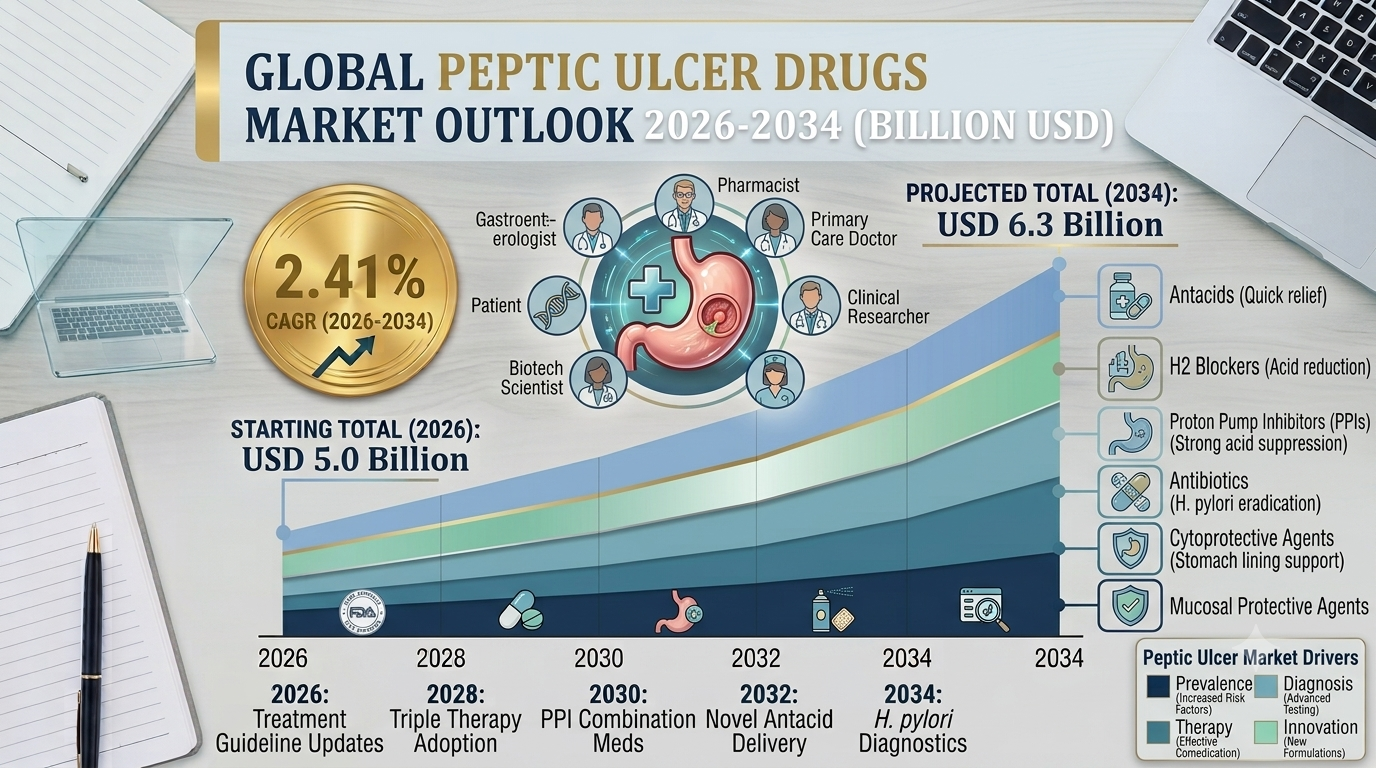
According to IMARC Group, the global peptic ulcer drugs market size reached USD 5.0 billion in 2025 and is projected to reach USD 6.3 billion by 2034, expanding at a CAGR of 2.41% during 2026–2034. These peptic ulcer drugs market figures reflect a steadily growing sector, supported by demographic trends, therapeutic innovation, and improving global healthcare access.
Peptic Ulcer Drugs Industry Overview
Peptic ulcers are open sores that develop on the inner lining of the stomach, upper small intestine, or esophagus — most commonly caused by H. pylori bacterial infection or long-term use of nonsteroidal anti-inflammatory drugs (NSAIDs). The peptic ulcer drugs industry encompasses a broad array of pharmacological interventions designed to reduce gastric acid secretion, eradicate bacterial infections, protect the gastric lining, and support ulcer healing.
Key drug categories in the peptic ulcer treatment landscape include:
● Proton Pump Inhibitors (PPIs): Widely used first-line agents that block acid production in the stomach
● Potassium-Competitive Acid Blockers (P-CABs): Next-generation acid suppressants offering faster and more sustained acid control
● Antibiotics: Critical for H. pylori eradication therapy, often used in combination regimens
● H2-Antagonists: Histamine blockers that reduce stomach acid production
● Antacids: Fast-acting OTC agents for symptomatic relief
● Ulcer Protectives: Agents that coat and protect the stomach lining from acid damage
Global Peptic Ulcer Drugs Market Size & Key Statistics
Below are the key peptic ulcer drugs market size statistics drawn from IMARC Group's comprehensive market analysis:
|
Report Attribute |
Key Statistics |
|
Base Year |
2025 |
|
Historical Period |
2020–2025 |
|
Forecast Period |
2026–2034 |
|
Market Size in 2025 |
USD 5.0 Billion |
|
Market Forecast in 2034 |
USD 6.3 Billion |
|
Market Growth Rate (2026–2034) |
2.41% CAGR |
|
Largest Region |
North America |
Request for a Sample Report for Detailed Market Insights Evaluation: https://www.imarcgroup.com/peptic-ulcer-drugs-market/requestsample
Key Market Drivers & Peptic Ulcer Drugs Market Trends in 2026
Several significant forces are shaping the peptic ulcer drugs market trends and driving sustained demand across global healthcare markets:
1. Aging Global Population and Rising PUD Prevalence
The global geriatric population is expanding rapidly. According to the World Health Organization (WHO), by 2030, one in six people worldwide will be aged 60 or older. Older adults are disproportionately affected by peptic ulcers due to increased NSAID use for musculoskeletal conditions, weakened gastrointestinal mucosal defenses, and comorbid conditions that require long-term medication. This demographic shift is a primary structural driver of the peptic ulcer drugs market growth.
2. High Incidence of H. pylori Infection
H. pylori infection remains the leading cause of peptic ulcers globally. According to data from the National Library of Medicine, peptic ulcer disease affects approximately four million individuals worldwide annually, with a lifetime prevalence of 5–10% in the general population. The persistent burden of H. pylori-associated ulcers continues to drive demand for antibiotic-based eradication therapies and combination drug regimens.
3. Technological Advancements in Drug Development
Innovation in pharmaceutical R&D is accelerating the development of next-generation ulcer therapies. The emergence of potassium-competitive acid blockers (P-CABs) — such as vonoprazan and zastaprazan — represents a significant leap over traditional PPIs, offering faster onset, longer acid suppression duration, and improved efficacy against antibiotic-resistant H. pylori strains. These advancements are reshaping treatment protocols and driving premiumization within the market.
4. Growing Demand for OTC Ulcer Medications
There is increasing consumer preference for over-the-counter (OTC) treatments to manage mild-to-moderate peptic ulcer symptoms and gastroesophageal reflux disease (GERD). Products such as antacids, H2-antagonists, and low-dose PPIs available without prescription are gaining traction, particularly in emerging markets where access to prescription healthcare remains limited.
5. Shifting Consumer Preference Toward Non-Invasive Treatment
Patients are increasingly opting for pharmacological management of peptic ulcers over invasive surgical interventions. Drug-based therapies offer comparable efficacy with significantly lower risk, shorter recovery periods, and reduced healthcare costs — making them the preferred choice for both patients and physicians.
6. Lifestyle Factors Fueling Duodenal and Gastric Ulcers
Rising consumption of spicy and processed foods, alcohol, caffeine, and tobacco — coupled with high-stress modern lifestyles — is increasing the incidence of both gastric and duodenal ulcers. As fast-food consumption continues to grow globally, so does the population of individuals at elevated risk for peptic ulcer disease, sustaining demand for preventive and curative drug therapies.
Key Market Segmentation
By Product Type
Antibiotics – Largest Segment
Antibiotics represent the largest product type segment in the peptic ulcer drugs market. Since H. pylori infection is the primary cause of peptic ulcers in the majority of cases globally, antibiotics are a cornerstone of combination eradication therapy. Regimens typically pair antibiotics such as clarithromycin, amoxicillin, or metronidazole with a PPI to achieve high eradication rates and prevent ulcer recurrence.
Other Product Types:
● Proton Pump Inhibitors (PPIs)
● Potassium-Competitive Acid Blockers (P-CABs)
● Antacids
● H2-Antagonists
● Ulcer Protectives
By Ulcer Type
Duodenal Ulcer – Largest Market Share
Duodenal ulcers account for the largest share by ulcer type. Dietary habits — particularly diets high in spicy foods, alcohol, and caffeine — are significant risk factors for duodenal ulcer development. As global fast-food consumption grows and alcohol use rises, duodenal ulcer incidence is expected to remain elevated, sustaining demand for targeted pharmacological interventions.
Other Ulcer Types:
● Gastric Ulcer
● Others
By Distribution Channel
Hospital Pharmacies – Largest Segment
Hospital pharmacies represent the dominant distribution channel. The aging population's higher vulnerability to gastrointestinal complications drives increased hospital admissions for PUD-related issues, boosting demand for intravenous and prescription-only ulcer medications dispensed through hospital channels. Additionally, prophylactic use of ulcer drugs in ICU patients and those on mechanical ventilation contributes to sustained hospital pharmacy demand.
Other Distribution Channels:
● Retail Pharmacies
● Online Pharmacies
Regional Market Analysis
|
Region |
Key Highlights |
|
North America – Largest |
United States & Canada; high PUD prevalence, strong OTC medication demand, aging population, advanced pharmaceutical infrastructure, widespread NSAID use |
|
Europe |
Germany, France, UK, Italy, Spain, Russia; mature healthcare systems, rising H. pylori awareness, growing demand for combination therapies |
|
Asia Pacific |
China, Japan, India, South Korea, Australia, Indonesia; fast-growing healthcare sector, rising gastrointestinal disorder incidence, expanding pharmaceutical manufacturing |
|
Latin America |
Brazil, Mexico; Brazil is the largest LatAm healthcare market, growing demand for affordable ulcer medications as healthcare access expands |
|
Middle East & Africa |
UAE, Saudi Arabia, South Africa; healthcare modernization programs, rising chronic disease burden, increasing awareness of peptic ulcer treatments |
Connect for Detailed Segmentation Analysis – Speak to an Analyst: https://www.imarcgroup.com/request?type=report&id=6684&flag=C
Leading Players in the Peptic Ulcer Drugs Industry
The global peptic ulcer drugs market features a mix of multinational pharmaceutical giants and specialized drug manufacturers. Key companies covered in the IMARC Group report include:
● Abbott Laboratories
● AstraZeneca plc
● Boehringer Ingelheim International GmbH
● Novitium Pharma LLC
● Pfizer Inc.
● PharmaKing Co. Ltd.
● RedHill Biopharma Ltd
● Viatris Inc.
● Yuhan Corporation
● Zydus Lifesciences Limited
The report includes competitive analysis covering market structure, player positioning, top winning strategies, a competitive dashboard, and a company evaluation quadrant.
Latest Industry Developments
September 2024 – HK inno.N
HK inno.N announced that its new drug for gastroesophageal reflux disease and peptic ulcer, "K-CAB," received regulatory approval in six Latin American countries — a significant market expansion for this innovative potassium-competitive acid blocker.
September 2024 – Jeil Pharmaceutical
Jeil Pharmaceutical released Jaqbo (zastaprazan citrate), a novel potassium-competitive acid blocker (P-CAB), entering the Korea peptic ulcer medicine market and reinforcing the global pipeline of next-generation acid-suppression therapies.
June 2024 – Mankind Pharma & Takeda Pharmaceutical
Mankind Pharma and Takeda Pharmaceutical Company Limited signed a non-exclusive patent license agreement to commercialize "Vonoprazan" in the Indian market — enabling Mankind Pharma to market this innovative P-CAB for treating GERD, duodenal ulcers, and peptic ulcers under its own trademark.
About Us
IMARC Group is a leading global market research company providing data-driven insights and expert consulting services to businesses seeking to achieve their strategic objectives. With a multi-disciplinary team of industry experts, IMARC delivers thorough, reliable market intelligence across sectors including Technology, Construction, Healthcare, Energy, Food & Beverages, and more.
Contact Us
IMARC Group
United States: +1-201-971-6302
India: +91-120-433-0800
United Kingdom: +44-753-714-6104
