

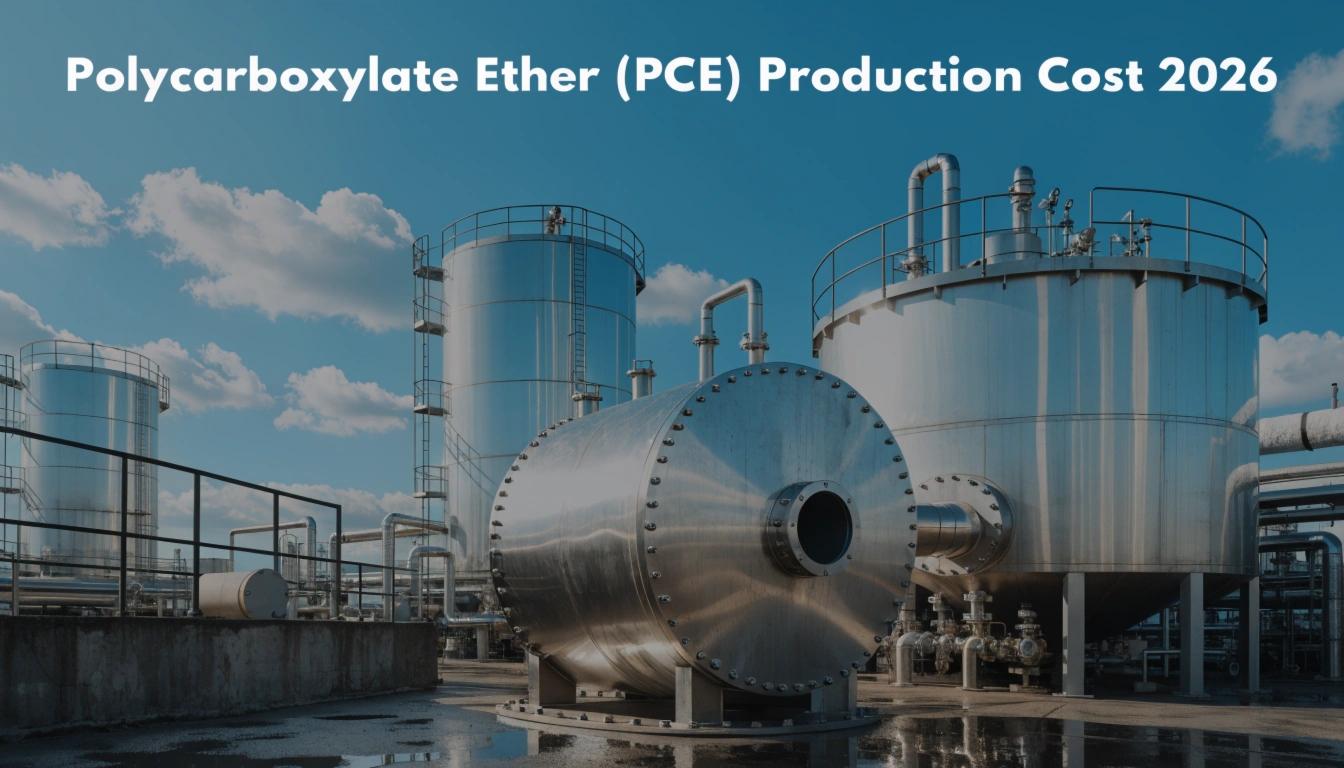
Polycarboxylate Ether (Pce) Production Plant Setup Cost 2026 DPR: CapEx/OpEx , ROI Analysis, Business Plan Consultant and Profitability

Setting up a polycarboxylate ether (PCE) production plant offers manufacturers and entrepreneurs an opportunity to enter the expanding construction chemicals and specialty admixtures sector, supported by growing demand across ready-mix concrete, precast concrete, dry-mix mortars, self-leveling compounds, grouts, and repair materials. As infrastructure development, urbanization, and construction activity continue to expand, the adoption of high-performance concrete and advanced chemical admixtures is increasing across residential, commercial, and infrastructure projects. PCE-based admixtures are widely valued for their ability to improve concrete workability, flowability, and performance while supporting efficient material utilization. This creates opportunities for businesses seeking to establish operations in the technologically advanced specialty chemicals segment.
IMARC Group's Detailed Project Report (DPR) provides a complete roadmap for establishing a polycarboxylate ether (PCE) production plant cost - covering market outlook, plant setup, machinery, raw materials, cost structure, and investment opportunities.
Market Outlook and Investment Opportunity:
India's polycarboxylate ether (PCE) market demonstrates strong growth potential, valued at USD 324.39 Million in 2025. According to IMARC Group's estimates, the market is expected to reach USD 554.59 Million by 2034, exhibiting a CAGR of 6.14% from 2026 to 2034. This growth is driven by rapid infrastructure development, increasing demand for high-performance concrete, rising urbanization, and the growing adoption of advanced chemical admixtures in construction.
Polycarboxylate ether (PCE) is a superplasticizer made from polymers, used to improve the workability, strength, and durability of concrete. PCE concrete admixtures are produced from acrylic-based monomers and feature molecular comb polymer chains measuring several nanometers. Compared to other admixtures, PCE offers higher dispersion capability by employing steric hindrance rather than electrostatic repulsion, along with excellent cementability, higher early and long-term strengths, lower dosage rates, and greater workability.
Key Investment Highlights:
●Process Used: Polymerization, esterification and etherification.
● End-use Industries: Ready-mix concrete, precast concrete, dry-mix mortars, self-leveling compounds, grouts and repair materials.
● Applications: Used as a superplasticizer in high-performance concrete, a water reducer in mortars, a dispersant in cement suspensions, and a rheology modifier in specialized construction formulations.
Plant Capacity and Production Scale:
The proposed polycarboxylate ether (PCE) production facility is designed with an annual production capacity ranging between 20,000-50,000 MT, enabling economies of scale while maintaining operational flexibility. This capacity allows manufacturers to serve ready-mix concrete, precast concrete, dry-mix mortars, self-leveling compounds, and grouts and repair materials - ensuring steady demand across multiple construction verticals.
Factors Affecting Polycarboxylate Ether (PCE) Production Plant Cost:
The operating cost structure of a polycarboxylate ether (PCE) production plant is primarily driven by raw material consumption, particularly ethylene oxide/propylene oxide, which accounts for approximately 60-70% of total operating expenses (OpEx), followed by utilities at 15-20% of OpEx. The remainder comprises transportation, packaging, salaries and wages, depreciation, taxes, and other expenses. As with any manufacturing project, the precise investment quantum varies by plant location, capacity, technology, and material sourcing strategy.
● Raw Materials: 60-70% of OpEx
● Utilities: 15-20% of OpEx
Capital investment for the plant is led by machinery costs, which account for the largest portion of total capital expenditure, followed by land and site development costs covering land registration, boundary development, and related expenses. Exact CapEx figures (Land and Site Development Costs, Civil Works Costs, Machinery Costs, and Other Capital Costs) and detailed OpEx line items are Transportation, Packaging, Salaries and Wages, Depreciation, Taxes, Other Expenses.
Request for a Sample Report: https://www.imarcgroup.com/polycarboxylate-ether-manufacturing-plant-project-report/requestsample
Plant Setup Considerations: Step-by-Step Execution Plan:
● Site Selection: The location must offer easy access to key raw materials such as EO/PO (ethylene oxide/propylene oxide), methacrylic acid, initiators, and solvents. Proximity to target markets helps minimize distribution costs, and the site must have robust infrastructure, including reliable transportation, utilities, and waste management systems, along with compliance with local zoning laws and environmental regulations.
● Plant Layout Optimization: The layout should be optimized to enhance workflow efficiency, safety, and minimize material handling, with separate areas designated for raw material storage, production, quality control, and finished goods storage, plus space for future expansion.
● Equipment Selection: High-quality, corrosion-resistant machinery tailored for polycarboxylate ether (PCE) production must be selected, including automated reactor systems, temperature-controlled feed tanks, distillation columns, cooling and neutralization units, filtration and drying systems, quality control laboratories, and bulk storage or bagging lines, all compliant with industry safety and efficiency standards.
● Raw Material Sourcing: Reliable suppliers must be secured for raw materials like EO/PO, methacrylic acid, initiators, and solvents to ensure consistent production quality, minimize transportation costs, and stabilize pricing through long-term contracts.
● Safety and Environmental Compliance: Safety protocols must be implemented throughout the production process, with advanced monitoring systems to detect leaks or deviations, and effluent treatment systems to minimize environmental impact and ensure compliance with emission standards.
● Quality Assurance Systems: A comprehensive quality management system should be implemented across all stages of operations, with appropriate testing, monitoring, validation, SOPs, documentation, traceability, and regular audits to support continuous improvement.
Machinery, Equipment, and Production Line Planning:
Key machinery for a polycarboxylate ether (PCE) production plant includes automated reactor systems for polymerization, temperature-controlled feed tanks for monomer dosing, distillation columns, cooling and neutralization units, filtration and drying systems for purification, quality control laboratories, and bulk storage or bagging lines for finished product handling.
Raw Material Sourcing and Supply Chain Strategy:
Ethylene oxide/propylene oxide, methacrylic acid, initiators, and solvents serve as the primary raw materials for polycarboxylate ether (PCE) production, with additional chain transfer agents and neutralizing agents required depending on the process used. Establishing long-term contracts with reliable suppliers of EO/PO and methacrylic acid helps mitigate price volatility and ensures consistent raw material supply, given that raw materials alone account for the largest share of total operating expenditure.
Regulatory Compliance and Quality Standards:
Setting up a polycarboxylate ether (PCE) production plant typically requires business registration, environmental clearances, factory licenses, fire safety certifications, and industry-specific permits, with local, state, and national regulations applying depending on the location. Compliance with construction chemical specifications and quality standards creates entry barriers that favor efficient and experienced producers.
ROI and Profitability Analysis:
The polycarboxylate ether (PCE) production business demonstrates healthy profitability potential under normal operating conditions, supported by stable demand and value-added applications:
● Gross Profit Margins: 35-45%
● Net Profit Margins: 15-20%
Break-even in a polycarboxylate ether (PCE) production business typically ranges from 3 to 7 years, depending on production scale, plant capacity, market demand, and the high costs associated with safety, storage, and quality assurance for this highly reactive compound. Lower operating costs and bulk sales contracts can accelerate return on investment.
How IMARC Group Supports Polycarboxylate Ether (PCE) Production Projects:
IMARC Group provides customized Detailed Project Reports (DPRs), feasibility studies, and end-to-end project execution support to help investors, specialty chemical companies, and construction material manufacturers plan, budget, and execute polycarboxylate ether (PCE) production projects across global markets - including market assessment, machinery selection guidance, regulatory navigation, and cost modeling tailored to specific plant locations and capacities.
Speak to Analyst for a Customized Report: https://www.imarcgroup.com/request?type=report&id=14777&flag=C
Who Should Read This Report:
● First-time investors evaluating manufacturing diversification into construction chemicals
● Concrete admixture and specialty chemical companies exploring backward or forward integration
● Ready-mix concrete, precast concrete, and construction companies seeking a dependable polycarboxylate ether (PCE) supply chain
● Entrepreneurs and investors evaluating entry into the polycarboxylate ether (PCE) production sector
Industry Leadership:
The global polycarboxylate ether (PCE) industry is led by established players including BASF SE, Sika AG, Arkema Group, MAPEI S.p.A., and Fosroc International - serving ready-mix concrete, precast concrete, dry-mix mortars, self-leveling compounds, and grouts and repair materials sectors worldwide.
Recent Industry Developments:
● May 2025: BASF Industrial Formulators expanded its line of reactive polyethylene glycol products for polycarboxylate ethers (PCE) in the European construction sector with Pluriol A 2400 I. Pluriol A 2400 I is an isoprenol-PEG (iPEG) that is utilised to make third-generation superplasticizers with improved durability and flow properties.
Frequently Asked Questions:
1. What is the annual production capacity of the proposed plant?
The proposed facility is designed for an annual capacity ranging between 20,000-50,000 MT.
2. What are the expected profit margins?
Gross profit margins typically range from 35-45%, with net profit margins of 15-20%, subject to plant-specific cost structures.
3. What is the biggest cost driver in polycarboxylate ether (PCE) production?
Raw materials - primarily ethylene oxide/propylene oxide - account for 60-70% of total operating expenditure, with utilities accounting for a further 15-20%, making supplier relationships and price contracts a critical planning priority.
4. What raw materials are required for polycarboxylate ether (PCE) production?
Polycarboxylate ether (PCE) production requires raw materials such as acrylic acid, methacrylic acid, polyethylene glycol (PEG) or other polyether derivatives, initiators, chain transfer agents, neutralizing agents, and water.
Buy Now: https://www.imarcgroup.com/checkout?id=14777&method=2175
About Us:
IMARC Group is a global management consulting firm that helps the world's most ambitious changemakers create a lasting impact. The company excels in understanding its clients' business priorities and delivering tailored solutions that drive meaningful outcomes. IMARC Group provides a comprehensive suite of market entry and expansion services, including market assessment, feasibility studies, company incorporation assistance, factory setup support, regulatory approvals and licensing navigation, branding, marketing and sales strategies, competitive landscape and benchmarking analyses, pricing and cost research, and procurement research.
Contact Us:
IMARC Group
134 N 4th St. Brooklyn, NY 11249, USA
Email: [email protected]
Tel No: (D) +91 120 433 0800
United States: (+1-201-971-6302)
