

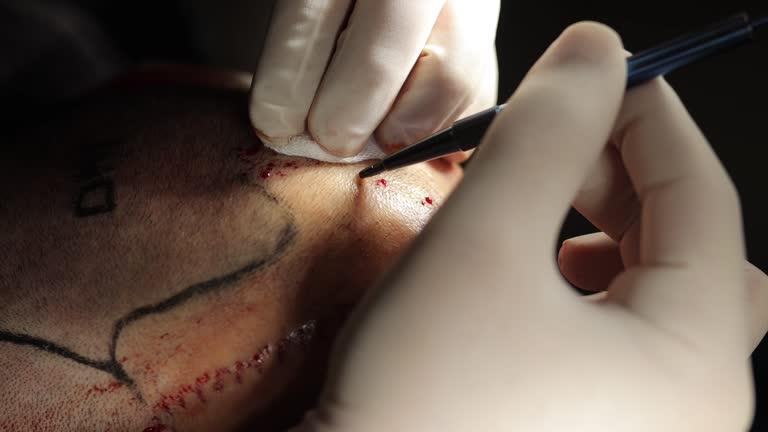
Yes, FUSS Hair Transplant in Dubai can restore density through a thinning mid-scalp when suitable donor follicles are available and the recipient area can support transplantation. Mid-scalp restoration is particularly dependent on blending transplanted grafts with existing miniaturized hair rather than simply filling the region with uniform density.
The middle scalp also acts as a visual bridge between the frontal hairline and crown, making graft distribution important for overall continuity.
Why Mid-Scalp Thinning Is Different
The mid-scalp is a transition zone
The mid-scalp connects the frontal region to the vertex. If density is restored only at the front while the middle remains thin, the overall scalp can still appear sparse.
Existing miniaturized hair matters
Many patients seeking mid-scalp restoration still have native follicles in the region. These hairs may provide meaningful coverage and should be incorporated into the surgical design.
How FUSS Hair Transplant in Dubai Can Add Mid-Scalp Density
Donor strip harvesting
FUSS removes a strip of donor scalp containing follicular units. The strip is then dissected under magnification into individual grafts.
This can provide a substantial graft supply for patients who require more than a small localized restoration.
Recipient mapping
The surgeon identifies areas of greatest visual thinning and maps the recipient sites around existing follicles.
Gradual density transition
The objective is to avoid an obvious difference between transplanted and native hair. Density can be graduated according to the surrounding pattern.
Graft Direction in the Mid-Scalp
Following native growth
Mid-scalp hair generally has a forward-oriented pattern, but individual angles vary. Recipient sites need to follow the existing direction rather than imposing one uniform angle.
Connecting frontal and crown regions
The middle area should visually connect both regions. A poorly planned transition can make the frontal and crown areas appear like separate restoration zones.
Working between existing follicles
Where native hair remains, recipient sites need to be placed with care to reduce unnecessary trauma and preserve existing density.
Donor Assessment for Mid-Scalp Restoration
Donor density
A larger thinning region can require considerable donor supply. Donor density therefore needs to be assessed before promising a particular coverage level.
Hair thickness
Hair caliber affects how much visual coverage individual grafts can create.
Overall scalp pattern
The surgeon should evaluate whether the mid-scalp is the primary area of loss or part of a broader pattern involving the frontal scalp and crown.
A clinical review of strip harvesting identifies donor surface area and density relative to the recipient area as important considerations when selecting candidates.
Mid-Scalp Graft Planning
| Planning variable | Mid-scalp relevance | Desired outcome |
|---|---|---|
| Existing native hair | Provides baseline coverage | Preserve useful follicles |
| Donor density | Determines graft availability | Efficient allocation |
| Hair caliber | Affects visual fullness | Match graft characteristics |
| Growth direction | Controls natural appearance | Follow native angles |
| Frontal density | Influences transition | Avoid abrupt density changes |
| Crown density | Affects posterior balance | Maintain continuity |
Mid-Scalp Restoration With Extensive Loss
Frontal-first planning
When frontal recession is substantial, the hairline may receive priority because it strongly influences facial appearance.
Mid-scalp priority
If the frontal region remains reasonably covered but the middle scalp is visibly sparse, donor follicles can be directed toward the central thinning area.
Combined restoration
When both frontal and mid-scalp areas are significantly affected, graft distribution needs to be planned across the entire region rather than treating each area independently.
FUSS and the Goal of Density
Density should be understood as visual coverage rather than simply the number of grafts inserted.
Natural spacing
Follicular units should be distributed according to the existing pattern.
Appropriate graft selection
Single-hair units can support softer transitions, while larger follicular units may contribute greater density in appropriate areas.
Avoiding unnecessary overpacking
More grafts do not automatically equal a better result. Recipient-site planning needs to account for native follicles, tissue characteristics and available donor resources.
FUSS Versus FUE for Mid-Scalp Restoration
FUSS and FUE differ primarily in how donor follicles are harvested. FUSS removes a strip and then separates follicular units; FUE extracts units individually.
Either approach requires careful recipient-site planning. The relevant question is which harvesting method fits the patient's donor characteristics, graft requirements, hairstyle and restoration objectives.
Recovery After Mid-Scalp FUSS
Early period
Patients may experience redness, swelling, tightness and scabbing. The scalp needs gentle handling during this period.
Shedding
Transplanted hairs can shed after surgery before entering a resting phase. This is part of the expected growth cycle.
Regrowth
New growth develops gradually rather than immediately. Tajmeels' FUT guidance places early visible growth several months after surgery, with fuller maturation continuing toward approximately 10–12 months.
Dubai-Specific Aftercare
Mid-scalp patients should protect the healing scalp from direct Dubai sunlight and follow instructions concerning exercise, scalp washing and physical activity.
For people who work indoors with continuous air conditioning, gentle scalp care remains preferable to applying unapproved products during the healing period.
Questions Patients Commonly Ask
Can FUSS restore density between existing hairs?
It can be planned around existing native follicles when the recipient area and donor supply are suitable.
Is mid-scalp restoration different from hairline restoration?
Yes. The mid-scalp functions as a transition zone and usually requires different density and directional planning from the frontal edge.
Can mid-scalp thinning be treated without restoring the hairline?
Potentially, if the frontal region is sufficiently stable and the surgical plan supports isolated mid-scalp restoration.
How long does mid-scalp regrowth take?
Hair restoration develops progressively over several months, with fuller maturation generally taking longer.
The Strategic Investment
Mid-scalp restoration is about rebuilding continuity, not simply adding follicles to a sparse patch. FUSS Hair Transplant in Dubai can improve mid-scalp density when donor supply, native hair and recipient-site conditions support transplantation. At Tajmeels Clinic, graft placement can be planned to connect the frontal and posterior scalp while preserving the natural direction and distribution of existing hair.
