

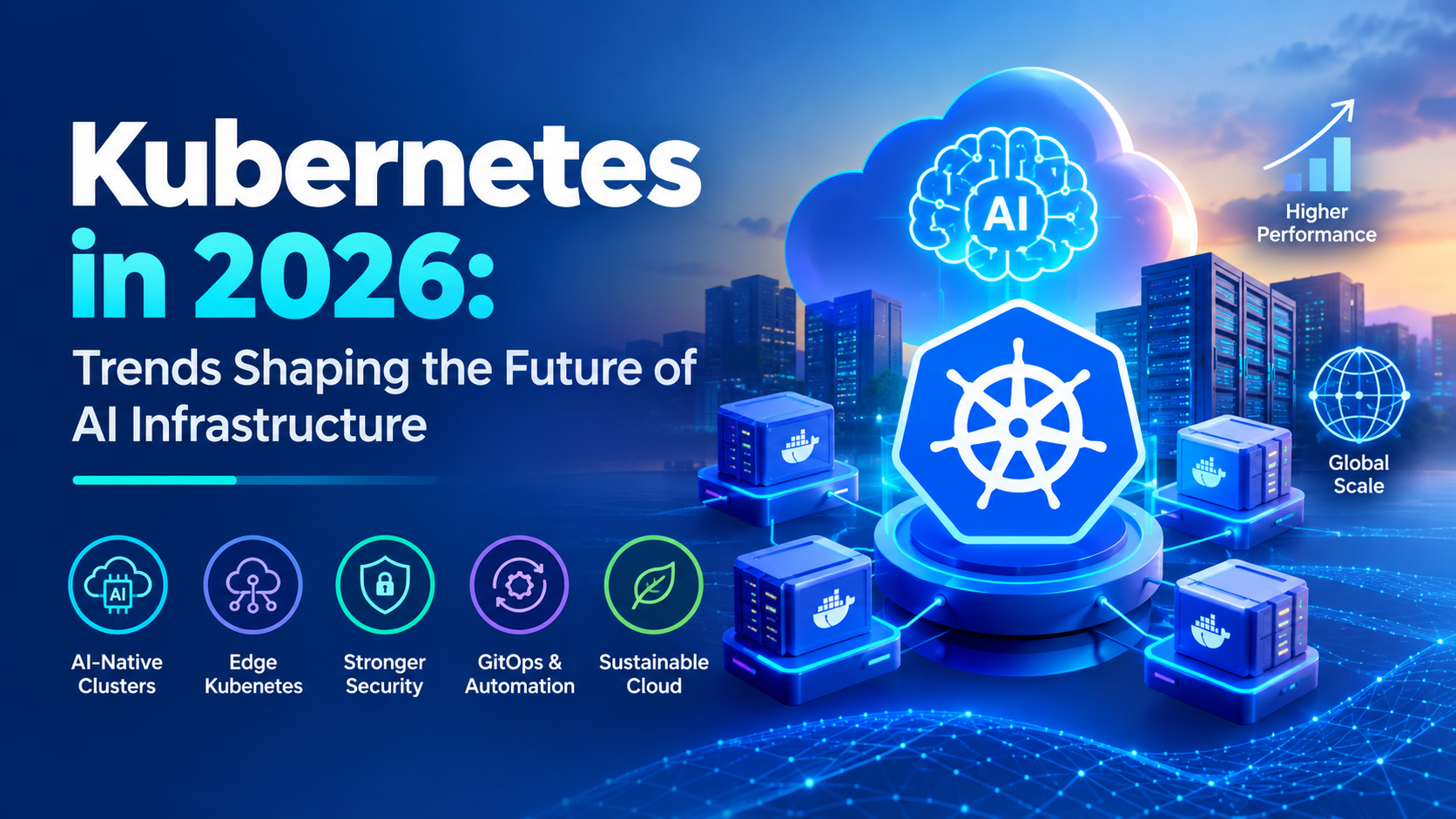

Kubernetes began as a way to manage containers. Today, it's become something much bigger. Red Hat's 2026 State of Kubernetes Fleet Management report, based on a survey of 785 IT professionals conducted in March 2026, found that 85 percent of organizations grew their Kubernetes fleet over the past year, and 70 percent now run Kubernetes across multiple cloud providers. Kubernetes in 2026 stands as a genuine foundation for distributed, cloud-native infrastructure, increasingly supporting AI workloads alongside everything else it manages.
How AI is Changing the Role of Kubernetes
Teams are using Kubernetes for far more than deploying microservices now. Model training, inference, data processing, and full AI pipelines increasingly run on Kubernetes clusters, and that shift brings real technical demands: GPU scheduling and efficient resource allocation have become genuine priorities.
The Three Trends Shaping Kubernetes in 2026
Trend 1: AI Infrastructure is Becoming an Integrated Ecosystem
Kubernetes now connects AI models with data pipelines, storage, compute, observability, and deployment infrastructure, all working together as one system. This is what AI infrastructure as an integrated ecosystem looks like in practice: managing AI workloads and the data that feeds them as a single operational environment, tightly connected instead of scattered across disconnected tools.
Enterprises running real AI initiatives need infrastructure built to support the complete AI lifecycle, from raw data through a trained model to something running reliably in production, and that's exactly the gap Kubernetes is stepping into.
Trend 2: Kubernetes Is Expanding Across Modern IT Environments
As edge computing expands, Kubernetes is increasingly being used to manage workloads closer to where data is generated.
Hybrid, Multi-Cloud, and Distributed Kubernetes
Managing workloads across different cloud and enterprise environments has become the standard setup for most organizations today. That reality demands consistent orchestration, clear visibility, and centralized management, capabilities that matter even more once workloads span multiple providers and regions at once.
Kubernetes at the Edge
Edge infrastructure is playing a growing role in real-time AI inference and distributed applications. Industries like manufacturing, healthcare, logistics, and retail are putting this to real use, running inference directly where data is generated, closer to the source and faster to respond.
Trend 3: Reliability and Observability Take Center Stage
Monitoring AI and data-intensive workloads has become genuinely important as these systems scale. Performance, reliability, resource utilization, and cost visibility all demand real attention, and AI-assisted observability is helping teams build more proactive Kubernetes operations.
For deeper reading on OpenTelemetry, eBPF, SLOs, and AI-powered observability, USDSI®'s Kubernetes Observability and Monitoring Trends in 2026 covers this ground well.
Kubernetes Cost and Resource Efficiency Become Business Priorities
Managing expensive compute and GPU resources efficiently has become a genuine business priority alongside an engineering one. Workload optimization and infrastructure utilization are getting serious attention, and FinOps is playing a growing role in balancing Kubernetes performance against cloud costs.
What Kubernetes Evolution Means for Data and AI Professionals
Kubernetes knowledge is becoming genuinely relevant alongside MLOps, data engineering, cloud, and AI infrastructure skills. Understanding how models move from experimentation into scalable production environments matters more than ever for professionals working in this space.
Building Skills for the Kubernetes-Driven AI Future
Working across Kubernetes, cloud infrastructure, AI workloads, data platforms, and MLOps takes a real mix of skills, spanning several disciplines at once. Combining infrastructure knowledge with data science and AI expertise is becoming genuinely valuable, professionals who understand both sides can move models from experimentation into scalable, production-ready systems.
● USDSI®'s Certified Senior Data Scientist (CSDS™) is a natural fit here, an advanced credential built for professionals already working across AI, data science, and production technologies. This certification is self-paced, priced at US $885 all-inclusive, 4-25 weeks at 8-10 hours a week.
● Columbia Engineering's Applied Artificial Intelligence certificate offers a strong Ivy League option, built around project-based work covering real-world applications like fraud detection and demand prediction, and runs US $1,400 over three months at 6 to 8 hours a week.
● Wharton's Digital Strategy in the Era of AI Certificate rounds this out with a more strategic lens, spanning four self-paced courses on where AI actually creates value and how to lead adoption, priced at US $4,950 with roughly four weeks per course.
In a Nutshell
AI is expanding Kubernetes far beyond its original role as a container-management tool. What's emerging instead is AI infrastructure as an integrated ecosystem, one that ties AI, data, cloud infrastructure, observability, and resource management together into a single, coherent operating layer, the clearest picture yet of the Kubernetes future.
FAQs
Q. What is the difference between Kubernetes and Docker?
- Docker packages applications into containers. Kubernetes orchestrates and manages those containers at scale, handling deployment, scaling, and recovery across a cluster of machines.
Q. Can Kubernetes run without a public cloud?
- Yes. Kubernetes runs on-premises, on private infrastructure, or in hybrid setups just as well as it does on public cloud platforms.
Q. How much does it cost to run Kubernetes?
- Costs vary widely based on cluster size, cloud provider, and resource usage, especially GPU-heavy AI workloads, making FinOps practices genuinely important for keeping spend under control.
Q. Is Kubernetes difficult for beginners to learn?
- It has a real learning curve, but structured resources and hands-on practice make it approachable for engineers with a solid foundation in containers and distributed systems.
