

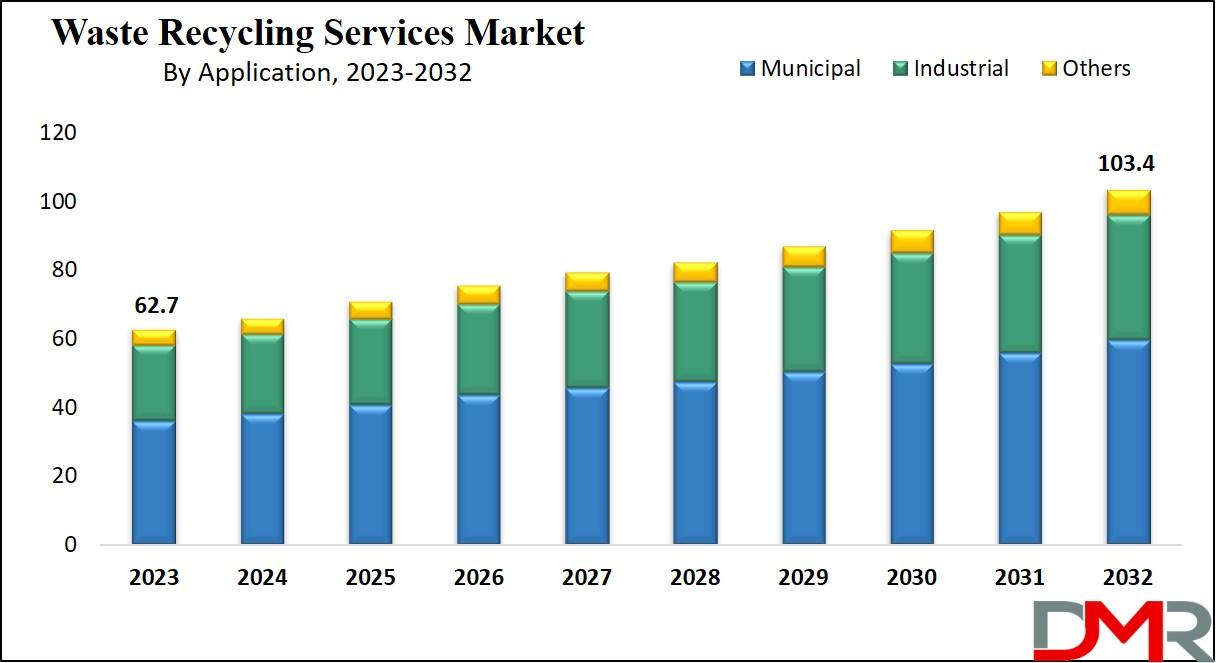

The Waste Recycling Services Market is becoming increasingly important as governments, businesses, municipalities, and consumers place greater emphasis on sustainable waste management and resource recovery. Recycling services help convert discarded materials into reusable resources while reducing the amount of waste sent to landfills and supporting more efficient use of natural resources.
According to Dimension Market Research, the Global Waste Recycling Services Market is projected to reach USD 62.7 billion in 2023 and is expected to reach USD 103.4 billion by 2032, expanding at a CAGR of 5.7% during 2023–2032.
Waste recycling services cover the collection, sorting, processing, recovery, and reuse of materials such as metals, paper and paperboard, glass, electronics, food waste, yard trimmings, and other recyclable materials. Increasing waste generation, environmental awareness, regulatory requirements, and demand for recovered materials are supporting market development.
The expansion of e-commerce, growing use of electronic devices, industrialization, and urbanization are also increasing the volume and diversity of waste streams. These developments are encouraging investment in modern recycling infrastructure, automated sorting systems, waste recovery technologies, and resource-efficient waste management services.
Complimentary Sample Report
Businesses, municipalities, recycling companies, investors, manufacturers, and sustainability professionals can access the complimentary sample report for detailed market insights covering segmentation, regional analysis, competitive landscape, market dynamics, and forecasts.
https://dimensionmarketresearch.com/request-sample/waste-recycling-services-market/
Waste Recycling Services Market Size and Growth Outlook
The Waste Recycling Services Market is projected to grow from USD 62.7 billion in 2023 to USD 103.4 billion by 2032, reflecting a 5.7% CAGR. Growing awareness of recycling benefits, stricter waste-management policies, rising waste generation, and increasing investment in recycling infrastructure are contributing to this expansion.
| Market Indicator | Value |
|---|---|
| Market Size, 2023 | USD 62.7 Billion |
| Forecast Value, 2032 | USD 103.4 Billion |
| CAGR, 2023–2032 | 5.7% |
| Asia-Pacific Share, 2023 | 45.3% |
| Leading Product Segment | Paper & Paperboard |
| Leading Application Segment | Municipal |
Asia-Pacific held the largest regional share in 2023, accounting for approximately 45.3% of the global market. Paper and paperboard represented the dominant product segment, while municipal applications held the leading position by application.
What Are Waste Recycling Services?
Waste recycling services involve organized processes for collecting, transporting, sorting, processing, recovering, and reusing materials that would otherwise be discarded.
These services can cover a wide range of waste streams, including:
- Metals
- Paper and paperboard
- Glass
- Electronics
- Batteries
- Bulbs
- Food waste
- Yard trimmings
- Industrial waste
- Other recyclable materials
Modern recycling operations increasingly combine physical collection networks with automated sorting, material recovery facilities, digital tracking, and specialized processing technologies.
Key Factors Driving the Market
Increasing Waste Generation
Rapid urbanization, population growth, industrial development, and changing consumption patterns are increasing the volume of waste generated worldwide.
Food and beverage products, consumer goods, packaging materials, electronics, and disposable products contribute to growing waste streams. As waste volumes increase, governments and businesses require more effective collection and recycling systems.
Growing Environmental Awareness
Awareness of environmental pollution and the impact of waste disposal is encouraging consumers and organizations to adopt recycling practices.
Businesses are increasingly incorporating sustainability objectives into their operations, while consumers are showing greater interest in products and services that support resource conservation.
Stricter Waste Management Policies
Governments are introducing policies and regulations designed to improve waste collection, recycling, material recovery, and responsible disposal.
These regulatory initiatives can encourage investment in recycling facilities and create opportunities for companies offering specialized waste recycling services.
Growth of Electronic Waste
The increasing use of smartphones, computers, televisions, appliances, and other electronic devices is contributing to the growth of electronic waste.
Shorter replacement cycles and declining prices of electronics can encourage consumers to replace devices more frequently. This creates additional demand for e-waste collection, processing, material recovery, and responsible disposal services.
Expansion of E-Commerce
The growth of online shopping has increased the consumption of paperboard, corrugated packaging, cartons, and other packaging materials.
The resulting increase in paper and paperboard waste is supporting demand for recycling services and recovered packaging materials.
Major Trends Shaping the Industry
Automated Waste Sorting
Automated sorting systems are becoming increasingly important in modern recycling facilities.
Sensors, optical sorting technologies, robotics, and automated separation systems can help identify and separate different materials more efficiently.
These technologies can improve sorting accuracy and increase the recovery of valuable recyclable materials.
Robotic Recycling Systems
Robotics can support repetitive sorting and handling activities within recycling facilities.
Automated systems can identify specific materials and move them into appropriate processing streams, helping recycling operators improve productivity.
Growth of E-Waste Recycling
Electronic waste is becoming an increasingly important recycling category.
Specialized recycling services can recover metals, plastics, glass, and other materials from discarded electronic products while supporting responsible handling of potentially hazardous components.
Waste-to-Energy Technologies
Waste-to-energy technologies can convert selected waste streams into usable energy.
Thermal treatment and anaerobic digestion are among the approaches that can support energy recovery from certain organic and non-recyclable waste streams.
Circular Economy Development
The shift toward a circular economy is encouraging businesses to recover materials and return them to productive use instead of treating waste as a final disposal product.
Recycling services can support circular supply chains by providing recovered materials for packaging, construction, automotive manufacturing, and other industries.
Market Segmentation
The Waste Recycling Services Market is segmented by product and application.
By Product
The market includes:
- Metals
- Paper & Paperboard
- Glass
- Bulbs, Batteries & Electronics
- Yard Trimmings
- Food
- Others
Paper and Paperboard
Paper and paperboard held the dominant position in the market.
The segment benefits from large volumes of paper-based waste generated by packaging, containers, newspapers, offices, retail operations, and e-commerce.
The increasing use of paper-based packaging as an alternative to some single-use plastic applications is also contributing to paper waste generation and recycling demand.
Metals
Metal recycling supports the recovery of valuable materials from industrial, commercial, construction, automotive, and consumer waste streams.
Recycled metals can reduce the requirement for virgin raw materials and support resource efficiency.
Glass
Glass can be repeatedly recycled without fundamentally changing its material properties, making glass collection and processing an important part of recycling infrastructure.
Bulbs, Batteries and Electronics
This category represents an important growth opportunity because of increasing electronic device consumption.
The DMR report indicates that the bulbs, batteries, and electronics segment is expected to grow at approximately 7% CAGR, supported by rising electronic waste generation.
Food Waste
Food recycling and organic waste processing can include composting, anaerobic digestion, and other recovery methods.
These approaches can help divert organic waste from landfills and create useful outputs such as compost or energy.
Yard Trimmings
Yard waste can be processed into compost, mulch, and other useful materials, supporting resource recovery and reducing landfill volumes.
By Application
The market is divided into:
- Industrial
- Municipal
- Others
Municipal Applications
Municipal applications held the leading market position in 2023.
Municipalities play a central role in waste collection, recycling, treatment, and resource recovery. Public waste-management networks can provide large-scale collection and processing capabilities across residential and commercial areas.
Public-private partnerships can also help municipalities expand recycling infrastructure and improve operational efficiency.
Industrial Applications
Industrial waste recycling is expected to experience strong growth during the forecast period.
Manufacturing, construction, food processing, energy, automotive, and other industries generate significant quantities of recyclable and recoverable materials.
Stricter environmental requirements and increased investment in industrial facilities can encourage companies to adopt specialized recycling services.
Role of Technology in Waste Recycling
Technology is transforming recycling operations by improving sorting, material identification, processing, and monitoring.
Important technologies include:
- Optical sorting
- Sensor-based separation
- Robotics
- Artificial intelligence
- Automated conveyor systems
- Digital waste tracking
- Material recovery systems
- Waste-to-energy technologies
Artificial intelligence can potentially improve material identification by analyzing visual and sensor data. Combined with robotics, AI-enabled sorting systems can increase automation and improve separation efficiency.
Applications Across Major Industries
Packaging Industry
Packaging is one of the largest sources of recyclable waste.
Paperboard, corrugated packaging, metals, glass, and other materials can be collected and processed for reuse in new packaging applications.
Automotive Industry
Automotive recycling involves the recovery of metals, plastics, glass, and other materials from vehicles and manufacturing waste.
Recovered materials can help manufacturers reduce reliance on virgin resources.
Construction Industry
Construction and demolition activities generate substantial quantities of metals, concrete, wood, glass, and other materials.
Recycling services can recover valuable materials and reduce the volume of construction waste sent to landfills.
Electronics Industry
Electronic waste recycling enables recovery of metals, plastics, and other materials from discarded devices.
Specialized processing is important because some electronic components require controlled handling.
Food and Beverage Industry
Food processing and beverage operations generate organic waste, packaging waste, glass, metals, and other recyclable materials.
Recycling and organic waste processing can support resource efficiency and sustainability goals.
Regional Market Outlook
Asia-Pacific
Asia-Pacific held the largest share of the global Waste Recycling Services Market in 2023, accounting for approximately 45.3% of market revenue.
The region's large population, rapid urbanization, industrial development, and increasing consumption are generating substantial waste volumes.
China, India, Japan, South Korea, and Southeast Asian economies represent important markets for recycling infrastructure and waste recovery services.
India is identified by DMR as a significant market for waste recycling services.
North America
North America benefits from established waste collection networks, recycling infrastructure, technology adoption, and environmental regulations.
The United States and Canada continue to invest in waste processing, material recovery, e-waste recycling, and advanced recycling technologies.
Europe
Europe has established recycling systems and strong environmental policies supporting resource recovery.
Countries such as Germany and Austria have developed relatively advanced recycling systems, while continued sustainability initiatives are encouraging investment in circular-economy infrastructure.
Latin America
Latin America offers opportunities as urbanization and industrialization increase waste volumes.
Investment in collection infrastructure, recycling facilities, and public-private partnerships can support market development across the region.
Middle East and Africa
The Middle East and Africa are gradually expanding waste-management infrastructure as urban populations grow and governments place greater emphasis on environmental sustainability.
Investment in recycling plants, waste-to-energy systems, and resource recovery can create new opportunities for service providers.
Competitive Landscape
The Waste Recycling Services Market is moderately fragmented, with numerous local and international companies operating across different waste streams and geographic markets. Companies are using investments, partnerships, acquisitions, and mergers to expand capabilities and strengthen market positions.
Prominent companies identified by Dimension Market Research include:
- Northstar Recycling
- Eurokey Recycling Ltd.
- Triple M Metal LP
- Covanta
- Epson Inc.
- Interface Inc.
- Xerox Corp.
- Biffa
- Rubicon Global
Competition is influenced by collection networks, processing capacity, technology adoption, geographic coverage, material recovery capabilities, pricing, and sustainability performance.
Challenges in the Waste Recycling Services Market
High Infrastructure Costs
Modern recycling facilities require substantial investment in collection systems, sorting equipment, processing plants, transportation, and waste-management infrastructure.
High capital requirements can create challenges for smaller operators.
Contamination of Recyclable Materials
Contamination can reduce the quality and economic value of recovered materials.
Effective source separation, consumer education, automated sorting, and improved collection practices are therefore important for maintaining recycling efficiency.
Fluctuating Recycled Material Prices
The economic value of recycled materials can vary depending on commodity prices, demand, supply, and processing costs.
Price volatility can affect the profitability of recycling operations.
Complex Waste Streams
Modern waste contains increasingly diverse materials, particularly in electronics, packaging, and consumer products.
Processing these complex waste streams may require specialized technologies and skilled personnel.
Regulatory Compliance
Recycling companies must comply with environmental, safety, transportation, and waste-handling requirements.
Changing regulations can increase compliance costs while also creating opportunities for advanced recycling solutions.
Growth Opportunities
Advanced Sorting Technologies
Sensor-based sorting, robotics, artificial intelligence, and automated separation systems can improve recovery rates and create opportunities for technology providers.
E-Waste Recycling
The continuing growth of electronic waste creates demand for specialized collection and processing services.
Plastic and Microplastic Recycling
Plastic waste remains an important area for innovation. Advanced recycling technologies can potentially recover materials from waste streams that are difficult to process through conventional methods.
Waste-to-Energy
Thermal treatment and anaerobic digestion can provide opportunities to recover energy from selected waste streams while reducing landfill dependence.
Circular Economy Solutions
Companies can develop new business models around material recovery, reuse, remanufacturing, recycled-material supply, and closed-loop recycling.
Purchase the Complete Waste Recycling Services Market Report
Organizations seeking detailed market size, segmentation, regional analysis, competitive landscape, growth drivers, trends, challenges, and opportunities can access the complete report:
https://dimensionmarketresearch.com/checkout/waste-recycling-services-market/
Future Outlook
The Waste Recycling Services Market is expected to maintain steady growth through 2032 as governments, municipalities, businesses, and consumers increase their focus on resource recovery and sustainable waste management.
The market is projected to grow from USD 62.7 billion in 2023 to USD 103.4 billion by 2032, representing a 5.7% CAGR.
Future development will be influenced by increasing waste generation, stricter environmental policies, e-commerce growth, electronic waste, industrialization, and demand for recovered materials.
Technology will remain a major factor shaping the industry. Automated sorting, robotics, sensor-based separation, digital tracking, and waste-to-energy technologies can improve the efficiency of recycling operations.
Asia-Pacific is expected to remain an important regional market because of its large population, rapid urbanization, and expanding industrial activity. North America and Europe will continue to benefit from established infrastructure, regulatory frameworks, and technology investment.
The growing emphasis on circular economy models can also expand opportunities beyond traditional waste collection and processing toward material recovery, recycled-material supply chains, and closed-loop manufacturing.
Frequently Asked Questions
1. What is the size of the Waste Recycling Services Market?
The Waste Recycling Services Market is projected to reach USD 62.7 billion in 2023 and is expected to reach USD 103.4 billion by 2032.
2. What is the CAGR of the Waste Recycling Services Market?
The market is projected to grow at a 5.7% CAGR between 2023 and 2032.
3. Which region holds the largest market share?
Asia-Pacific held the largest share in 2023, accounting for approximately 45.3% of global market revenue.
4. Which product segment dominates the market?
The Paper and Paperboard segment holds the dominant position in the Waste Recycling Services Market.
5. Who are the major companies in the market?
Major companies include Northstar Recycling, Eurokey Recycling Ltd., Triple M Metal LP, Covanta, Epson Inc., Interface Inc., Xerox Corp., Biffa, and Rubicon Global.
Conclusion
The Waste Recycling Services Market is expanding as governments, businesses, and consumers increasingly prioritize waste reduction, material recovery, and sustainable resource management.
Growing waste generation, e-commerce, electronic device adoption, industrialization, environmental awareness, and stricter waste-management policies are supporting demand for recycling services.
Technological innovation is also changing the industry through automated sorting, robotics, sensor-based systems, digital tracking, and waste-to-energy solutions.
With the market projected to grow from USD 62.7 billion in 2023 to USD 103.4 billion by 2032, recycling service providers have opportunities to expand through advanced processing technologies, e-waste management, circular economy solutions, and improved material recovery systems.
For complete market analysis:
https://dimensionmarketresearch.com/report/waste-recycling-services-market/
