

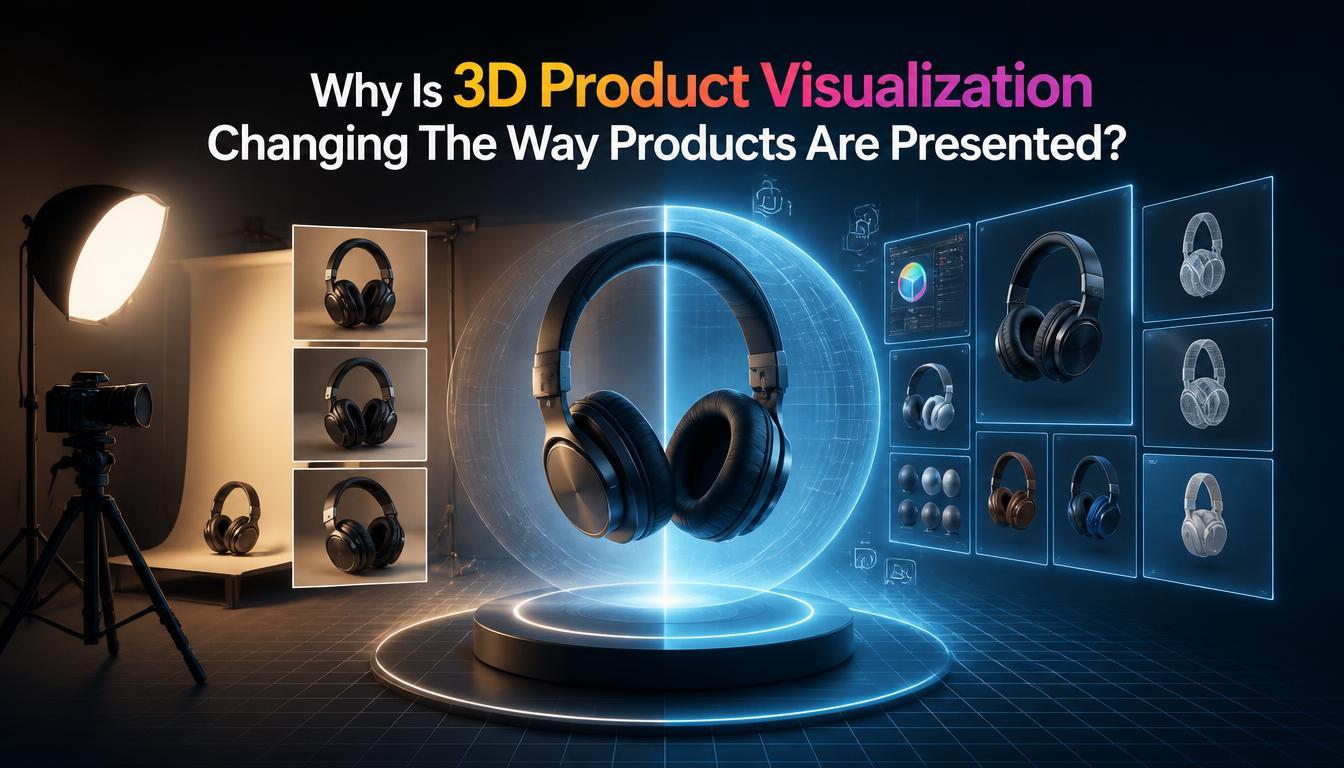

Online buyers returned an estimated 19.3% of the items they bought in 2025, nearly 1/5 of orders. And that's a huge number that can be explained by the fact that products purchased often look different on a screen than they do in real life. Which is why 3D product visualization is taking off as not only a creative solution but a critical business enabler.
SMA Archviz provides 3D product visualization services that help close this gap. Clear and accurate visuals show shoppers what they are actually buying before they click “purchase.”
“What Is Driving The Rise In Online Return Rates?
Conclusively, the issue is unsuitability since the consumer is not allowed to touch, feel, and examine the commodity before they buy it. Online returns jumped from 17.6% in 2024 to 19.3% in 2025, compared to 15.8% of all retail (NRF, 2025).
A few of the most common reasons behind that gap:
-
Static photos don't convey true scale, texture, or material finish.
-
Color and lighting in photography often do not match the real product.
-
Shoppers cannot rotate or inspect a product from angles a photographer did not shoot.
How Does 3D Product Visualization Reduce This Gap?
3D product visualization allows a shopper to interact with a product as they would in a store. They can rotate it, zoom in, and view it from different angles as opposed to only the views that a photographer chooses to capture. This allows the shopper to have more information on a product before they purchase it and can also prevent returns due to products not matching their expectations.
3D product rendering allows for accurate depictions of the products with the materials and lighting applied as one would see them in a store from all angles. Static photos can make these details harder to judge or show them differently from one image to another.
What Makes Digital Product Rendering Different From Photography?
Flexibility and consistency are major benefits of digital product visualization. A photoshoot captures one product in one setting and from only a few angles. A new shoot may be needed for each color, size, or configuration. Digital visualization allows one accurate model to create different variants, angles, and lighting conditions without starting over.
|
U.S. Retail Returns Data |
Figure |
|
Online return rate, 2025 |
19.3% |
|
Online return rate, 2024 |
17.6% |
|
Total U.S. retail returns value, 2025 |
$849.9 billion |
|
Blended all-channel retail return rate, 2025 |
15.8% |
Source: NRF
Where Does 3D Product Rendering Fit Into The Buying Journey?
3D product presentation can be used early in the product development process, often before a physical prototype is ready. A rendered product can appear in marketing, on product pages, or in early customer research while manufacturing is still underway.
It also makes product updates easier. Rather than doing a full photoshoot for each product change, the same 3D model can be modified as per the new specifications and rendered once again.
What Should Brands Look For In A Product Presentation Partner?
Accuracy matters. The render should match the real product, not a stylized version that looks better than what will actually be shipped. If a rendering makes the product look better than it really is, it may only move the return problem to a later stage.
Look for a partner that works from real product specifications and material data instead of generic stock templates. SMA Archviz creates every product render using confirmed dimensions and materials. This helps ensure that what buyers see online matches what they receive.
Conclusion
With nearly 1/5 of online orders being returned, accurate product visuals have become a vital part of online selling. 3D product visualization helps to ensure that they will get exactly what they want to buy. The main point of visualizing 3D products is to minimize the disparity between the customer's expectations and actual appearance. SMA Archviz will use the real-life dimensions, materials, and specifications of products in their renderings to guarantee that customers receive exactly what they see on the web.
