

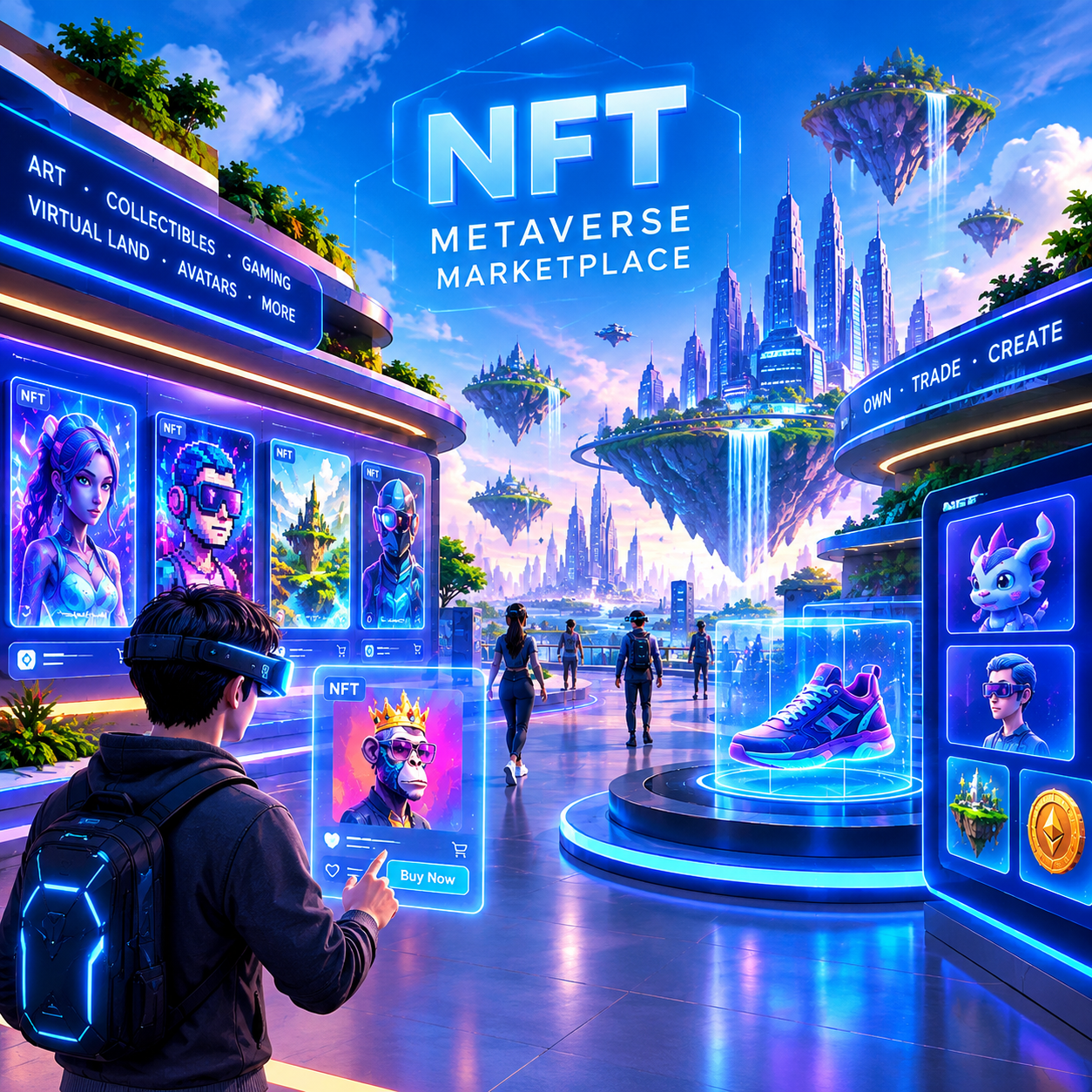
How to Build a Metaverse NFT Marketplace: Features, Technology, and Development Process

The idea of owning something in a virtual world is no longer limited to science fiction.
Virtual land, digital collectibles, gaming items, avatars, artwork, and virtual merchandise can all be represented as blockchain-based assets. When these assets are combined with immersive digital environments, a new type of platform emerges: the metaverse NFT marketplace.
But building one involves much more than creating an NFT storefront.
A successful metaverse NFT marketplace needs to bring together blockchain infrastructure, smart contracts, digital wallets, NFT standards, marketplace functionality, security, user experience, and the virtual environment itself.
So, how does the development process work?
Let's explore it.
What Is a Metaverse NFT Marketplace?
A metaverse NFT marketplace is a digital platform that allows users to discover, create, buy, sell, auction, and trade NFTs associated with a virtual ecosystem.
For example, a platform could allow users to purchase:
-
Virtual land
-
Digital artwork
-
Gaming characters
-
In-game assets
-
Avatars
-
Virtual clothing
-
Collectibles
-
Accessories
-
Virtual merchandise
The NFT represents ownership or rights associated with a particular digital asset, while the metaverse provides the environment in which that asset can be experienced or used.
This combination creates a marketplace that goes beyond simply displaying NFT images.
Why Are NFT Marketplaces Important to the Metaverse?
A virtual world needs an economy if users are going to interact with it at scale.
Imagine a gaming metaverse where users can purchase characters, upgrade their avatars, acquire virtual land, or trade digital items with other participants.
Without a marketplace, these transactions can be difficult to organize.
An NFT marketplace provides an infrastructure layer for discovering and exchanging digital assets.
This can create several interconnected components:
Virtual environment → Digital assets → NFTs → Wallets → Marketplace → Transactions
The marketplace essentially becomes one of the economic layers of the broader metaverse ecosystem.
Core Features of a Metaverse NFT Marketplace
The exact feature set depends on the business model, but several components are commonly considered during development.
1. NFT Minting
Creators need a mechanism for converting digital assets into NFTs.
The minting system can be designed around the blockchain network and token standards selected for the project.
2. NFT Listings
Creators and asset owners need a simple way to list their NFTs.
A marketplace may display information such as:
-
Asset name
-
Description
-
Creator
-
Ownership information
-
Price
-
Collection
-
Transaction history
-
Availability
A well-designed listing page makes it easier for users to understand what they are purchasing.
3. Digital Wallet Integration
Wallets connect users to blockchain-based marketplaces.
Users can connect their wallets to manage NFTs and interact with smart contracts.
Wallet integration therefore becomes an important component of the overall user experience.
4. Auctions and Bidding
Not every digital asset needs to have a fixed price.
Auction functionality can allow creators to offer NFTs through competitive bidding.
Depending on the marketplace design, users can place bids, monitor auction activity, and complete transactions when the auction ends.
5. Search and Filtering
NFT marketplaces can contain thousands or even millions of digital assets.
Search and filtering functionality helps users find relevant assets based on categories, collections, prices, attributes, and other marketplace parameters.
6. Smart Contracts
Smart contracts automate blockchain-based marketplace transactions.
They can be used for functions such as NFT creation, ownership transfers, sales, auctions, and royalty mechanisms.
Because smart contracts directly interact with blockchain assets, testing and auditing are important parts of development.
7. Admin Dashboard
A marketplace also needs an administrative layer.
An admin dashboard can help platform operators manage:
-
Users
-
NFT collections
-
Listings
-
Transactions
-
Platform activity
-
Content
-
Fees
-
Reports
The exact controls depend on whether the platform is centralized, decentralized, or uses a hybrid architecture.
How to Build a Metaverse NFT Marketplace
Building the platform generally involves multiple stages.
Step 1: Define the Business Model
The first step is understanding what the marketplace is actually designed to achieve.
Will it focus on gaming assets?
Virtual land?
Digital art?
Collectibles?
Virtual commerce?
A clearly defined use case helps determine the required features and technology architecture.
Step 2: Choose the Blockchain Network
The blockchain network influences transaction costs, performance, smart contract compatibility, wallet support, and the overall user experience.
The appropriate network should therefore be selected according to the project's technical and business requirements.
Step 3: Design the User Experience
The marketplace should make complex blockchain interactions understandable to ordinary users.
Important screens can include:
-
Homepage
-
Marketplace
-
NFT details
-
Creator profile
-
User profile
-
Wallet
-
Collection pages
-
Auction pages
-
Transaction history
-
Admin dashboard
Good UX can be particularly important because blockchain terminology and wallet interactions can otherwise create unnecessary friction.
Step 4: Develop Smart Contracts
Smart contracts provide the blockchain-based logic behind marketplace transactions.
Developers can implement contracts for NFT minting, transfers, sales, auctions, royalties, and other required functions.
Testing is essential before deploying contracts to a production blockchain.
Step 5: Develop the Marketplace
The frontend and backend components are then developed and connected with the blockchain infrastructure.
Depending on the project, the architecture can include:
-
Frontend application
-
Backend services
-
Database
-
Blockchain network
-
Smart contracts
-
Wallet integration
-
NFT storage
-
APIs
-
Admin dashboard
Step 6: Integrate the Metaverse
The marketplace can then be connected to the broader virtual environment.
For example, purchasing an NFT could give a user access to a virtual item, character, land parcel, or other digital asset within the metaverse.
This is where a conventional NFT marketplace begins to become part of a larger virtual ecosystem.
Step 7: Test the Platform
Testing should cover both conventional application functionality and blockchain-specific interactions.
Important areas include:
-
Smart contract behavior
-
Wallet connections
-
Transactions
-
NFT transfers
-
Auction logic
-
API functionality
-
User authentication
-
Platform security
-
Performance
-
Mobile responsiveness
Step 8: Deploy and Improve
After testing, the platform can be deployed to users.
However, development does not necessarily end at launch.
User feedback, analytics, security monitoring, performance optimization, and feature improvements can help the platform evolve over time.
White-Label vs Custom Metaverse NFT Marketplace
Businesses generally have two broad approaches.
Custom Development
A custom marketplace is developed around the organization's specific requirements.
This provides greater flexibility over:
-
Features
-
User experience
-
Architecture
-
Blockchain integration
-
Revenue model
-
Marketplace logic
The trade-off is that custom development generally requires more planning and development work.
White-Label Development
A white-label solution provides a pre-developed foundation that can be customized and branded for a specific business.
This can be useful for businesses that want to reduce development time while retaining control over branding and selected marketplace functionality.
Clarisco also provides white-label NFT marketplace development services, including customizable marketplace solutions and smart contract-related services.
What Does It Cost to Build a Metaverse NFT Marketplace?
There is no single development cost that applies to every project.
The final cost can depend on factors such as:
-
Number of features
-
Blockchain network
-
Smart contract complexity
-
Marketplace architecture
-
Wallet integrations
-
UI/UX requirements
-
Metaverse integration
-
Security requirements
-
Admin functionality
-
Mobile application requirements
-
Third-party integrations
-
Development team structure
A basic NFT marketplace and a complete metaverse ecosystem are very different projects.
Therefore, defining the product requirements before estimating the development budget is essential.
Security Should Be a Priority
Blockchain applications deal with digital assets and transactions, which makes security a critical consideration.
Developers should pay attention to:
Smart contract security
Smart contracts should be thoroughly tested before deployment.
Wallet security
Wallet connection and transaction flows should be designed carefully.
Application security
The web application, APIs, database, authentication mechanisms, and admin dashboard all require appropriate security controls.
Data protection
Off-chain metadata and application data should be stored and managed using appropriate infrastructure.
Security should not be treated as an afterthought added immediately before launch.
The Future of Metaverse NFT Marketplaces
The evolution of Web3 is moving beyond the simple idea of buying digital collectibles.
Future platforms can combine NFTs with gaming, virtual commerce, social experiences, digital identity, virtual events, and other interactive applications.
The more important question for businesses may therefore not be:
"How do we launch an NFT marketplace?"
Instead, it may be:
"What digital economy do we want to build?"
That distinction matters.
An NFT marketplace is ultimately infrastructure. Its long-term usefulness depends on the experience, community, digital assets, business model, and virtual environment built around it.
Building a Metaverse NFT Marketplace With Clarisco
Clarisco Solutions provides metaverse and NFT marketplace development services for businesses exploring Web3 applications.
Its development approach covers requirements analysis, smart contract development, backend and frontend development, database integration, testing, deployment, feedback-driven improvements, and ongoing updates.
The company also provides related NFT marketplace and white-label development services for businesses looking to build customized digital asset platforms.
For companies exploring a metaverse marketplace, the first step is to clearly define the assets, users, transactions, virtual environment, and business model the platform needs to support.
Once those foundations are clear, the technology can be designed around the actual product rather than the other way around.
Final Thought
The metaverse does not need another marketplace simply because NFTs exist.
It needs marketplaces that solve real problems for creators, users, gamers, brands, and digital communities.
The businesses that approach development with that principle can build platforms that are not only technically interesting, but also useful to the people who interact with them.
