


Market Overview
According to Dimension Market Research, the Global Smart Buildings Cybersecurity Market is projected to reach USD 9.0 billion in 2025 and grow at a compound annual growth rate (CAGR) of 12.5% from 2025 to 2034, reaching a value of USD 26.0 billion by 2034. This robust growth is driven by the increasing adoption of IoT devices, cloud-based building management systems (BMS), and connected infrastructure across commercial, industrial, and residential buildings.
The rapid digitalization of HVAC, lighting, access control, and energy management systems has significantly expanded the attack surface in smart environments, fueling demand for network security, endpoint protection, identity and access management (IAM), and OT/ICS security solutions. Rising concerns over data privacy, operational continuity, and regulatory compliance are accelerating investments in AI-powered threat detection, SIEM platforms, and zero-trust architectures.
Major technology providers and integrators such as Siemens, Honeywell, Cisco, IBM, Schneider Electric, and Microsoft are incorporating machine learning, behavioral analytics, and automated response mechanisms to enhance system resilience. Furthermore, the surge in cloud-based deployments, hybrid infrastructure models, and managed security services (MSSPs) is transforming how enterprises secure their smart building ecosystems.
A key restraint on market progression is the substantial upfront financial investment required for implementing comprehensive cybersecurity protocols and the ongoing operational expenses for specialized personnel. Compounding this issue is a pronounced lack of universal regulatory standards and security certification protocols for the vast ecosystem of IoT devices, leading to inconsistent security postures and vulnerabilities.
Definition and Market Significance
Smart buildings cybersecurity refers to the technologies, processes, and practices designed to protect smart building systems—including building automation, HVAC, lighting, access control, video surveillance, fire and life safety, and energy management—from cyber threats, unauthorized access, and operational disruption. It encompasses network security, endpoint and device security, identity and access management, data security, monitoring and analytics, and OT/ICS security solutions.
The importance of smart buildings cybersecurity lies in its critical role in ensuring occupant safety, operational continuity, and asset protection. As buildings become increasingly connected and automated, the potential consequences of a cyber breach—ranging from loss of climate control to disabled access systems and compromised safety systems—make robust cybersecurity essential.
Smart buildings cybersecurity also supports broader organizational objectives by ensuring regulatory compliance, protecting sensitive data collected by building systems, and enabling the safe adoption of smart technologies that improve energy efficiency and occupant experience.
Request a Complimentary PDF Sample
https://dimensionmarketresearch.com/request-sample/smart-buildings-cybersecurity-market/
Market Drivers
A major factor driving the Smart Buildings Cybersecurity Market is the escalating cyber-physical threat landscape. The primary growth driver is the escalating frequency and sophistication of targeted cyber-physical attacks on critical infrastructure, which now explicitly includes commercial and governmental buildings. High-profile incidents, such as ransomware campaigns that deliberately disable a building's environmental controls or lock down its digital access systems, have demonstrated the severe tangible financial and operational impacts.
Stringent government regulations and compliance mandates are another key driver supporting market expansion. Legislative initiatives like the EU's NIS2 Directive and the U.S. government's reinforced focus on critical infrastructure protection through CISA guidelines are legally obligating building operators in key sectors to adhere to strict cybersecurity standards and reporting requirements. Furthermore, stringent data protection regulations like the GDPR impose heavy fines for breaches that compromise personal data.
The growing convergence of IT and OT networks, along with the increasing adoption of cloud-based building management systems, is also contributing to market growth, as organizations seek to protect previously isolated operational technology from a broader range of cyber threats.
Market Trends
The convergence of Information Technology and Operational Technology networks is emerging as a dominant trend in the smart buildings cybersecurity market. Traditionally, OT systems managing physical building functions like HVAC, power, and elevators were air-gapped and relied on proprietary, isolated protocols. Modern smart buildings, however, integrate these systems with corporate IT networks for data analytics and centralized control, inadvertently erasing this defensive boundary.
Another significant trend is the strategic adoption of Zero-Trust Architecture, moving beyond the outdated "castle-and-moat" security assumption. In a zero-trust model, no device or user, whether inside or outside the network perimeter, is implicitly trusted. Access is granted on a per-session basis after strict identity verification, and the principle of least privilege is enforced for every access attempt.
The growing use of AI and machine learning-powered security platforms is also transforming the market, enabling automated threat detection, predictive vulnerability prioritization, and context-aware identity and access control.
Market Restraints
Despite its strong growth potential, the Smart Buildings Cybersecurity Market faces certain limitations. High cost and implementation complexity pose significant restraints. The significant cost and operational complexity associated with implementing and managing a comprehensive cybersecurity program includes substantial upfront capital expenditure for advanced security software, hardware, and network redesign, as well as ongoing operational costs for hiring and retaining specialized security personnel capable of managing both IT and OT environments.
The lack of universal IoT security standards is another significant restraint. The absence of universal security standards and certification for the vast, fragmented, and rapidly evolving IoT device ecosystem leads to profoundly inconsistent security postures, with many low-cost devices possessing well-documented vulnerabilities like hard-coded passwords, unpatchable firmware, and insecure communication channels.
In addition, many building owners and facility managers, particularly those with older building stock or smaller real estate portfolios, face severe budget constraints and struggle to demonstrate a clear, quantifiable return on investment for proactive cybersecurity measures.
Market Opportunities
AI and machine learning-powered security platforms present significant growth opportunities. The sheer, overwhelming volume of data generated by thousands of interconnected IoT sensors and building systems makes manual monitoring and traditional threat detection methods entirely impractical. AI-driven solutions can autonomously analyze this data in real-time to establish nuanced behavioral baselines for every connected device and user, enabling them to identify subtle, anomalous activities.
Integration with global smart city projects is another promising opportunity. The rapid global expansion of national-level smart city projects presents a massive, long-term opportunity for smart buildings cybersecurity vendors. Municipal and national governments worldwide are investing billions in interconnected urban infrastructure, creating an urgent and complex need for interoperable and scalable cybersecurity frameworks.
Furthermore, the growing adoption of managed security services among SMEs is expected to open new opportunities for smart buildings cybersecurity providers, enabling organizations of all sizes to access enterprise-grade security capabilities.
Segmentation
The Smart Buildings Cybersecurity Market is categorized based on component, solution type, deployment mode, organization size, application, and end user.
By component, software is projected to be the dominant and most critical sub-segment. It delivers the core intelligence and adaptive capabilities required for modern security, including centralized security platforms, AI and machine learning behavioral analytics, identity and access management, and specialized applications for securing OT protocols like BACnet.
By solution type, OT/ICS security for building systems is poised to be the dominant and fastest-growing sub-segment. While solutions like network security, endpoint protection, and identity management are foundational, OT/ICS security is specifically tailored to address the unique and critical risks inherent in smart building operations.
By deployment mode, cloud-based deployment is poised to be increasingly dominant, particularly for new deployments and managed service offerings. Cloud-based security platforms provide centralized visibility and control across a distributed portfolio of buildings from a single pane of glass.
By organization size, large enterprises are expected to be the dominant end-users, possessing the financial resources, technical expertise, and strategic imperative to invest in comprehensive smart buildings cybersecurity programs.
By application, building automation and HVAC systems are projected to represent the most dominant and critical segment requiring cybersecurity protection. The Building Automation System (BAS) is the central nervous system of a smart building, controlling its core operational functions.
By end user, the commercial buildings segment is expected to be the dominant end-user, encompassing high-value, high-occupancy properties including corporate office towers, retail spaces, shopping malls, and business parks.
Regional Analysis
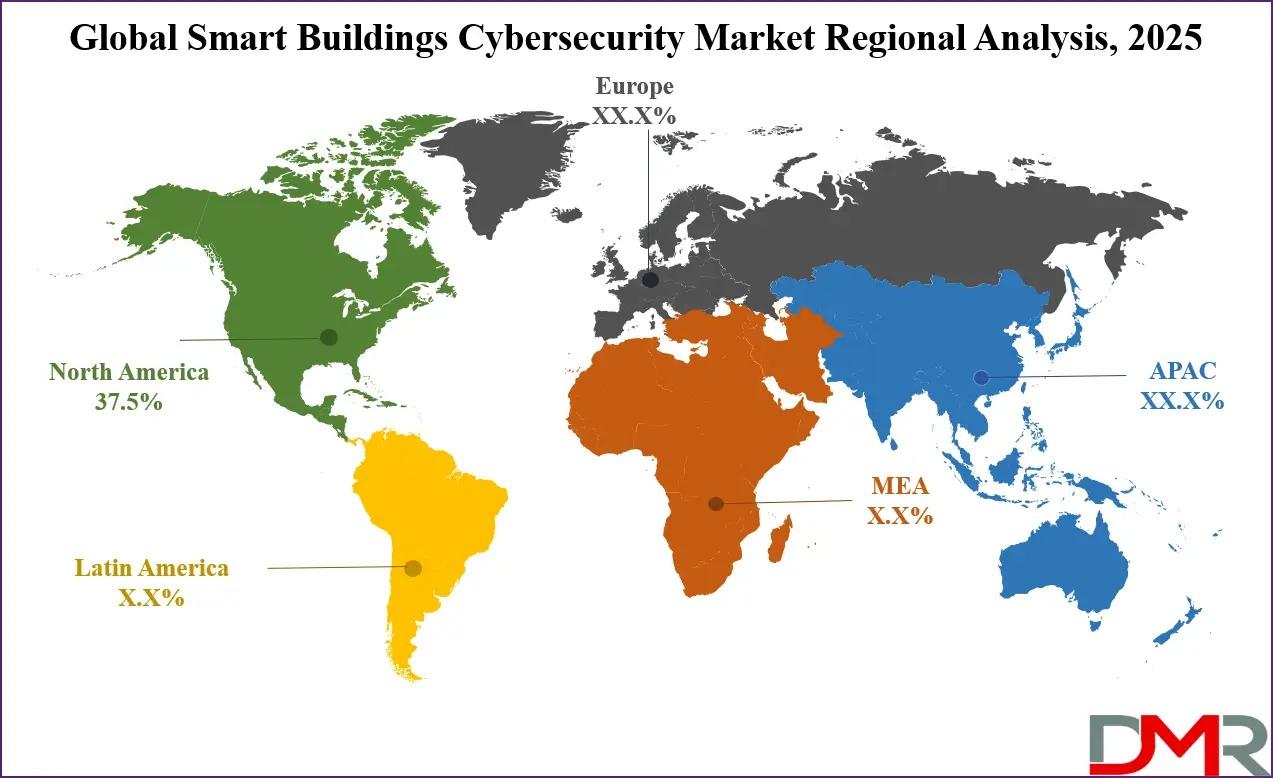
North America, led by the United States, is projected to command a dominant position in the global smart buildings cybersecurity market with 37.5% of total revenue by the end of 2025, due to a powerful confluence of early technological adoption, stringent regulatory pressure, and a high concentration of critical infrastructure. The region has a mature and sophisticated commercial real estate sector that was among the first to widely integrate IoT and Building Management Systems. The US market is projected to be valued at USD 2.8 billion in 2025, reaching USD 7.7 billion in 2034 at a CAGR of 11.7%.
Europe is estimated to be valued at USD 1,350 million in 2025 and is further anticipated to reach USD 3,483 million by 2034 at a CAGR of 11.0%. The European landscape is fundamentally shaped by robust regulatory frameworks and ambitious sustainability goals. The cornerstone is the EU's NIS2 Directive, which expands the scope of critical sectors to include energy providers and digital infrastructure, compelling entities to manage cybersecurity risks in their supply chains.
Asia Pacific is poised to register the highest CAGR in the smart buildings cybersecurity market, fueled by unprecedented urban development, massive government-led digitalization initiatives, and a rapidly escalating awareness of cyber risks. National programs such as China's "Smart City Initiative" and India's "Smart Cities Mission" are creating a vast new ecosystem of connected buildings. Japan's market is projected to be valued at USD 340 million in 2025, reaching USD 1,496 million in 2034 at a CAGR of 12.0%.
Latin America and the Middle East & Africa are gradually adopting smart buildings cybersecurity solutions as digital infrastructure improves and awareness of cyber risks grows, with Brazil, Mexico, the UAE, and Saudi Arabia emerging as key markets.
Competitive Landscape
The competitive landscape of the global smart buildings cybersecurity market is fragmented and dynamic, characterized by a diverse mix of players including established cybersecurity giants, specialized OT/IoT security firms, and major building automation vendors. Large, broad-spectrum cybersecurity companies like Cisco, Palo Alto Networks, and Fortinet leverage their extensive portfolio and global sales channels to offer integrated network security solutions.
Prominent players include Siemens AG, ABB Ltd., Cisco Systems, Inc., Honeywell International Inc., Schneider Electric SE, Johnson Controls International plc, IBM Corporation, Microsoft Corporation, Fortinet, Inc., Palo Alto Networks, Inc., Check Point Software Technologies Ltd., Broadcom Inc., Trend Micro Incorporated, Kaspersky Lab, Darktrace Holdings Limited, Dragos Inc., Claroty Ltd., Tenable Holdings, Inc., Rockwell Automation, Inc., and Armis Security, Inc. Recent developments include the inaugural Smart Building Cybersecurity Summit in Washington, D.C. (May 2024), Johnson Controls' investment in its OpenBlue cybersecurity platform (March 2024), Siemens and Palo Alto Networks' strategic collaboration (October 2023), and Armis' acquisition of Tempered Networks (September 2023).
Technological Advancements
Rapid advancements in AI, machine learning, behavioral analytics, and zero-trust architectures are transforming the smart buildings cybersecurity market. AI-driven solutions can autonomously analyze data from HVAC, access control, cameras, and IoT sensors to spot unusual patterns, reducing mean-time-to-detect and enabling automated containment.
Predictive vulnerability and maintenance prioritization, context-aware identity and access control, and reduced false positives through ML-powered correlation are also playing significant roles, improving resilience and operational efficiency across smart building environments.
Consumer Adoption Patterns
Commercial buildings, residential buildings, healthcare facilities, educational institutions, retail and hospitality venues, industrial facilities, government and defense installations, and data centers are increasingly adopting smart buildings cybersecurity solutions to protect critical infrastructure, ensure regulatory compliance, and maintain operational continuity. The growing availability of cloud-based and managed security services is making these solutions more accessible to organizations of all sizes.
Regulatory Environment
Regulatory frameworks across different regions, including the NIS2 Directive and Cybersecurity Act in Europe, CISA guidelines and NIST frameworks in the United States, and various national cybersecurity strategies, significantly influence the smart buildings cybersecurity market. Compliance with these regulations drives investment in advanced security solutions and shapes procurement decisions.
Market Challenges
The smart buildings cybersecurity market faces challenges related to high implementation costs, lack of universal IoT security standards, shortage of skilled personnel, integration complexity with legacy systems, and the need for continuous investment in technology and training. Additionally, the evolving threat landscape requires ongoing adaptation and innovation.
Future Outlook
The future of the Smart Buildings Cybersecurity Market remains highly promising as building digitalization accelerates and cyber threats continue to evolve. Increasing adoption of AI-powered security platforms, growth of smart city projects, convergence of IT and OT security, and expansion into emerging markets are expected to drive strong market growth during the forecast period, with the market projected to reach USD 26.0 billion by 2034 at a CAGR of 12.5%.
FAQs
What is the expected size of the Smart Buildings Cybersecurity Market in 2025?
The market is expected to reach USD 9.0 billion in 2025.
What is the projected market value by 2034?
The market is forecast to reach USD 26.0 billion by 2034.
What is the CAGR of the Smart Buildings Cybersecurity Market?
The market is expected to grow at a CAGR of 12.5% during 2025–2034.
Which solution type dominates the market?
OT/ICS security for building systems is poised to be the dominant and fastest-growing sub-segment.
Which region leads the global smart buildings cybersecurity market?
North America is projected to command 37.5% of total revenue by the end of 2025.
Summary of Key Insights
The global Smart Buildings Cybersecurity Market is expected to grow from USD 9.0 billion in 2025 to USD 26.0 billion by 2034, recording a CAGR of 12.5% during the forecast period. Software leads the component segment, while OT/ICS security dominates solution types. Cloud-based deployment is increasingly dominant, large enterprises lead by organization size, building automation and HVAC systems lead applications, and commercial buildings lead end-user demand. North America holds the largest regional share with 37.5% of global revenue in 2025, while Asia Pacific is projected as the fastest-growing region. The US market is projected to reach USD 7.7 billion by 2034 at a CAGR of 11.7%.
Purchase the Full Report
https://dimensionmarketresearch.com/checkout/smart-buildings-cybersecurity-market/
