

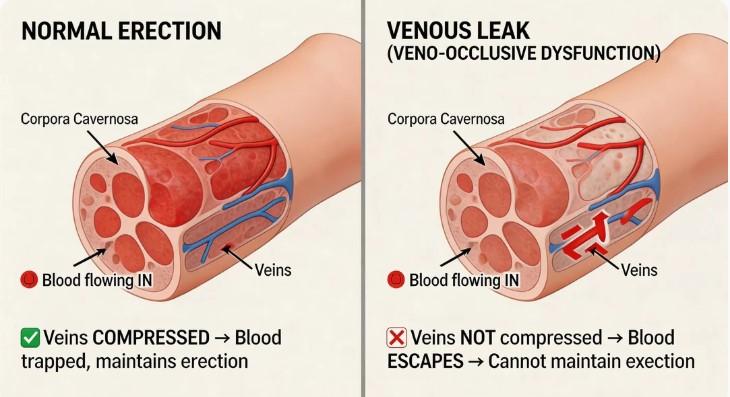

Venous leak, medically known as veno-occlusive erectile dysfunction (ED), is a condition in which the penis has difficulty maintaining an erection because blood does not remain trapped inside the erectile tissues long enough. A man may be able to achieve an erection but find that it becomes soft too quickly or cannot be maintained during sexual activity.
Venous leak can have several possible causes, including injury, vascular problems, structural changes in the erectile tissues, and certain medical conditions. Importantly, difficulty maintaining an erection does not automatically mean that a man has venous leak. Other forms of erectile dysfunction can produce similar symptoms, so proper medical evaluation is important.
This comprehensive guide explains what venous leak is, its symptoms, possible causes, how doctors diagnose it, available treatment options, and when to seek medical advice.
What Is Venous Leak?
A normal erection depends on a coordinated process involving the brain, nerves, blood vessels, hormones, and erectile tissues.
During sexual stimulation, blood flows into the penis through the penile arteries. The erectile tissues expand and compress the veins that normally allow blood to leave the penis. This process helps maintain pressure within the penis and keeps the erection firm.
With veno-occlusive erectile dysfunction, this mechanism may not work effectively. Blood can leave the erectile tissues too readily, making it difficult to maintain adequate rigidity.
The term venous leak is commonly used to describe this problem, although the underlying issue is not necessarily a literal hole or damaged vein. In many cases, the problem involves inadequate compression of the veins during erection.
How a Normal Erection Works
A simplified erection process looks like this:
- Sexual stimulation activates the nervous system.
- Penile arteries widen and allow increased blood flow.
- Blood fills the corpora cavernosa, the main erectile tissues.
- The expanding erectile tissue compresses veins responsible for drainage.
- Blood becomes trapped within the penis.
- Pressure increases and produces a firm erection.
- After sexual activity, the erectile tissues relax and normal blood flow resumes.
If the blood-retention mechanism does not work properly, an erection may be difficult to maintain.
Symptoms of Venous Leak
Symptoms can vary between individuals. The most commonly reported problem is difficulty maintaining an erection.
Possible symptoms include:
- Getting an erection but losing it quickly
- Difficulty keeping the penis sufficiently hard during intercourse
- Erections that become softer during sexual activity
- Needing continuous sexual stimulation to maintain an erection
- Difficulty maintaining rigidity after changing position
- An erection that is firm initially but gradually becomes less rigid
- Reduced sexual confidence because of repeated erection loss
Some men may still be able to achieve an erection through masturbation or with strong stimulation but have difficulty maintaining it during intercourse.
Is Losing an Erection Always Venous Leak?
No.
A temporary or occasional loss of erection can happen for many reasons, including:
- Stress
- Performance anxiety
- Relationship difficulties
- Lack of sleep
- Alcohol consumption
- Certain medications
- Hormonal abnormalities
- Diabetes
- High blood pressure
- Cardiovascular disease
- Smoking
- Reduced sexual stimulation
Therefore, symptoms alone cannot establish a diagnosis of venous leak.
Causes of Venous Leak
There is no single cause of veno-occlusive erectile dysfunction. Several factors can interfere with the ability of erectile tissue to maintain adequate pressure.
1. Damage to Erectile Tissue
Injury or structural damage to the penis can sometimes interfere with the normal mechanism that traps blood inside the erectile tissues.
Trauma, previous surgery, or other penile conditions may contribute to erectile dysfunction.
2. Aging
As men age, changes can occur in blood vessels and erectile tissues. Reduced elasticity and changes in smooth-muscle function can affect erection quality.
However, erectile difficulties should not simply be considered an unavoidable part of aging. Persistent ED deserves medical evaluation.
3. Diabetes
Diabetes can damage blood vessels and nerves involved in erection. Long-term poorly controlled blood sugar may contribute to erectile dysfunction through several mechanisms.
4. Cardiovascular Disease
Conditions affecting blood vessels can reduce the ability to achieve and maintain erections. Erectile dysfunction may sometimes occur alongside cardiovascular disease because both can involve vascular dysfunction.
5. High Blood Pressure
Chronic hypertension can contribute to vascular damage and may affect erectile function.
6. Smoking
Smoking can damage blood vessels and impair circulation. It is an established risk factor for erectile dysfunction.
7. Penile Structural Conditions
Certain structural abnormalities affecting the penis may interfere with normal erection mechanics.
For example, Peyronie's disease, which can cause scar tissue and curvature of the penis, may sometimes be associated with erectile difficulties.
8. Pelvic Injury or Surgery
Injuries or procedures involving the pelvis can affect blood vessels, nerves, or tissues involved in erection.
9. Hormonal Problems
Low testosterone and other hormonal abnormalities can contribute to erectile dysfunction, although hormonal problems do not necessarily mean that venous leak is present.
10. Psychological Factors
Psychological factors generally do not cause a physical venous leak, but they can cause or worsen erectile dysfunction and can produce symptoms that resemble difficulty maintaining an erection.
Anxiety, stress, depression, relationship problems, and performance anxiety can all affect sexual performance.
Venous Leak vs. Other Types of Erectile Dysfunction
Erectile dysfunction is a broad condition with multiple possible causes.
Arterial Erectile Dysfunction
In arterial ED, insufficient blood reaches the penis. A man may have difficulty achieving a sufficiently firm erection in the first place.
Veno-Occlusive Erectile Dysfunction
In veno-occlusive ED, the problem is primarily maintaining adequate pressure after blood enters the erectile tissues.
Neurogenic Erectile Dysfunction
Damage or dysfunction involving the nerves responsible for erections can interfere with sexual function.
Hormonal Erectile Dysfunction
Hormonal abnormalities, particularly low testosterone in appropriate clinical circumstances, can contribute to reduced sexual function and libido.
Psychogenic Erectile Dysfunction
Stress, anxiety, depression, relationship problems, and performance concerns can interfere with erections without an underlying structural vascular problem.
In reality, a person can have more than one contributing factor.
How Is Venous Leak Diagnosed?
Diagnosis should be performed by a qualified healthcare professional, usually a urologist or another clinician experienced in sexual medicine.
A doctor generally begins with a detailed medical and sexual history.
The evaluation may include:
Medical History
The doctor may ask about:
- When the erection problem began
- Whether erections occur during sleep or upon waking
- Whether erections are possible during masturbation
- How long erections can be maintained
- Existing medical conditions
- Medications
- Smoking and alcohol use
- Previous pelvic or penile injuries
- Previous surgeries
- Psychological or relationship factors
Physical Examination
A physical examination may help identify:
- Penile abnormalities
- Plaque or curvature
- Testicular abnormalities
- Hormonal signs
- Vascular problems
- Other physical causes of erectile dysfunction
Blood Tests
Depending on the individual's symptoms and medical history, laboratory testing may include assessments related to:
- Blood glucose
- HbA1c
- Lipid profile
- Testosterone
- Thyroid function
- Other hormones or metabolic markers when clinically appropriate
Not every patient requires every test.
Penile Doppler Ultrasound
One of the most important tests used when a vascular cause of ED is suspected is penile duplex Doppler ultrasound.
The examination evaluates blood flow through the penile arteries and can provide information about arterial inflow and the veno-occlusive mechanism.
It is commonly performed after administration of a medication that produces an erection, allowing the clinician to assess blood flow under erection conditions.
The test can help distinguish between:
- Arterial insufficiency
- Possible veno-occlusive dysfunction
- Mixed vascular causes
Can a Doppler Test Confirm Venous Leak?
Penile Doppler can provide important information, but interpretation is not always straightforward.
Measurements can be affected by:
- The medication used
- Dose and response
- Anxiety
- Degree of erection
- Operator experience
- Timing of measurements
- Technical factors
Therefore, a diagnosis should not be based on a single number without considering the complete clinical picture.
Venous Leak Treatment
Treatment depends on the underlying cause, severity, overall health, and response to previous treatments.
There is no single treatment that works for every patient.
1. Lifestyle Changes
Improving general vascular health can support erectile function.
Helpful measures may include:
- Stopping smoking
- Maintaining a healthy weight
- Exercising regularly
- Managing blood pressure
- Controlling diabetes
- Improving cholesterol levels
- Limiting excessive alcohol
- Getting adequate sleep
- Managing stress
These measures can improve overall cardiovascular health and may improve erectile function.
2. Oral ED Medications
Phosphodiesterase type-5 (PDE5) inhibitors are commonly used to treat erectile dysfunction.
Examples include:
- Sildenafil
- Tadalafil
- Vardenafil
- Avanafil
These medications improve erectile response by enhancing the natural blood-flow pathway involved in erections.
They do not physically repair a venous abnormality, but they may improve erection quality in some men with erectile dysfunction.
Important Safety Consideration
PDE5 inhibitors should not be combined with nitrate medications because the combination can cause a dangerous drop in blood pressure.
A healthcare professional should review a patient's medications and cardiovascular health before prescribing these drugs.
3. Vacuum Erection Devices
A vacuum erection device uses negative pressure to draw blood into the penis.
A constriction ring can then help maintain blood within the erectile tissues.
For some men, this approach can be particularly useful when maintaining an erection is the main difficulty.
A doctor or qualified healthcare provider can explain appropriate use and safety precautions.
4. Intracavernosal Injection Therapy
Some men with ED may benefit from medication injected directly into the erectile tissue.
These medications can produce an erection by directly relaxing penile smooth muscle and increasing blood flow.
Injection therapy should only be used under medical supervision because incorrect dosing can cause complications, including priapism, a prolonged erection requiring urgent treatment.
5. Psychological or Sex Therapy
When anxiety, performance concerns, relationship difficulties, or other psychological factors contribute to erectile dysfunction, counseling or sex therapy can be useful.
Psychological treatment can also be combined with medical treatment when ED has both physical and psychological components.
6. Penile Constriction Rings
A constriction ring may help some men maintain an erection by slowing blood outflow.
When appropriately prescribed and used, it can be part of a treatment strategy for erection-maintenance problems.
A ring should not be left in place longer than recommended by the manufacturer or healthcare professional.
7. Penile Implants
For men with severe erectile dysfunction who do not obtain satisfactory results from less invasive treatments, penile prosthesis surgery may be considered.
Penile implants are surgically placed devices that allow a man to produce an erection when desired.
There are different types, including:
- Inflatable penile prostheses
- Malleable or semirigid prostheses
Implants are generally considered when other treatments have failed, are unsuitable, or are not acceptable to the patient.
Because implantation is surgery, potential risks include infection, mechanical problems, bleeding, and other surgical complications.
Can Venous Leak Be Permanently Cured?
The answer depends on what is causing the erectile dysfunction.
Some underlying conditions can be treated or improved, while other cases may require long-term management.
The term "permanent cure" can therefore be misleading.
Treatment may focus on:
- Improving vascular health
- Treating underlying diseases
- Improving erectile response
- Managing psychological contributors
- Using medications or devices
- Considering surgery when appropriate
A urologist can determine which options are realistic based on the patient's diagnosis.
Can Venous Leak Be Treated Without Surgery?
Yes.
Many men with erectile dysfunction can initially be treated using non-surgical approaches.
Depending on the diagnosis, these may include:
- Lifestyle modifications
- Oral medications
- Vacuum erection devices
- Psychological therapy
- Intracavernosal injections
- Other physician-directed treatments
Surgery is generally reserved for selected patients, particularly those who do not respond adequately to conservative or medical treatment.
Venous Leak and Erectile Dysfunction
Venous leak is often discussed in connection with ED because maintaining an erection requires both adequate blood inflow and effective blood trapping.
However, it is important not to self-diagnose based solely on erection loss.
For example, if a man becomes anxious during intercourse, his sympathetic nervous system can interfere with erection maintenance. This can feel like a physical inability to keep the erection even when the penile vascular system is functioning normally.
That is why a comprehensive evaluation is important.
Is Venous Leak Common?
Erectile dysfunction itself is common, particularly with increasing age and in men with conditions such as diabetes and cardiovascular disease.
However, not every case of erectile dysfunction is caused by veno-occlusive dysfunction.
The term "venous leak" is sometimes used broadly by patients and clinics to describe any problem with maintaining an erection. A proper medical assessment is necessary to determine whether a genuine vascular abnormality exists.
Does Masturbation Cause Venous Leak?
There is no established evidence that normal masturbation causes a physical venous leak.
Temporary changes in erection quality after ejaculation are normal and do not indicate vascular damage.
If persistent difficulty achieving or maintaining erections occurs, the underlying cause should be evaluated rather than assuming masturbation is responsible.
Does Porn Cause Venous Leak?
Pornography does not physically damage penile veins or directly create a structural venous leak.
However, excessive pornography use may be associated with psychological or behavioral factors that can affect sexual performance in some individuals. These situations are different from a confirmed vascular veno-occlusive disorder.
Can Exercise Help Venous Leak?
Regular physical activity can improve cardiovascular health, circulation, metabolic health, and general erectile function.
Aerobic exercise is particularly beneficial for cardiovascular health, while resistance training can support overall fitness.
Exercise may not "repair" a structural venous abnormality, but improving vascular health can be an important part of managing erectile dysfunction.
Can Diet Improve Erectile Function?
A healthy diet can support cardiovascular and metabolic health.
A diet emphasizing:
- Vegetables
- Fruits
- Whole grains
- Legumes
- Nuts
- Fish
- Lean protein
- Healthy fats
while limiting excessive processed foods, added sugars, and unhealthy fats may support overall vascular health.
Diet alone should not be promoted as a guaranteed cure for venous leak.
Venous Leak and Age
The likelihood of erectile dysfunction generally increases with age because vascular, metabolic, neurological, hormonal, and other health conditions become more common.
Nevertheless, persistent erectile dysfunction is not simply something a man has to accept because of aging.
A medical evaluation can identify potentially treatable causes.
When Should You See a Doctor?
You should consider seeing a healthcare professional if erection problems:
- Continue repeatedly
- Last for several weeks or longer
- Interfere with sexual activity
- Cause significant distress
- Develop suddenly
- Occur alongside other health problems
A urologist can determine whether the problem is related to vascular factors, hormones, medications, psychological factors, neurological issues, or another condition.
Sudden erectile dysfunction can sometimes be an early sign of cardiovascular or metabolic disease, so it should not automatically be attributed to venous leak.
What Happens During a Venous Leak Consultation?
A typical consultation may involve:
Step 1: Medical History
The doctor discusses your symptoms, medical conditions, medications, lifestyle, and sexual history.
Step 2: Physical Examination
The physician checks for physical or structural factors that could contribute to ED.
Step 3: Laboratory Testing
Blood tests may be recommended depending on your history and symptoms.
Step 4: Erectile Function Assessment
The doctor may use validated questionnaires and clinical assessment to understand the severity of ED.
Step 5: Doppler Ultrasound
If vascular ED is suspected, penile Doppler ultrasound may be recommended.
Step 6: Treatment Planning
The doctor discusses appropriate treatment based on the findings.
Prevention of Erectile Dysfunction
Not every case of erectile dysfunction can be prevented, but several healthy habits can reduce risk.
Maintain a Healthy Weight
Excess body weight is associated with metabolic and cardiovascular conditions that can contribute to ED.
Exercise Regularly
Physical activity supports cardiovascular health and blood circulation.
Avoid Smoking
Smoking damages blood vessels and is a major modifiable risk factor for erectile dysfunction.
Manage Diabetes
Good blood-sugar management can help reduce complications affecting nerves and blood vessels.
Control Blood Pressure and Cholesterol
Healthy blood pressure and cholesterol levels support vascular health.
Limit Alcohol
Excessive alcohol consumption can interfere with sexual function.
Manage Stress
Chronic stress can affect sexual desire and erection quality.
Get Adequate Sleep
Poor sleep can negatively affect general health and sexual function.
Frequently Asked Questions About Venous Leak
What is venous leak?
Venous leak is a commonly used term for veno-occlusive erectile dysfunction, a condition in which the penis may have difficulty retaining sufficient blood during an erection.
What is the main symptom?
The most characteristic complaint is difficulty maintaining an erection, particularly when the erection becomes softer soon after it is achieved.
Can venous leak be diagnosed at home?
No. Symptoms alone cannot reliably diagnose venous leak. Medical evaluation and, when appropriate, vascular testing such as penile Doppler ultrasound may be necessary.
Is venous leak the same as erectile dysfunction?
No. Venous leak is one possible vascular mechanism contributing to erectile dysfunction. ED has many other causes.
Can tablets treat venous leak?
ED medications such as PDE5 inhibitors can improve erections in some men, but they do not necessarily correct an underlying structural veno-occlusive abnormality.
Can venous leak be treated without surgery?
Yes. Depending on the cause and severity, treatment can include lifestyle changes, oral medication, vacuum devices, injections, and psychological therapy.
Is venous leak caused by masturbation?
Normal masturbation is not established as a cause of structural venous leak.
Can venous leak cause infertility?
Erectile dysfunction and infertility are different conditions. A man can have erectile difficulties while producing normal sperm, and infertility can occur without ED.
Can venous leak be cured permanently?
It depends on the underlying cause. Some contributing factors can be improved or treated, while other cases may require ongoing management.
Final Thoughts
Venous leak, or veno-occlusive erectile dysfunction, refers to difficulty maintaining adequate pressure within the penis during an erection. Although it is often discussed as a specific cause of ED, erection problems can result from many physical and psychological factors.
The most important step is obtaining an accurate diagnosis rather than assuming that difficulty maintaining an erection automatically means venous leak. A medical evaluation can identify contributing factors such as cardiovascular disease, diabetes, hormonal problems, medication effects, psychological factors, or vascular abnormalities.
Treatment can range from lifestyle improvements and oral medications to vacuum devices, injection therapy, counseling, and, in selected cases, penile implant surgery.
If persistent erection problems are affecting sexual activity or quality of life, consulting a qualified urologist or sexual-medicine specialist can help determine the underlying cause and appropriate treatment.
