

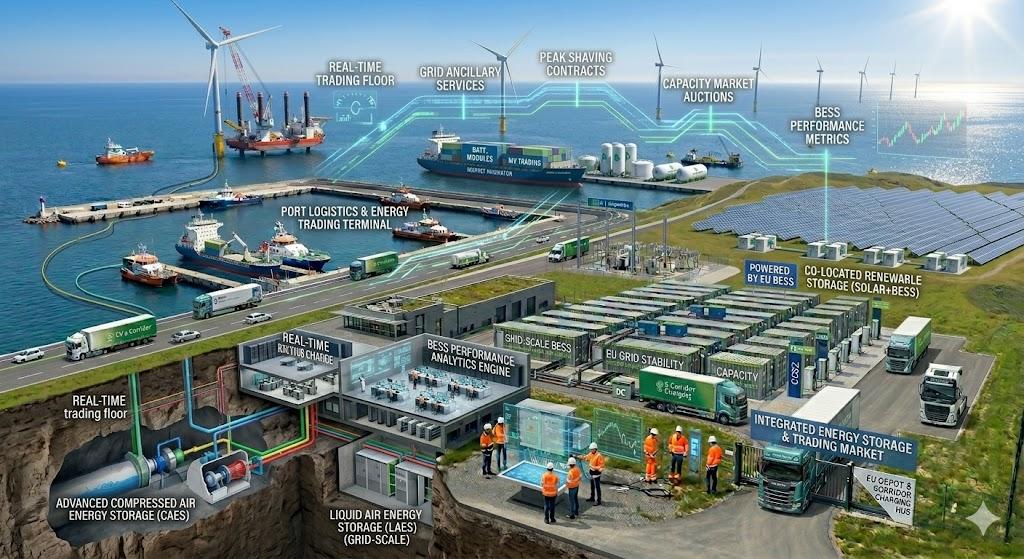

EU Battery Storage (Grid + Co-located) Investment Report: Signals for 2026–2030 Ahead
Europe’s battery storage sector is moving into a phase where investment decisions depend increasingly on project quality rather than headline pipeline volume. Grid-scale and co-located systems are expanding alongside renewable generation, network congestion, and changing electricity-market structures. For investors, lenders, developers, and technology companies, the key question is becoming how individual projects can convert flexibility into dependable commercial value.
An EU Battery Storage (Grid + Co-located) Market Report can help frame this transition by examining capacity development alongside connection risk, revenue structure, project execution, and operating performance. This broader perspective matters because a proposed battery is not automatically an investable battery. A project can have attractive technical specifications while still facing uncertainty around grid access, market participation, commissioning, or long-term cash flow.
The European market benefits from several structural drivers. Solar and wind generation continue to increase the need for flexible resources capable of responding to variable supply. Electricity prices can change rapidly across hours, creating opportunities for batteries to shift energy. Grid operators also need resources that can support balancing, congestion management, and system stability. These requirements create a growing role for storage beyond conventional energy arbitrage.
Co-located storage adds another investment pathway. Solar and wind projects can face export limitations or periods when generation coincides with weak market prices. A battery can store selected output and release it when grid conditions or commercial signals improve. The configuration can therefore address both renewable-asset economics and flexibility requirements. However, the business case depends on control logic, interconnection rules, dispatch permissions, and the ability to coordinate renewable and battery assets.
Connection risk is one of the most important investment variables. Projects can spend years progressing through development stages before reaching energization. Changes requested during grid studies may require additional protection equipment, transformer capacity, inverter adjustments, communications systems, or testing. Such changes can increase costs and extend schedules. A robust investment process therefore examines the evidence behind the connection timeline instead of relying only on a stated target date.
Revenue quality is equally important. Storage projects may combine wholesale trading, ancillary services, capacity mechanisms, flexibility contracts, or structured agreements. Each stream has a different risk profile. Merchant revenues can provide upside but are exposed to price competition and changing capture rates. Contracted or quasi-contracted revenues can improve visibility, provided counterparties, performance obligations, penalties, and contract duration are credible.
Technology and execution risks should also be integrated into financial assessment. Battery chemistry, inverter selection, thermal management, fire protection, and monitoring influence performance and safety. Warranty terms need to match expected cycling behavior. Aggressive dispatch strategies can increase degradation or create availability concerns if equipment specifications and operating assumptions are misaligned.
Capital is becoming more selective. Investors can compare projects not only by projected returns but by the strength of their evidence. A credible route-to-market strategy, mature EPC structure, clear commissioning plan, and demonstrated grid progress can reduce uncertainty.
From 2026 through 2030, European storage investment is likely to become increasingly differentiated by market zone, configuration, and revenue architecture. Standalone projects may appeal where flexibility markets are deep, while co-located systems may gain relevance where renewable curtailment and export constraints are significant. Technology suppliers, developers, and financial sponsors that understand these local differences can position their portfolios more effectively.
The central investment signal is not simply that Europe needs more batteries. It is that the market increasingly rewards projects capable of demonstrating how grid access, dispatch, contracts, compliance, and availability fit together. As storage becomes a core infrastructure asset, evidence-based project selection will become as important as technology selection. Evidence matters most.
