

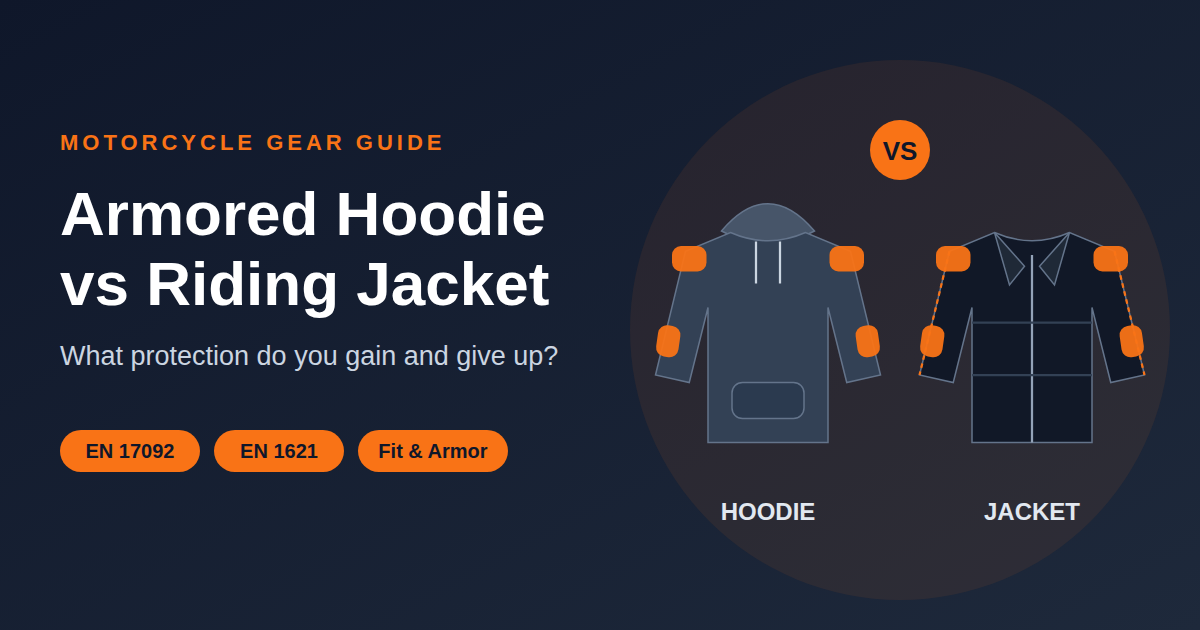
Are Armored Hoodies Really Safe? How to Judge EN 17092 Class, Aramid Coverage and Armor Fit

After two decades of working around riding gear, I've seen the same mistake repeated by new and experienced riders alike. They compare two hoodies that look identical on the rack and assume the protection is identical too. It rarely is.
A well-made armored motorcycle hoodie can look like everyday streetwear while still carrying real crash protection. But the word "armored" on a product page tells you very little. What matters is how the whole garment is built, tested, fitted and kept in place when things go wrong. Let's break down what actually separates a protective hoodie from a fashionable one.
Garment Certification Comes Before Armor Claims
The first thing I check is what the complete hoodie is certified to, not what the pads inside are certified to. These are two different claims, and sellers often blur them.
Personal protective equipment sold in Europe falls under EU Regulation 2016/425, which sets requirements for design, manufacture and conformity. For motorcycle clothing, the performance classification comes from EN 17092, which sorts garments into classes AAA, AA, A, B and C:
- AAA, AA, A: full protective garments, with AAA the highest abrasion and strength performance.
- B: abrasion performance comparable to Class A, but without required impact protectors.
- C: designed mainly to carry impact protection, without the same minimum abrasion performance.
This is why "CE rated hoodie" is a loose phrase. A CE mark signals conformity with the European framework. The letters A, AA or AAA tell you how the garment performed. A trustworthy listing names the standard and the class for the hoodie itself.
What Gets Tested Under EN 17092
EN 17092 testing for motorcycle protective garments looks at much more than fabric strength. It covers abrasion resistance, tear strength, seam and closure strength, protector positioning, dimensional stability, fit and ergonomics.
In the abrasion test, material is run against a concrete surface under controlled conditions, and the layer closest to the skin must not open a hole of 5 mm or more. Seams and closures are tested because the strongest fabric in the world is useless if a seam splits and exposes your skin. Fit is assessed too: the garment must match its stated size and let you make the movements riding requires.
Aramid Coverage: Where It Is Matters More Than That It Exists
"Aramid" is one of the most overused words in this category. It's a genuinely excellent fiber for abrasion resistance, but the word alone doesn't describe the protection of the finished hoodie.
Ask two questions instead.
How much of the body does it cover? Some hoodies reinforce only high-risk zones like shoulders and elbows. Others use a broader lining or blend strong fibers through more of the garment. Both may say "aramid" in the description, yet perform very differently.
How do the layers work together? A hoodie is usually an outer textile, a reinforcement layer, a comfort liner, armor pockets, seams and closures. In a slide, all of these are stressed at once. If the outer layer tears, the reinforcement must still be where you need it. If a structural seam fails, even excellent material gets pulled out of position.
My rule of thumb: treat "aramid lined" as a construction detail, not as proof of safety. Look for the garment class, find out exactly where the reinforcement sits, and confirm the finished hoodie was tested as sold.
Impact Armor Is a Separate Piece of the Puzzle
The armor inside the hoodie is certified separately from the shell. Shoulder and elbow protectors are typically assessed under EN 1621 impact-protector standards, specifically EN 1621-1, while back protectors fall under EN 1621-2.
Shoulder and elbow armor (EN 1621-1): The test measures how much impact force gets through the protector. Lower transmitted force means better impact absorption. Level 1 and Level 2 are the two performance tiers, and Level 2 offers more protection. The pass threshold is a mean transmitted force below 35 kN, with no single result above 50 kN.
Back protectors (EN 1621-2): These are tested to a stricter standard: a mean below 18 kN and no single value above 24 kN. Full-back, central-back and lumbar types are recognized, again in two levels. Higher protection can mean more thickness, weight or reduced airflow, so it's a trade-off.
A thin foam sheet that simply fills the back pocket is not automatically a certified back protector. Check for markings on the armor itself showing the standard, level, size and intended body area.
Fit and Retention: The Part Most Buyers Skip
Certified armor only works if it stays over the body part it was designed for. I've handled plenty of otherwise good hoodies where a loose sleeve lets the elbow pad rotate sideways, or an oversized cut drops the shoulder armor halfway down the arm.
Test fit the way you ride, not the way you pose in a mirror. Bend your elbows, reach forward as if gripping the bars, rotate your shoulders. The armor should stay centered over joints through the whole range of motion.
Retention is built into the garment too: secure armor pockets, sleeve fit, cuff adjustment, waistband construction and overall cut all play a role. EN 17092 even includes a sleeve restraint test, applying a 50 N circumferential force for 30 seconds to check the sleeve holds in place.
If your arm length, shoulder width or torso doesn't suit standard sizing, a custom armored motorcycle hoodie can solve the placement problem. Just remember that tailoring should sit on top of sound protective construction and certified armor, never replace them. When you're shortlisting protective riding hoodies, fit and retention deserve the same weight as the certification label.
It Has to Stay On Your Body During a Slide
A riding hoodie shouldn't be judged like a regular sweatshirt. In a crash, hems, cuffs, seams and closures take loads they never see in daily wear.
If the hem rides up, the area you were covering while seated suddenly isn't covered. If a sleeve pulls back, you lose both abrasion cover and armor alignment. So examine the front closure, cuff security, waist adjustment, and any features meant to limit garment movement. The design solutions vary, but the goal is constant: keep tested materials and protectors on the rider under load.
Comfort Matters, but It Isn't a Safety Class
People buy armored hoodies because they're easier to live in than a heavy touring jacket. Lower bulk, flexibility and ventilation make protective gear something you'll actually wear for short trips and daily commutes, and gear you wear beats gear you leave at home.
There are trade-offs, though. Class AAA garments offer the highest protection under EN 17092 but can bring extra weight, heat and restriction. Match the class to how you ride. A city commuter may be best served by a certified, comfortable A or AA garment. Someone logging long, faster highway miles may reasonably choose something heavier with a higher class and more secure construction.
A Quick Pre-Purchase Checklist
- Is the complete hoodie certified to EN 17092, and which class (A, AA or AAA)?
- Do the shoulder and elbow protectors carry EN 1621-1 markings and a stated level?
- Is a certified back protector included, optional, or just a comfort insert?
- Where exactly is the abrasion-resistant reinforcement, and is coverage partial or broad?
- Are armor pockets, sleeves, cuffs, waist, closures and seams solidly built?
- Does the armor stay in position when you sit in a riding posture and move?
- Do the care instructions respect the garment's dimensional stability? EN 17092 permits no more than ±5% change in the relevant test.
If a seller keeps repeating "Kevlar," "aramid" or "CE armor" without naming the garment standard, class, protector standard or supporting documentation, treat that as a warning sign.
Buy the System, Not a Single Feature
A hoodie becomes truly protective when every piece works together: abrasion-resistant material with sensible coverage, strong seams, certified armor that fits properly, and a cut that stays put when you slide. So don't ask whether a hoodie has aramid or armor. Ask whether the whole product was designed, tested, fitted and retained as motorcycle protective equipment.
Start with the EN 17092 class, verify the EN 1621 markings on the armor, and finish with a fit check in riding posture. Do that, and you'll quickly see which options deserve your money. If you're ready to compare certified options, explore a range of armored motorcycle hoodie styles built with real protection in mind.
