

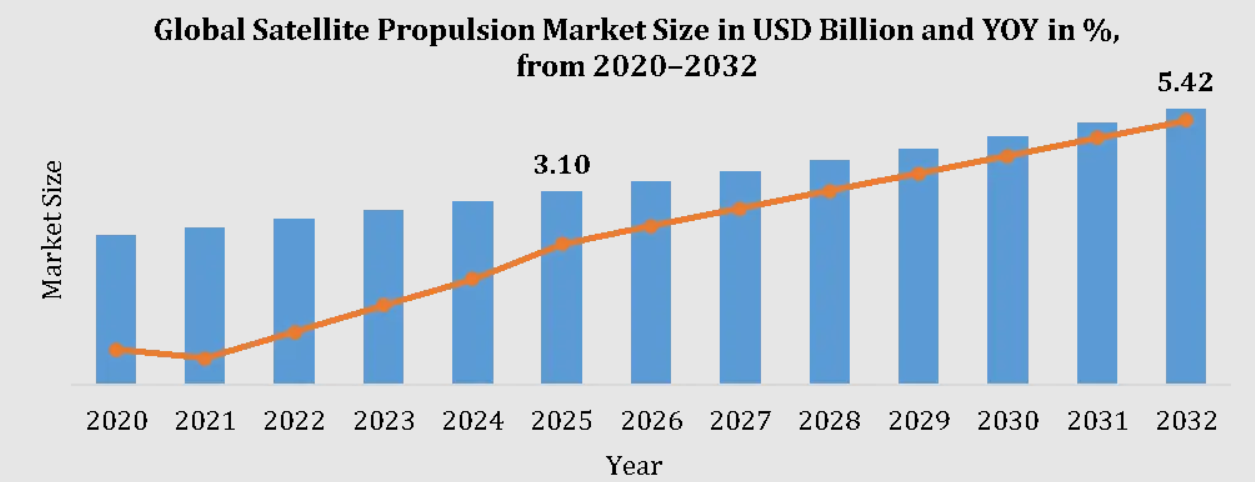

The Global Satellite Propulsion Market is witnessing a transformative paradigm shift as low Earth orbit (LEO) commercial constellations and sustainable space practices reshape space architecture, according to the latest market intelligence report by Stellar Market Research. The comprehensive analysis reveals that the market, valued at USD 12.44 billion in 2024, is projected to expand at a CAGR of 11.78% from 2025 to 2032, reaching nearly USD 30.32 billion. Driven by high-density satellite deployment, miniaturized thruster engineering, and stringent international orbital compliance, satellite propulsion systems have evolved from auxiliary attitude-control hardware into mission-critical strategic assets.
The global satellite industry is undergoing an unprecedented transition from capital-intensive, geostationary (GEO) heavy platforms toward distributed, low-latency LEO and medium Earth orbit (MEO) constellations. This structural evolution demands advanced mobility, collision-avoidance maneuverability, and reliable post-mission disposal capabilities. Traditional monopropellant and bipropellant chemical systems, long burdened by toxic hydrazine handling costs and high wet-mass fractions, are rapidly relinquishing market share to electric, hybrid, and green propellants.
Key Findings from the Report
-
Market Size & Valuation: Global market revenue is slated to grow from USD 12.44 billion in 2024 to USD 30.32 billion by 2032, exhibiting a compound annual growth rate (CAGR) of 11.78%.
-
Type Dominance: Non-chemical (Electric and Hybrid) propulsion systems hold the dominant revenue share, driven by superior specific impulse ($I_{sp}$) and substantial fuel mass savings for long-duration missions.
-
Fastest-Growing Segment: Green propellant and electric thruster modules for SmallSat and CubeSat applications represent the fastest-growing product category, registering an estimated sub-segment CAGR exceeding 14.5%.
-
Orbit Analysis: LEO applications account for over 52% of total demand, backed by broadband internet rollout and high-revisit Earth observation constellations.
-
Regional Supremacy: North America leads the global landscape, generating over 40% of market revenues, supported by heavy NASA and U.S. Space Force contract awards alongside commercial space infrastructure.
-
Emerging Growth Engine: Asia-Pacific is projected as the fastest-growing regional market, propelled by national space agency expansions in India, Japan, and South Korea, combined with private space venture investments in China.
For further information, click the following link:https://www.stellarmr.com/report/req_sample/satellite-propulsion-market/2918
Market Drivers and Restraints
Key Market Drivers
-
Proliferation of LEO Broadband Megaconstellations: Mass deployment of commercial broadband communications networks requires thousands of small-to-medium satellites fitted with high-efficiency thrusters for orbit insertion, phased array maintenance, and active collision avoidance.
-
Transition toward Electric and High-Impulse Propulsion: Electric propulsion systems (Hall-effect thrusters and ion engines) deliver up to five times greater fuel efficiency than chemical thrusters, enabling operators to increase revenue-generating payload capacity or extend mission lifespans.
-
Escalating Orbital Sustainability and Debris Mitigation Mandates: Global regulatory enforcement restricting passive orbital decay is compelling satellite manufacturers to integrate active propulsion modules dedicated to end-of-life deorbiting maneuverability.
Market Restraints
-
High Engineering Capital Costs and Testing Overhead: Space-grade propulsion design requires expensive vacuum chamber testing, specialized propellant handling infrastructure, and complex qualification protocols, creating steep entry barriers for early-stage hardware providers.
-
Precision Component and Raw Material Supply Chain Constraints: Market expansion faces headwinds from tight supply chains in aerospace-grade titanium, xenon/krypton noble gases, precision valves, and high-purity green energetic compounds.
Technology, Regulation, and Sustainability Trends
-
Water, Metal, and Iodine-Based Propellants: To eliminate high-cost xenon storage and hazardous hydrazine exposure, propulsion developers are commercializing iodine-fueled Hall thrusters, water electrolysis propulsion, and solid metal-fueled systems, dramatically cutting pre-launch preparation costs.
-
Integrated AI-Driven Collision Avoidance: Satellite propulsion control units are increasingly integrated with onboard autonomous AI algorithms, allowing real-time trajectory corrections without ground station latency.
-
ESG and Green Space Architecture: Environmental, Social, and Governance (ESG) criteria are reshaping launch services. Non-toxic hypergolic alternatives and green monopropellants (such as hydroxylammonium nitrate blends) reduce ground-handling toxicity and carbon footprint during launch preparation.
-
In-Space Servicing, Assembly, and Manufacturing (ISAM): The emergence of active debris removal (ADR) and satellite refueling missions is creating dedicated demand for standardized, dockable propulsion refueling interfaces.
Regional Insights
-
North America: Dominates the global market owing to dense private space firm concentration, robust venture capital funding, and defense modernizations under the U.S. Department of Defense and Space Development Agency (SDA). The region's mature launch ecosystem accelerates commercial thruster integration.
-
Europe: Maintains a strong position led by ESA's zero-debris initiative, strong commercial satellite fabrication hubs in France, Germany, and the UK, and pioneer deployments of green monopropellant thrusters.
-
Asia-Pacific: Represents the fastest-growing market. Expanding national space budgets in India (ISRO) and Japan (JAXA), along with booming commercial SmallSat ecosystems in China, Taiwan, and South Korea, are accelerating local propulsion manufacturing and cross-border technology alliances.
-
Latin America and Middle East & Africa: Emerging hubs driven by state-sponsored regional earth observation initiatives and national satellite communications infrastructure projects (e.g., UAE, Saudi Arabia).
Recent Industry Developments
-
Safran Passenger & Space (2025): Expanded high-volume manufacturing facilities for its PPS6000 Hall-effect thrusters to support next-generation European and international commercial LEO constellations.
-
Busek Co. Inc. (2025): Secured strategic NASA and U.S. Space Force contracts to supply high-power green monopropellant and Hall thruster systems for lunar and cislunar exploration architectures.
-
Exotrail (2024): Closed major commercial delivery agreements for its space-proven spacedrop and spaceware electric propulsion units across European and U.S. SmallSat constellation developers.
-
Impulse Space (2024): Unveiled high-thrust chemical and hybrid propulsion modules designed for rapid orbit transfer vehicles (OTVs) and operational maneuverability in GEO and MEO regimes.
-
Benchmark Space Systems (2024): Partnered with commercial space station developers to supply non-toxic, high-thrust chemical propulsion suites for orbital maneuvering and station-keeping.
Competitive Landscape
The global satellite propulsion market features a mix of prime defense contractors, legacy aerospace systems providers, and agile space-tech startups. Market leaders maintain dominant market share through long-term government supply contracts, vertical integration, and continuous modular design innovation. Prime players include:
-
Lockheed Martin Corporation
-
Safran S.A.
-
Thales Alenia Space
-
Northrop Grumman Corporation
-
L3Harris Technologies, Inc.
-
Moog Inc.
-
Busek Co. Inc.
-
Exotrail
-
Benchmark Space Systems
-
Aerojet Rocketdyne (L3Harris)
Key competitive strategies revolve around modular plug-and-play thruster designs, strategic M&A to secure component suppliers, and regional production localization to comply with international defense trade regulations (such as ITAR).
Analyst Commentary
"We are witnessing an unprecedented shift where space mobility is no longer an afterthought but the central enabler of commercial space viability," said a Senior Research Analyst at Stellar Market Research. "As orbit congestion intensifies and regulatory bodies strictly enforce five-year post-mission deorbiting rules, propulsion systems have evolved into essential risk-mitigation assets. Operators who adopt high-efficiency electric thrusters or non-toxic green propellants are not only optimizing launch mass economics—they are future-proofing their constellations against regulatory penalties and orbital collisions."
Future Outlook
Through the remainder of the decade, the satellite propulsion market will experience sustained capital inflow fueled by constellation replenishment cycles, cislunar logistical infrastructure development, and defense space mobility initiatives. As electric propulsion manufacturing achieves scale, thruster unit costs are expected to decrease, encouraging adoption across CubeSat and NanoSat formats. Simultaneously, the convergence of orbital refueling capabilities and standardized docking ports will redefine mission architectures, extending satellite operational lifespans from years to decades and securing long-term growth across the entire space infrastructure value chain.
For further information, click the following link:https://www.stellarmr.com/report/req_sample/satellite-propulsion-market/2918
About Stellar Market Research
Stellar Market Research is a multifaceted market research and consulting company with professionals from several industries. Some of the industries we cover include medical devices, pharmaceutical manufacturers, science and engineering, electronic components, industrial equipment, technology and communication, cars and automobiles, chemical products and substances, general merchandise, beverages, personal care, and automated systems. To mention a few, we provide market-verified industry estimations, technical trend analysis, crucial market research, strategic advice, competition analysis, production and demand analysis, and client impact studies.
Address
Phase 3, Navale IT Zone, S.No. 51/2A/2, Office No. 202, 2nd floor, Near, Navale Brg, Narhe, Pune, Maharashtra 411041
Email
[email protected]
Mobile
+91 9607365656
