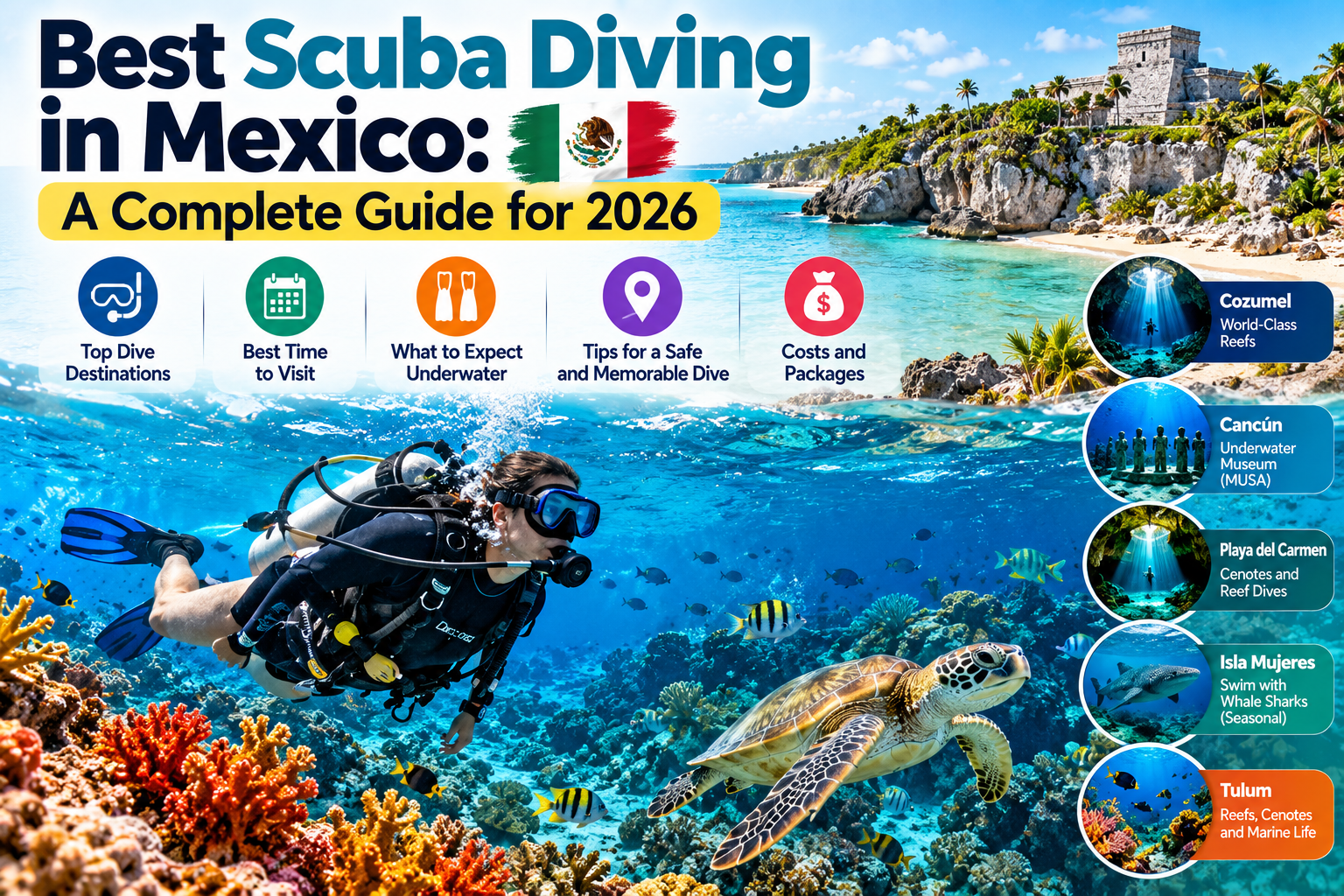
Mexico is one of the most diverse diving destinations on the planet. It offers three distinct oceans, underground river systems, and marine encounters that range from playful sea lions to giant manta rays. Whether you are a beginner looking for warm, calm Caribbean reefs or an experienced diver chasing pelagic giants, the country delivers.
This guide covers the main diving regions, what you will see in each, and how to plan your trip.
Mexico's Three Diving Worlds
Mexico's geography gives it an unusual advantage: divers can experience three completely different ecosystems without leaving the country.
The Caribbean Coast includes Cozumel, the Riviera Maya, and the cenotes of the Yucatán Peninsula. This is warm-water diving with excellent visibility, coral reefs, and the unique freshwater cavern systems.
The Sea of Cortez sits between the Baja California peninsula and mainland Mexico. Jacques Cousteau called it "the world's aquarium," and the name has stuck because of the sheer density of marine life. Nutrient-rich currents support sea lions, whale sharks, mobulas, and schooling fish.
The Pacific Ocean includes Socorro Island, Guadalupe Island, and coastal sites like Puerto Vallarta. This is where you go for big animals — oceanic mantas, hammerhead schools, and great white sharks.
Baja California and the Sea of Cortez
The Baja peninsula is the access point for some of Mexico's most celebrated diving. You fly into La Paz or Cabo San Lucas, and from there the dive infrastructure is well developed. If you are planning a trip specifically around scuba diving Baja California, the region offers a mix of reef, wreck, and big-animal diving that few places can match.
La Paz and Los Islotes
The highlight here is Los Islotes, a pair of rocky islands near La Paz where a colony of sea lions lives. The diving is shallow — typically between 25 and 50 feet — and the sea lions are famously curious and playful. They will approach divers, nip at fins, and pose for cameras. It is one of the most reliable places in the world to interact with sea lions in the water.
La Paz itself is a relaxed city with a growing dive scene. Operators offer trips to Isla Espíritu Santo, whale shark snorkeling in season, and liveaboard departures to Socorro.
Cabo Pulmo
Cabo Pulmo is a UNESCO World Heritage Site and one of the great conservation success stories. The reef was once depleted by overfishing, but a community-led protection effort allowed it to recover. Today divers see large schools of jacks, bull sharks, and swirling sardine clouds. It is a testament to what marine protection can achieve.
Cabo San Lucas and Gordo Banks
Cabo San Lucas sits at the tip of the peninsula, where the Sea of Cortez meets the Pacific. Land's End is a popular dive site with underwater sand falls and schooling fish. Farther offshore, Gordo Banks is a seamount that attracts hammerheads, giant mantas, and occasionally whale sharks. It is a deeper, more advanced dive.
Loreto Bay National Marine Park
Loreto Bay is a protected area with over 800 species of fish recorded. The uninhabited islands of Danzante and Coronados offer volcanic rock formations, coral gardens, and abundant schooling fish. It is a quieter alternative to the more commercialised dive hubs.
The Caribbean Side: Cozumel and the Riviera Maya
Cozumel
Cozumel is one of the world's premier drift diving destinations. The island's western coast is lined with a protected reef system, and sites like Palancar Reef and Santa Rosa Wall are ranked among the top dive sites globally. Visibility regularly exceeds 100 feet. The diving is drift-style, which means you float with the current rather than swimming against it.
The "Devil's Throat" is a swim-through tunnel for more experienced divers. Eagle rays are present year-round, with groups of 15 or more during cooler months.
The Cenotes
The Yucatán Peninsula has no surface rivers. Water instead flows through underground limestone cave systems. Where the cave ceilings collapse, cenotes form — natural sinkholes filled with freshwater. Diving in these cenotes is a unique experience: crystal-clear water, dramatic light beams from openings above, and stalactites and stalagmites that took thousands of years to form.
Popular cenotes include Dos Ojos, The Pit, and Angelita. The halocline — where freshwater meets saltwater — creates a blurry visual effect that is unlike anything else in diving. Cavern diving (staying within daylight zones) requires no additional certification beyond Open Water, but full cave diving requires specialist training.
MUSA Underwater Museum
Off the coast of Cancún, over 500 submerged sculptures form an artificial reef. The sculptures were placed to give natural reefs a break from diver pressure. At depths of four to eight metres, this is accessible to beginners and snorkelers.
The Pacific: Socorro and Guadalupe
Revillagigedo Islands (Socorro)
The Revillagigedo Archipelago, commonly called Socorro, is Mexico's most spectacular diving destination. It sits about 250 nautical miles south of Cabo San Lucas and is accessible only by liveaboard. The crossing takes roughly 24 hours.
What makes Socorro special is the big animal encounters. Giant oceanic manta rays are the star attraction — they are present year-round and are famously interactive, often approaching divers closely. Humpback whales pass through from January to March. Hammerhead schools, silky sharks, dolphins, and occasionally orcas are also seen.
The season runs from November to May. Summer months are closed due to weather and conservation regulations. Visibility ranges from 20 to 30 metres, with water temperatures between 21 and 26°C.
Socorro is for experienced divers. The diving is often in open blue water with currents, and while the rewards are extraordinary, it is not a beginner destination.
Guadalupe Island
Guadalupe Island is the world's premier location for great white shark cage diving. It lies 165 miles west of Ensenada on the Pacific side. The season runs from August to October. Visibility often exceeds 100 feet, and water temperatures average 65 to 70°F.
This is not scuba diving in the traditional sense — you breathe from surface-supplied air while inside a cage. It is suitable for certified and non-certified divers. Permits are strictly limited and allocated to a small number of licensed operators, so berths book months in advance.
When to Dive in Mexico
Mexico is a year-round destination, but conditions vary by region.
Caribbean (Cozumel, Riviera Maya): Peak conditions run from December through April, when visibility is at its best and swells are minimal. Hurricane season from June to November can occasionally disrupt diving, though cenotes remain diveable because they are unaffected by surface weather.
Sea of Cortez: The best visibility is from August to November. Water temperatures range from 65 to 75°F. A 3mm wetsuit works in summer, but a 5-6mm suit with hood and gloves is recommended for winter months.
Socorro: November to May. Giant mantas are present year-round, humpbacks from January to March.
Guadalupe: August to October for great white sharks.
What Certification Do You Need?
Open Water is sufficient for most reef dives in Cozumel, the Riviera Maya, and the Sea of Cortez. Cenote cavern diving also works with Open Water certification, provided you stay within daylight zones and are guided by a certified cavern guide.
Advanced Open Water is recommended for drift diving in Cozumel, deeper sites like Gordo Banks, and any liveaboard trip to Socorro. Some operators require it.
Cave diving certification is required for any penetration beyond the daylight zone in cenotes.
Guadalupe cage diving does not require any dive certification since you are not on scuba.
Choosing Where to Go
If you want warm, easy, colourful reef diving with excellent visibility, go to Cozumel.
If you want something completely different — underground rivers, light beams, stalactites — go to the cenotes.
If you want sea lions, whale sharks, and a mix of reef and wreck diving in a relaxed setting, go to La Paz or Cabo Pulmo.
If you want big animals — oceanic mantas, hammerhead schools, dolphins — go to Socorro on a liveaboard.
If you want great white sharks, go to Guadalupe.
Many divers combine two or three regions in one trip. A common itinerary is Cozumel plus the cenotes, or La Paz plus a Socorro liveaboard. Domestic flights connect the regions efficiently.
Practical Notes
Water temperatures range from 21°C in the Sea of Cortez in winter to 29°C on the Caribbean coast in summer. Pack accordingly.
Visibility in Cozumel often exceeds 100 feet. Cenotes have near-perfect visibility. The Sea of Cortez varies from 30 to 80 feet depending on season and location.
Dive infrastructure is well developed across all major destinations. Operators follow PADI and SSI standards, and recompression facilities are available in Cozumel, Playa del Carmen, and La Paz.
Liveaboards are the standard way to reach Socorro. For the Sea of Cortez, day boats work well from La Paz and Cabo San Lucas, though liveaboards offer access to more remote sites.
Final Thoughts
Mexico's diving is defined by variety. You can drift along a Caribbean wall in the morning, descend into a freshwater cavern in the afternoon, and spend the next week on a liveaboard surrounded by manta rays in the Pacific. Few countries offer that range.
For Baja California specifically, the combination of sea lions at Los Islotes, the recovered reefs of Cabo Pulmo, and the pelagic encounters offshore makes it one of the most rewarding dive regions in the Americas. Whether you are planning a first trip or returning for a liveaboard expedition, the region delivers.
If you are ready to explore Baja California diving further, you can start with the best scuba diving in Mexico information available for the region and connect with local operators who know the conditions and marine life best.