

Gaming Market Outlook 2026-2034: Size, Share, Trends, Demand and Forecast

Market Overview
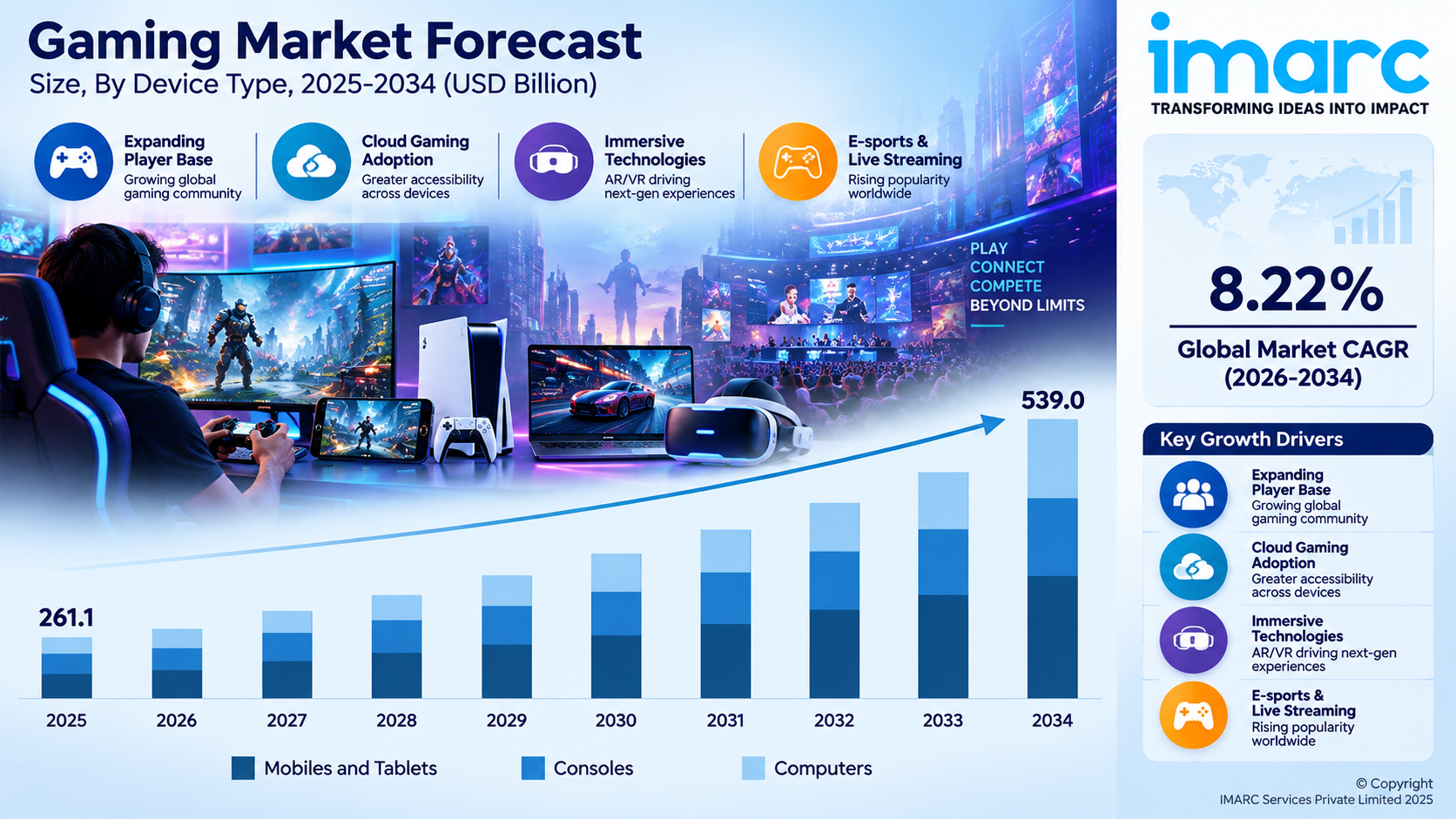
The global gaming market size reached USD 261.1 Billion in 2025 and grew to USD 286.5 Billion in 2026. Looking forward, IMARC Group expects the market to reach USD 539.0 Billion by 2034, exhibiting a growth rate (CAGR) of 8.22% during 2026-2034. Asia Pacific currently dominates the market, holding a significant market share of over 49.5% in 2025. The rising popularity of gaming, especially among young individuals, the emergence of e-sports and multiplayer video game competitions, increasing utilization of smartphones, tablets, and laptops, and continual technological advancements are some of the major factors positively influencing the market.
Gaming Market Report: Key Highlights
-
Market Size & Growth: The global gaming market grew from USD 261.1 Billion in 2025 to USD 286.5 Billion in 2026 and is projected to reach USD 539.0 Billion by 2034, registering a CAGR of 8.22% during 2026–2034, according to IMARC Group.
-
Regional Leadership: Asia Pacific represents the largest regional market, accounting for over 49.5% of the market share in 2025, supported by widespread smartphone adoption, expanding internet connectivity, a large tech-savvy population, and the growing popularity of esports.
-
By Device Type: The market is segmented into consoles, mobiles and tablets, and computers, with mobiles and tablets accounting for the largest share.
-
By Platform: The market covers online and offline platforms, with offline gaming holding the leading share.
-
By Revenue Type: The market is divided into in-game purchase, game purchase, and advertising, with in-game purchase representing the largest segment.
-
By Type: The market includes adventure/role playing games, puzzles, social games, strategy, simulation, and others, with adventure/role playing games accounting for the largest share.
-
By Age Group: The market is segmented into adults and children, with adults representing the dominant segment.
-
Key Market Drivers: Rising mobile gaming adoption, growing esports and online multiplayer gaming, increasing internet connectivity, expanding smartphone penetration, and technological advancements in gaming hardware and software.
-
Key Market Trends: Increasing mobile gaming, expanding esports and multiplayer competitions, cloud gaming, VR and AR integration, 5G adoption, live streaming, in-game purchases, subscription models, and cross-platform gaming.
-
Key Market Opportunities: Emerging gaming markets across Asia Pacific and Latin America, growing esports ecosystems, expanding cloud gaming infrastructure, increasing adoption of immersive technologies, and continued development of mobile gaming.
Request for a Sample Report for Detailed Evaluation: Request Sample
What Is Driving Gaming Market Growth in 2026?
Rising Mobile Gaming
The growing usage of smartphones, coupled with improvements in mobile internet connectivity, is making gaming accessible to a broader demographic and represents one of the key factors positively influencing the market. Affordable data plans and increasing smartphone penetration are further supporting the expansion of mobile gaming across developed and emerging economies.
Mobile gaming continues to lead in India, accounting for a significant portion of the country's total gaming revenue. The growth is supported by a tech-savvy youth demographic, increasing in-app purchases, enhanced smartphone penetration, and expanding internet access. With the Indian gaming community continuously expanding, the sector is also expected to create significant employment opportunities over the coming decade, strengthening India's position in the global gaming ecosystem.
Growing Esports and Online Multiplayer Games
The increasing interest and investment in esports, along with the growing popularity of online multiplayer games, are driving player engagement and creating increasingly active communities of players and spectators. Esports provides competitive opportunities for professional gamers while also generating demand for gaming content, events, sponsorships, and related services.
According to IMARC Group, the global esports market is expected to reach USD 10.1 Billion by 2033, growing at a CAGR of 17.05% during 2025-2033. In addition, investments in gaming and esports infrastructure are supporting the development of local gaming ecosystems. For instance, in March 2024, Saudi Arabia's National Development Fund created two venture investment funds worth a combined USD 120 Million targeting the gaming and esports sectors.
Significant Technological Advancements
The growing adoption of advanced gaming technologies, including high-performance gaming consoles, virtual reality (VR), augmented reality (AR), cloud gaming, and next-generation graphics technologies, is driving continued growth across the global gaming industry. These innovations are transforming the video game industry by delivering more immersive, interactive, and realistic gaming experiences while expanding the ways in which consumers engage with digital content.
According to the supplied market information, the global virtual reality (VR) market was valued at approximately USD 15.9 billion in 2024 and is projected to expand at a CAGR of 21.1% from 2025 to 2033. The rapid development of VR technologies is creating new opportunities within the industry of video games, particularly through the integration of immersive hardware and interactive gaming environments. For instance, in March 2024, Virtuix announced a lineup of 35 games for the consumer launch of its Omni One full-body VR treadmill and gaming system. The system allows players to physically move within virtual environments while remaining in the same physical location, highlighting the increasing integration of immersive technologies into modern gaming.
The continued advancement of these technologies is expected to strengthen consumer engagement, encourage innovation in game development, and create new growth opportunities across the global gaming ecosystem.
Increasing Internet Connectivity and 5G Adoption
The expansion of high-speed internet connectivity and 5G networks is creating favorable conditions for online multiplayer gaming and other connected gaming experiences. Faster and more reliable connections enable smoother gameplay, reduce interruptions, and facilitate access to cloud-based and multiplayer gaming platforms.
Emerging markets are also benefiting from the expansion of digital infrastructure, helping gaming reach a wider consumer base. Increasing internet accessibility, combined with growing smartphone adoption, is consequently supporting the overall gaming market outlook.
Expanding Live Streaming and Gaming Communities
The growing popularity of live streaming platforms, including Twitch, is strengthening player engagement and creating new opportunities for gaming content creators, esports professionals, publishers, and advertisers. Gaming communities increasingly interact through streaming, social platforms, multiplayer environments, and competitive events, further establishing gaming as a mainstream form of entertainment.
Growing In-Game Purchases and Subscription Models
In-game purchases and subscription-based monetization models are contributing significantly to gaming industry revenue growth. Free-to-play games can generate recurring revenue by offering players virtual currency, cosmetic items, additional content, and other purchasable features.
These monetization mechanisms can also increase player engagement and retention by encouraging users to continue interacting with games and investing in additional content.
Gaming Market Segmentation Analysis
IMARC Group provides an analysis of the key trends in each segment of the global gaming market, along with forecasts at the global, regional, and country levels from 2026-2034. The market has been categorized based on device type, platform, revenue type, type, and age group.
By Device Type
-
Consoles
-
Mobiles and Tablets
-
Computers
Mobiles and tablets represent the largest device type segment, accounting for around 51.4% of the market in 2025. The demand for mobile and tablet gaming is being driven by widespread smartphone and tablet adoption, improved mobile internet connectivity, and the convenience of gaming on the go.
Enhanced mobile processing power and graphics capabilities are enabling high-quality gaming experiences on portable devices. In addition, the availability of affordable and free-to-play games, along with social and multiplayer features, is attracting a diverse audience. The increasing popularity of mobile esports and in-game purchases is further supporting the growth of this segment.
By Platform
-
Online
-
Offline
Offline gaming leads the market, accounting for around 53.6% of the market share in 2025. Offline gaming is often associated with single-player experiences that allow users to enjoy immersive and narrative-driven games without relying on an internet connection.
These games offer rich storytelling, character development, exploration, and gameplay experiences that allow players to engage with virtual environments at their own pace. Offline gaming is also particularly relevant for portable gaming devices, including handheld consoles and mobile devices, enabling users to play while traveling or in locations where internet connectivity may be unavailable or unstable.
By Revenue Type
-
In-Game Purchase
-
Game Purchase
-
Advertising
In-game purchase represents the largest revenue type segment, accounting for around 63.4% of the market share in 2025. In-game purchases have emerged as a highly lucrative revenue stream for game developers and publishers, particularly in free-to-play games.
This model enables developers to monetize games by offering additional content, cosmetic items, virtual currency, or gameplay advantages for a price. In-game purchases can also improve player engagement and retention by encouraging users to continue playing and investing in their gaming experiences.
Some purchases provide gameplay advantages or power-ups, allowing players to progress faster or gain an advantage in multiplayer matches. The desire to improve gameplay efficiency or gain a competitive edge can consequently encourage additional purchases.
By Type
-
Adventure/Role Playing Games
-
Puzzles
-
Social Games
-
Strategy
-
Simulation
-
Others
Adventure/role-playing games lead the market, accounting for around 41.1% of the market share in 2025. These games are widely recognized for immersive storytelling and narrative-driven experiences. They provide players with compelling storylines, well-developed characters, and detailed worlds to explore.
Adventure and role-playing games can also offer extensive gameplay through open worlds, quests, and diverse gameplay mechanics. The ability to customize characters, select abilities, develop skills, and progress through different levels provides players with a sense of achievement and personalization, supporting the popularity of this genre.
By Age Group
-
Adult
-
Children
Adults represent the largest age group, accounting for around 75.1% of the market share in 2025. Demand among adults is being driven by increasingly advanced game designs, immersive experiences, and storytelling that caters to mature audiences.
The growth of online multiplayer games and esports is providing social and competitive opportunities, while mobile and console gaming allows adults to engage with games according to their individual schedules. Nostalgia for classic games and the use of gaming as a form of stress relief are also contributing to adult engagement.
In addition, increased disposable income enables adult consumers to invest in gaming hardware, subscriptions, games, and in-game purchases.
By Region
-
Asia Pacific
-
North America
-
Europe
-
Middle East and Africa
-
Latin America
Asia Pacific accounted for the largest market share of over 49.5% in 2025. The region is home to a significant portion of the world's population, including densely populated countries such as China and India. Rapid growth in mobile gaming, widespread smartphone adoption, expanding internet connectivity, and the increasing popularity of esports are supporting regional market growth.
Countries such as South Korea and China have established strong esports ecosystems, attracting professional players, sponsors, and spectators. In addition, gaming companies are increasingly focusing on localized content and regional preferences to expand their consumer bases across the diverse Asia Pacific market.
Key Regional Insight: Asia Pacific's Strategic Position
Asia Pacific's leading position in the global gaming market is anchored in its large population, expanding smartphone penetration, increasing internet connectivity, and growing base of tech-savvy consumers. Mobile gaming has become particularly popular due to the affordability and accessibility of smartphones.
The rapid expansion of internet infrastructure is also supporting online multiplayer gaming across the region. At the same time, countries such as China, South Korea, India, and Japan are contributing to the development of gaming, esports, content creation, and related digital ecosystems.
For instance, South Korea unveiled a plan in 2024 to increase its share of the global console game market, with the Ministry of Culture, Sports and Tourism focusing on expanding the country's position in the console gaming sector by 2028.
Key Regional Takeaways
United States Gaming Market Analysis
In 2025, the United States accounted for around 92.10% of the total North America gaming market. The United States gaming market is primarily driven by technological advancements, increasing consumer demand, and changing cultural trends.
Mobile gaming has emerged as a major growth driver, as smartphones provide convenient access to a broad range of games. The growth of streaming platforms such as Twitch and YouTube is also contributing to market expansion, with competitive gaming and content creation becoming increasingly popular.
The rise of VR and AR technologies is further shaping the future of gaming by providing immersive experiences. Social gaming is also expanding, with multiplayer titles enabling users to interact with friends and communities through virtual environments.
The growing perception of gaming as a mainstream entertainment medium, together with its increasing presence in popular culture, is further broadening the industry's appeal across different age groups.
Asia Pacific Gaming Market Analysis
The Asia Pacific gaming market is expanding due to the region's large and growing population of technology-oriented consumers. Mobile gaming is particularly popular, with smartphones providing affordable and accessible gaming options to a broad range of players.
The rapid expansion of internet infrastructure, particularly in urban areas, is enabling seamless online multiplayer experiences and supporting demand for mobile and PC games. In India, 954.4 Million individuals have access to the Internet, with 556.05 Million living in urban areas. Moreover, 82.7% of total internet connections are 4G, while 5G accounts for 16.9%, highlighting the expansion of high-speed internet access.
Localized content, language support, culturally relevant themes, and the popularity of anime, manga, and fantasy themes are also influencing consumer preferences and supporting gaming demand across the region.
Europe Gaming Market Analysis
The Europe gaming market is growing amid demographic shifts and changing consumer preferences. The region has a strong gaming development ecosystem, with countries such as the United Kingdom, Germany, and France hosting numerous game studios producing globally recognized titles.
The penetration of next-generation consoles, including the PlayStation 5 and Xbox Series X, is supporting demand for high-performance gaming hardware and exclusive titles. Esports has also gained popularity across Europe, with tournaments and professional leagues creating additional opportunities for players, viewers, sponsors, and gaming companies.
Game streaming services are improving accessibility by enabling users to access high-quality gaming experiences without necessarily requiring expensive hardware. In addition, the increasing emphasis on inclusivity and diverse characters and stories is broadening the appeal of gaming across European markets.
Latin America Gaming Market Analysis
The Latin America gaming market is expanding due to increasing internet connectivity and improved access to gaming platforms. The growth of 5G networks is further improving connectivity and enabling more seamless gaming experiences.
Free-to-play models and microtransactions are supporting industry growth by allowing consumers to access games without significant upfront costs while creating opportunities for recurring in-game revenue. Gaming communities, tournaments, and local events are also becoming increasingly popular across the region.
An expanding middle class, growing disposable income, and cultural affinity for entertainment are further contributing to gaming adoption, establishing gaming as an increasingly mainstream form of leisure.
Middle East and Africa Gaming Market Analysis
The Middle East and Africa gaming market is increasingly supported by rising smartphone adoption, high-speed internet availability, and growing disposable incomes. Mobile gaming is becoming a dominant force as smartphones provide accessible gaming platforms for consumers across the region.
The young and dynamic population is also contributing to gaming's role as a form of social interaction and entertainment. Improvements in digital infrastructure, cloud gaming, and digital payment systems are making it easier for consumers to access and purchase games.
Partnerships between international gaming companies and local developers are further supporting the development of regional gaming ecosystems.
Competitive Landscape in the Gaming Industry
The competitive landscape of the gaming market is characterized by rapid innovation, strategic investments, technological development, and competition for player engagement. Leading companies are expanding their portfolios through exclusive game titles, partnerships with developers, acquisitions, and investments in intellectual property.
Many market players are investing in cloud gaming infrastructure to provide seamless, subscription-based gaming experiences. Companies are also enhancing their platforms with advanced social features, cross-play capabilities, and immersive technologies such as VR and AR.
Monetization strategies, including microtransactions, in-game purchases, and battle passes, are being refined to maximize recurring revenue. Acquisitions of gaming studios and intellectual properties are also being used to strengthen market positions.
The growing presence of independent developers is intensifying competition and encouraging established companies to prioritize creativity and player engagement. Investments in esports and live-service game models are further differentiating leading market participants.
Key Gaming Market Players Include:
-
Activision Publishing, Inc.
-
Apple Inc.
-
Bandai Namco Entertainment America Inc.
-
Electronic Arts Inc.
-
Epic Games Inc.
-
KRAFTON, Inc.
-
Microsoft Corporation
-
NetEase, Inc.
-
Nintendo Co., Ltd.
-
Rovio Entertainment Ltd.
-
Sega of America, Inc.
-
Sony Corporation
-
Tencent Holdings Limited
Latest News and Developments:
-
March 2025: Morocco and France launched the Video Game Incubator program, aiming to support nine video game startups. The five-month program provides training covering business administration, production supervision, brand and marketing strategies, video game testing, and financial and commercial planning.
-
March 2025: AMD's latest Zen 5 Ryzen 9000 3D V-Cache gaming processors, the Ryzen 9 9950X3D and Ryzen 9 9900X3D, became commercially available from March 12, 2025. The processors feature second-generation 3D V-Cache technology and up to 16 Zen 5 cores.
-
February 2025: HP released its latest Victus 15 gaming laptop in India, featuring enhanced AI capabilities and an AMD Ryzen 9 Hawkpoint 8945HS NPU processor designed to support gaming performance and functionality.
-
January 2025: Acer launched its new Nitro V line in multiple screen sizes, expanding its portfolio of entry-level gaming laptops. The devices combine gaming performance, graphics capabilities, storage, and AI-related features aimed at students, developers, and gamers.
-
October 2024: SuperGaming, a video game developer based in India, announced the release of its warfare game Indus for mobile devices. Indus Battle Royale introduces a distinctive approach to the battle royale genre and includes an in-game feature called "Grudge" that enables players to find competitors who previously defeated them.
-
June 2024: Apple introduced Game Mode as part of iOS 18, aimed at optimizing iPhone performance during gaming sessions and providing a smoother gaming experience.
-
May 2024: Solana Labs announced an expanded partnership with Google Cloud to bring GameShift, its Web3 gaming platform, to Google Cloud customers. The collaboration is intended to simplify developer access to Web3 gaming technologies.
-
May 2024: Microsoft announced plans to launch an online store for mobile-game consumables, providing an alternative to Apple's and Google's app stores and their associated fees.
Market Drivers, Challenges & Opportunities
Major Market Drivers:
-
Rising Mobile Gaming: Increasing smartphone penetration, affordable data plans, and improved mobile internet connectivity are making gaming accessible to a broader consumer base.
-
Growing Esports and Multiplayer Gaming: Rising interest in esports competitions and online multiplayer games is increasing player engagement and creating new gaming communities.
-
Technological Advancements: Developments in cloud gaming, VR, AR, advanced graphics, high-performance hardware, and 5G connectivity are enhancing gaming experiences.
-
Increasing Internet Connectivity: Expanding internet and high-speed network infrastructure is supporting online multiplayer gaming and access to digital gaming platforms.
-
Growing In-Game Purchases: In-game purchases and subscription models are providing developers and publishers with recurring monetization opportunities.
Key Challenges:
-
Intense Competition: Rapid innovation and the presence of established companies, independent developers, and new gaming platforms are creating a highly competitive environment.
-
Dependence on Digital Infrastructure: Online multiplayer, cloud gaming, and streaming experiences depend on reliable internet connectivity and high-speed networks.
-
Changing Consumer Preferences: Gaming companies need to continuously develop new content and experiences to maintain player engagement in a rapidly evolving market.
Emerging Opportunities:
-
Cloud Gaming: Continued improvements in cloud infrastructure are creating opportunities to deliver high-quality gaming experiences across devices.
-
VR and AR Gaming: Increasing adoption of immersive technologies is opening new avenues for interactive gaming experiences.
-
Mobile Gaming Expansion: Smartphone penetration and improving mobile connectivity in emerging economies are creating significant opportunities for mobile gaming companies.
-
Esports Growth: Rising investments in esports, tournaments, professional gaming, and related infrastructure are creating new revenue opportunities.
-
Cross-Platform Gaming: Increasing compatibility across devices is encouraging greater accessibility and inclusivity while expanding player communities.
Gaming Market FAQs
1. What is the current size of the gaming market?
The global gaming market grew from USD 261.1 Billion in 2025 to USD 286.5 Billion in 2026 and is expected to reach USD 539.0 Billion by 2034, exhibiting a CAGR of 8.22% during 2026-2034.
2. What is driving the growth of the gaming market?
The market is driven by rising mobile gaming, increasing smartphone and internet penetration, growing esports and online multiplayer gaming, technological advancements in cloud gaming, VR and AR, increasing 5G adoption, and the growing use of in-game purchases and subscription models.
3. Which region dominates the gaming market?
Asia Pacific leads the global gaming market, accounting for over 49.5% of the market share in 2025. Its dominance is supported by a large population, widespread smartphone adoption, expanding internet connectivity, and the growing popularity of mobile gaming and esports.
4. Which segment holds the largest share in the gaming market?
Mobiles and tablets lead by device type, accounting for around 51.4% of the market in 2025. Offline gaming leads by platform with around 53.6%, in-game purchases lead by revenue type with around 63.4%, adventure/role-playing games lead by type with around 41.1%, and adults lead by age group with around 75.1%.
5. What are the key trends in the gaming market?
Key trends include the rapid growth of mobile gaming, expanding esports and online multiplayer competitions, technological advancements in cloud gaming and VR/AR, increasing 5G connectivity, growing popularity of live streaming, in-game purchases and subscription models, and the expansion of cross-platform gaming.
Conclusion: Gaming Market Outlook to 2034
The global gaming market is set for strong growth through 2034, underpinned by rising mobile gaming adoption, increasing smartphone and internet penetration, growing esports and multiplayer gaming, technological advancements, and the expansion of digital entertainment. The growing use of in-game purchases, subscription models, live streaming, and cross-platform gaming is further creating opportunities for market participants.
With Asia Pacific maintaining its position as the leading regional market and North America, Europe, Latin America, and the Middle East and Africa offering further growth avenues, the outlook through 2034 remains positive. Companies investing in mobile gaming, cloud infrastructure, immersive technologies, esports, social features, and innovative monetization models will be well positioned to capture value as the global gaming industry continues to evolve.
About the Author:
IMARC Group is a leading global market research company providing data-driven insights and expert consulting services to businesses seeking to achieve their strategic objectives. With a multi-disciplinary team of industry experts, IMARC delivers thorough, reliable market intelligence across sectors including Energy and Mining, Construction and Manufacturing, Automotive, Chemicals and Materials, and more.
Media & Sales Contact:
IMARC Group
United States: +1-201-971-6302
India: +91-120-433-0800
United Kingdom: +44-753-714-6104
