

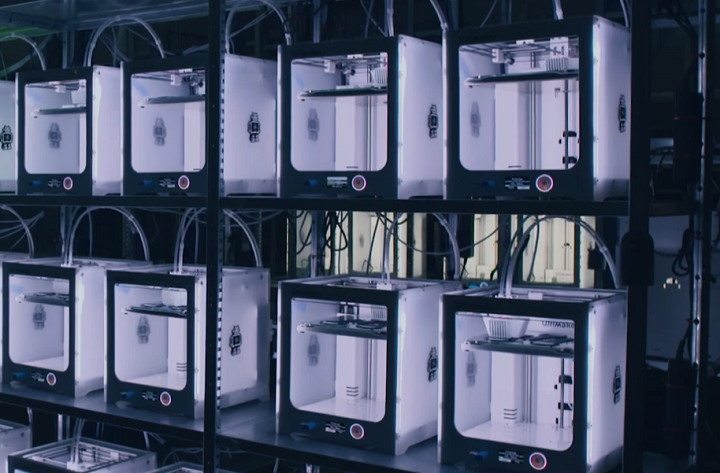
3D Printer Manufacturing Plant DPR and Financial Model Report: ROI, IRR and Break-Even Analysis 2026

IMARC Group's report, "3D Printer Manufacturing Plant Project Report 2026: Industry Trends, Plant Setup, Machinery, Raw Materials, Investment Opportunities, Cost and Revenue", offers a comprehensive guide for establishing a manufacturing plant. The 3D printer plant setup cost report offers insights into the manufacturing process, financials, capital investment, expenses, ROI, and more for informed business decisions.
3D Printer Manufacturing Plant Project Report Summary: -
- Comprehensive guide for setting up a 3D printer manufacturing plant.
- Covers market trends and industry outlook for 2026.
- Detailed project setup, including unit operations and processes.
- Raw material and utility requirements.
- Infrastructure and machinery specifications.
- Workforce and staffing requirements.
- Packaging and transportation details.
- Financial aspects: investment opportunities, cost analysis, and revenue projections.
In addition to covering operational aspects, the report offers detailed insights into the 3D printer manufacturing plant process and project economics.
- Detailed insights into the 3D printer manufacturing plant
- In-depth project economics and financial metrics.
- Covers capital investments and project funding.
- Analysis of operating expenses and income projections.
- Breakdown of fixed and variable costs, direct and indirect expenses.
- Evaluation of ROI (Return on Investment) and NPV (Net Present Value).
- Profit and Loss account analysis.
- Comprehensive financial analysis for decision-making.
- Provides a roadmap for successfully establishing a 3D printer manufacturing plant.
Request for a Sample Report: https://www.imarcgroup.com/3d-printer-manufacturing-plant-project-report/requestsample
What is a 3D printer?
A 3D printer is an advanced manufacturing device that creates three-dimensional objects by depositing, curing, or solidifying materials layer by layer based on a digital design file. Unlike conventional subtractive manufacturing methods that remove material from a solid block, 3D printing enables the production of complex geometries with comparatively efficient material utilization. Depending on the technology, 3D printers can process materials such as plastics, resins, metals, ceramics, and composites. Common technologies include fused deposition modeling (FDM), stereolithography (SLA), selective laser sintering (SLS), and direct metal laser sintering (DMLS). These systems are widely used for prototyping, product development, customized components, tooling, education, healthcare, aerospace, automotive, construction, and consumer products. 3D printing enables rapid prototyping, design flexibility, customization, and shorter development cycles, making it an increasingly important technology across industries. Continuous improvements in printer precision, material compatibility, automation, and software integration are further expanding its applications.
Market Trends and Drivers:
The 3D printer market is being driven by increasing demand for rapid prototyping, customized products, and cost-efficient manufacturing solutions across industries. Growing adoption in aerospace, automotive, healthcare, electronics, education, and consumer goods is encouraging businesses to integrate additive manufacturing into product development and production processes. In healthcare, 3D printing is gaining traction for customized implants, prosthetics, anatomical models, and medical devices, while manufacturers are increasingly using the technology to produce lightweight and complex components.
In India, these trends are contributing to strong market expansion. The India 3D printer market size was valued at USD 645.2 Million in 2025. According to IMARC Group estimates, the market is expected to reach USD 2,221.3 Million by 2034, exhibiting a CAGR of 14.28% from 2026 to 2034. Furthermore, advancements in printing technologies, improved material availability, declining equipment costs, and greater accessibility through specialized service providers are supporting adoption. Government initiatives promoting advanced manufacturing, digitalization, and domestic production are also creating favorable opportunities for the market.
ROI Analysis for 3D Printer Manufacturing Plant
The return on investment (ROI) for a 3D printer manufacturing plant depends on capital investment, production capacity, operating expenditure, product pricing, capacity utilization, and projected income. According to the IMARC Group report, the proposed facility can have an annual production capacity of 10,000–50,000 units, supporting economies of scale and operational flexibility. The plant demonstrates a gross profit margin of around 40–50% and a net profit margin of 18–25%, indicating attractive profitability potential under normal operating conditions. Raw materials, particularly electronic components such as PCBs and stepper motors, represent approximately 65–75% of total OpEx, while utilities account for around 5–10%. These cost parameters are important for evaluating the investment return and optimizing the overall financial performance of the 3D printer manufacturing project.
IRR and Investment Viability Assessment
The Internal Rate of Return (IRR) is an important financial indicator for assessing the long-term viability of a 3D printer manufacturing plant. The IMARC feasibility report incorporates internal rate of return analysis along with profitability analysis, payback period, net present value (NPV), profit and loss account, uncertainty analysis, sensitivity analysis, and economic analysis. The financial assessment considers capital expenditure, operating expenses, income projections, product pricing, margins, taxation, depreciation, and production capacity utilization. Since the exact IRR value is not publicly disclosed on the report page, the detailed financial model is required to determine the project-specific IRR based on the selected plant capacity, location, technology, investment structure, and operating assumptions.
Break-Even Analysis and Payback Potential
Break-even analysis determines the level of production and sales required for a 3D printer manufacturing plant to cover its fixed and variable costs before generating operating profits. The IMARC report includes break-even analysis within its project economics and specifically addresses the time required for the plant to break even. The assessment takes into account capital investment, machinery expenditure, raw material costs, utilities, labor, maintenance, packaging, transportation, depreciation, taxes, and other operating expenses. With raw materials accounting for approximately 65–75% of OpEx and utilities contributing 5–10%, effective cost management and production utilization are key considerations in reaching the break-even point.
Key Aspects Required for Setting Up a 3D Printer Manufacturing Plant
Detailed Process Flow:
- Product Overview: Comprehensive description of the 3D printer product and its characteristics.
- Unit Operations Involved: Step-by-step breakdown of the various operations in the production process.
- Mass Balance and Raw Material Requirements: Calculations for material inputs and outputs, along with required quantities of raw materials.
- Quality Assurance Criteria: Standards and procedures to ensure the quality of the final product.
- Technical Tests: Essential tests and evaluations to maintain product consistency and compliance.
Project Details, Requirements, and Costs Involved
- Land, Location, and Site Development: Assessment of land requirements, optimal location selection, and site development costs.
- Plant Layout: Design and layout planning for efficient plant operations.
- Machinery Requirements and Costs: Identification of machinery needed, along with the associated costs.
- Raw Material Requirements and Costs: Determination of the types and quantities of raw materials required and their costs.
- Packaging Requirements and Costs: Specifications for packaging materials and equipment, including associated expenses.
- Transportation Requirements and Costs: Logistics planning and cost estimation for the transportation of raw materials and finished products.
- Utility Requirements and Costs: Analysis of utility needs (such as water, electricity, and fuel) and their associated costs.
- Human Resource Requirements and Costs: Workforce planning, including staffing needs, roles, and costs for labor and management.
Project Economics
- Capital Investments: Initial costs required for setting up the 3D printer manufacturing plant, including land, equipment, and infrastructure.
- Operating Costs: Ongoing expenses for running the plant, such as raw materials, labor, utilities, and maintenance.
- Expenditure Projections: Detailed forecasts of all costs over the short and long term.
- Revenue Projections: Expected income generated from the sale of 3D printer and by-products.
- Taxation and Depreciation: Analysis of tax obligations, incentives, and asset depreciation over time.
- Profit Projections: Estimated profitability based on costs, revenues, and market conditions.
- Financial Analysis: Comprehensive evaluation of the plant's financial viability, including cash flow analysis, return on investment (ROI), and break-even point.
Ask Analyst for Customization: https://www.imarcgroup.com/request?type=report&id=18829&flag=C
Customization Options Available:
- Plant Location: Selection of optimal location for the plant.
- Plant Capacity: Customization based on desired production capacity.
- Machinery: Choice between automatic, semi-automatic, or manual machinery.
- List of Machinery Providers: Identification of suitable machinery suppliers.
Key Questions Addressed in This Report:
- How has the 3D printer market performed so far and how will it perform in the coming years?
- What is the market segmentation of the global 3D printer market?
- What is the regional breakup of the global 3D printer market?
- What are the price trends of various feedstocks in the 3D printer industry?
- What is the structure of the 3D printer industry and who are the key players?
- What are the various unit operations involved in a 3D printer manufacturing plant?
- What is the total size of land required for setting up a 3D printer manufacturing plant?
- What is the layout of a 3D printer manufacturing plant?
- What are the machinery requirements for setting up a 3D printer manufacturing plant?
- What are the raw material requirements for setting up a 3D printer manufacturing plant?
- And more...
How IMARC Can Help?
IMARC Group is a global management consulting firm that helps the world's most ambitious changemakers to create a lasting impact. The company provide a comprehensive suite of market entry and expansion services. IMARC offerings include thorough market assessment, feasibility studies, company incorporation assistance, factory setup support, regulatory approvals and licensing navigation, branding, marketing and sales strategies, competitive landscape and benchmarking analyses, pricing and cost research, and procurement research.
Services:
- Plant Setup
- Factoring Auditing
- Regulatory Approvals, and Licensing
- Company Incorporation
- Incubation Services
- Recruitment Services
- Marketing and Sales
Contact Us:
IMARC Group
134 N 4th St. Brooklyn, NY 11249, USA
Email: [email protected]
Tel No:(D) +91 120 433 0800
United States: +1-201971-6302
