

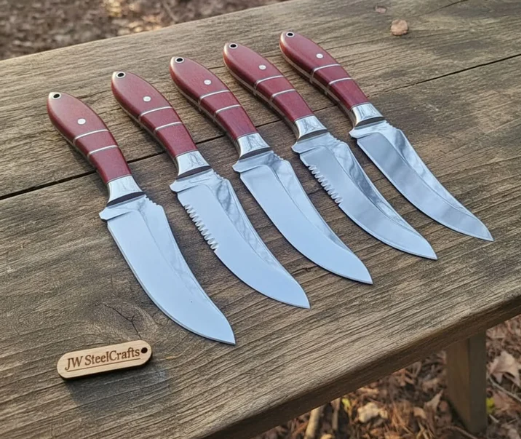

Drop Point Hunting Knife Set: How to Choose the Right Outdoor Blades
Choosing a hunting knife is less about finding the most impressive-looking blade and more about matching geometry, construction, materials, and maintenance requirements to the work the knife will actually perform. For hunters, campers, and bushcraft users, a drop point hunting knife set can be particularly practical because the profile combines a broad cutting belly with a controlled point.
But blade shape is only one part of the decision. A well-designed outdoor knife also needs appropriate edge geometry, suitable steel and heat treatment, a comfortable handle, dependable construction, and a storage system that works in real field conditions.
What Is a Drop Point Hunting Knife?
A drop point knife has a spine that slopes downward toward the tip, creating a relatively broad belly and a controlled point. This geometry is widely associated with hunting and general-purpose outdoor knives because it provides a useful balance between slicing surface, tip control, and overall versatility.
The important point is that “drop point” describes blade geometry, not the complete performance of a knife. Two knives can have the same profile while behaving very differently because of differences in steel, heat treatment, blade thickness, grind, edge geometry, handle design, and construction.
For hunting and outdoor use, that distinction matters. A familiar blade profile can be a good starting point, but it should never be the only buying criterion.
Why Is the Drop Point Shape Popular for Hunting?
The main advantage of a drop point is its combination of a substantial cutting belly and a relatively controlled tip. That makes the profile useful for many general cutting applications where predictable blade control is more important than a very fine or aggressively pointed tip.
For hunters, the broad belly can be useful for slicing-oriented work, while the lowered spine helps keep the point visually and physically controlled during detailed cutting.
That does not mean every drop point is automatically better than every other blade style. A clip point, spear point, trailing point, or another profile may be preferable for a particular task. The right choice depends on how the knife will be used.
What Should You Look for in a Drop Point Hunting Knife Set?
A practical evaluation should begin with six factors:
-
Blade geometry — Consider the belly, tip shape, thickness, grind, and edge geometry.
-
Steel and heat treatment — Steel composition matters, but its performance also depends on how it has been processed.
-
Construction — Examine how the blade and handle are joined and whether the construction matches the intended workload.
-
Handle ergonomics — A secure, comfortable grip matters during repetitive outdoor work.
-
Maintenance requirements — Consider corrosion resistance, sharpening needs, storage, and cleaning.
-
Set configuration — Multiple knives are useful only when the included blades serve different practical roles or provide meaningful redundancy.
This approach is more useful than judging a set simply by its appearance or the number of pieces included.
Blade Geometry: Look Beyond the Drop Point
A drop point tells you the general shape of the blade, but it does not tell you everything about cutting performance.
Edge geometry is especially important. A thinner and more acute edge generally improves cutting ability, while heavier geometry can provide greater resistance to certain forms of edge damage. Knife design therefore involves trade-offs rather than one universally perfect geometry.
For an outdoor knife, the appropriate balance depends on the work. A blade designed primarily for controlled slicing does not necessarily need the same geometry as a knife expected to tolerate more demanding contact.
This is why experienced knife buyers should ask:
-
How thick is the blade?
-
How much material remains behind the edge?
-
What type of grind is used?
-
Is the edge geometry appropriate for the intended work?
-
Is the tip designed for control or maximum piercing ability?
The answer to those questions can tell you more about practical performance than the phrase “drop point” alone.
How Important Is Steel?
Steel matters, but it should not be treated as a magic performance label.
Different steels involve different combinations of toughness, wear resistance, corrosion resistance, hardness, and ease of sharpening. Heat treatment also influences the final properties of a blade. Consequently, simply choosing a knife because its steel sounds advanced does not guarantee that it will perform better for a particular task.
For outdoor buyers, the better question is:
Does the steel and its treatment make sense for the environment and work the knife will encounter?
A hunter who regularly works in damp conditions may place more emphasis on corrosion resistance and maintenance. Someone who values easy field sharpening may accept different trade-offs from a user who prioritizes longer intervals between sharpening.
The best steel is therefore application-dependent.
Full Tang vs. Other Fixed-Blade Construction
For a serious outdoor knife, construction deserves close attention.
A full-tang fixed blade extends the blade material through the handle area rather than ending at the front of the grip. This can provide a robust construction platform when properly designed and assembled.
However, “full tang” should not be treated as a guarantee of quality by itself. Overall blade thickness, steel properties, heat treatment, handle construction, transitions, and intended use still matter.
A sensible inspection looks at the entire knife rather than one construction label.
What Does a Full-Tang Hunting Knife Offer?
A properly constructed full-tang knife can provide a strong foundation for an outdoor fixed blade, particularly where durability and consistent handle-to-blade construction are priorities.
For buyers comparing several knives, inspect the tang, handle attachment, blade-to-handle transition, and overall fit rather than assuming that one construction term answers every question.
Handle Design Matters More Than Many Buyers Expect
A hunting knife can have excellent steel and geometry and still be uncomfortable if the handle does not suit the user's hand.
Look for:
-
A shape that allows a controlled grip
-
Materials appropriate for the expected environment
-
Secure construction
-
Edges that do not create unnecessary pressure points
-
A size that fits the intended hand and use
-
A surface that remains manageable when conditions are less than ideal
For outdoor users, ergonomics should be evaluated alongside blade specifications.
A knife used repeatedly during a long day outdoors places different demands on the hand than a blade used occasionally for light camp chores. Comfort, control, and fatigue therefore deserve consideration before purchase.
Drop Point vs. Clip Point: Which Is Better?
Neither profile is universally better. A drop point generally emphasizes a broad belly and controlled tip, while a clip point removes more material from the upper portion of the blade to create a more pronounced point.
For many general hunting and outdoor tasks, a drop point is attractive because it offers a versatile balance between slicing area and tip control. A clip point may appeal to users who specifically prefer its narrower point and traditional blade character.
The best choice depends on the work rather than the popularity of the profile.
| Feature | Drop Point | Clip Point |
|---|---|---|
| Cutting belly | Broad | Often more moderate |
| Tip character | Controlled | More pronounced |
| General hunting use | Very versatile | Versatile, task-dependent |
| Slicing-oriented work | Strong option | Depends on geometry |
| Point-focused tasks | Controlled | Often more point-oriented |
| Overall choice | Excellent general-purpose profile | Useful alternative |
The table describes general geometry rather than a guarantee of performance for every individual knife.
Fixed Blade or Drop Point Folding Knife?
The main difference is construction and portability.
A fixed blade has a permanently attached blade and handle assembly, normally carried in a sheath or similar system. A folding knife incorporates a pivot and locking mechanism so the blade can be folded into the handle.
For dedicated hunting and outdoor work, a fixed blade is often attractive because its design is straightforward and it does not depend on a folding mechanism during use. A folding knife can be more convenient when compact carry is the priority.
The better choice depends on the user's workload, carry preferences, local regulations, and maintenance habits.
For a primary hunting knife, many buyers will reasonably prioritize a fixed blade. For a lightweight secondary or everyday outdoor knife, a folder may make more sense.
When Does a Hunting Knife Set Make More Sense Than One Knife?
A set makes sense when the individual knives serve distinct roles or provide useful redundancy.
For example, an outdoor user might prefer multiple blades when:
-
Different blade sizes are useful for different camp tasks
-
More than one person may need a knife
-
A primary and backup knife are desirable
-
The set is stored and transported together
-
The blades have complementary geometries
However, more knives do not automatically mean more value.
A three- or four-piece set containing nearly identical blades may be less useful than two thoughtfully selected knives with clearly different roles. Before buying, identify what each piece contributes.
The “Role Test” for Knife Sets
For every knife in a set, ask:
What job does this knife perform that another knife in the set does not perform as well?
If the answer is clear for each blade, the set has functional justification.
If several knives appear interchangeable, the additional pieces may offer more visual variety than practical utility.
How Important Is Edge Geometry?
Edge geometry is one of the most important factors in cutting performance.
A thinner, more acute edge can generally cut more efficiently, while heavier geometry can provide greater resistance to rolling or chipping. This creates a fundamental design trade-off between cutting performance and edge stability.
For an outdoor knife, the ideal balance depends on intended use. A knife optimized exclusively for maximum slicing efficiency may not be appropriate for rougher work, while an excessively heavy edge may sacrifice useful cutting performance.
This is one reason experienced buyers should evaluate the whole blade rather than focusing exclusively on steel names or hardness claims.
Does Blade Thickness Matter?
Yes, but thicker is not automatically better.
Blade thickness influences stiffness, weight, balance, and the amount of material supporting the cutting edge. More material can contribute to durability in certain situations, but excessive thickness can also make a knife less efficient at slicing.
The correct thickness depends on the knife's intended role.
A lightweight hunting knife designed around controlled cutting does not necessarily need the same construction as a heavier outdoor tool intended for substantially different work.
The goal is appropriate geometry, not maximum material.
Common Mistakes When Buying a Drop Point Hunting Knife
Mistake 1: Choosing by appearance alone
Damascus patterns, polished finishes, decorative handles, and distinctive shapes can make a knife visually appealing. They do not by themselves establish how well the knife suits a particular task.
Mistake 2: Assuming steel name equals performance
Steel composition matters, but geometry, heat treatment, sharpening, and intended use all influence real-world performance.
Mistake 3: Treating “full tang” as the entire construction story
Full tang is useful information, but it should be considered alongside the blade, handle, transitions, and overall construction.
Mistake 4: Ignoring maintenance
Outdoor knives are exposed to moisture, dirt, biological material, and changing temperatures. A knife that requires care should be maintained accordingly.
Mistake 5: Buying a set without defining each knife's role
More pieces are valuable only when they add useful capability, redundancy, or convenience.
Mistake 6: Choosing the most aggressive-looking tip
A more pointed blade is not automatically better for hunting. Tip design should match the desired level of control and the tasks the knife is intended to perform.
How Should a Hunting Knife Be Maintained?
Maintenance starts with keeping the blade clean and dry.
After outdoor use, remove debris, clean the blade appropriately, and dry it thoroughly. If the steel requires corrosion protection, follow the maker's care recommendations and use a suitable protective product.
Regularly inspect:
-
The cutting edge
-
Blade surface
-
Handle and fasteners
-
Sheath or storage system
-
Areas where moisture or debris may accumulate
Do not store a damp knife for extended periods.
Sharpening should also be treated as routine maintenance rather than something reserved for an emergency. The exact sharpening method should suit the knife's edge geometry and steel.
For leather storage equipment, follow appropriate leather-care practices as well. A well-maintained sheath or roll is part of the overall carrying system.
A Practical 7-Point Buying Framework
Instead of asking only, “What is the best drop point hunting knife?” use this seven-step framework:
1. Define the primary job.
Hunting, camp cutting, bushcraft, general outdoor use, or collection?
2. Choose the blade profile.
Determine whether the broad belly and controlled point of a drop point suit the work.
3. Examine geometry.
Look at blade thickness, grind, edge geometry, and tip design.
4. Evaluate steel and treatment.
Consider toughness, wear resistance, corrosion resistance, hardness, and sharpening requirements together.
5. Inspect construction.
Look at tang construction, handle attachment, transitions, and overall fit.
6. Check ergonomics and carry.
A good outdoor knife should be practical to hold, transport, clean, and store.
7. Match the maintenance burden to your habits.
A knife is a long-term tool only if you are prepared to care for the materials it uses.
This framework turns a vague search for the “best” knife into a more useful comparison between actual requirements.
What Makes a Drop Point Hunting Knife Set a Good Outdoor Choice?
A good set is not defined by one specification. It is the combination of appropriate geometry, suitable materials, sound construction, useful knife roles, comfortable handling, and manageable maintenance.
The drop point profile is a strong starting point for hunters and outdoor users who want a broad cutting belly with a controlled point. A fixed-blade construction can make sense for users prioritizing a straightforward outdoor knife platform, while a set becomes more valuable when its individual blades provide genuinely different utility.
Most importantly, buyers should evaluate the knife as a complete system rather than reducing the decision to steel type, blade pattern, or marketing terminology.
Final Buying Checklist
Before purchasing a drop point hunting knife set, ask:
-
Is the drop point profile appropriate for my primary tasks?
-
Is the blade geometry suited to those tasks?
-
Is the steel appropriate for my environment and maintenance habits?
-
Is the heat treatment information trustworthy and adequately documented?
-
Does the construction match the intended workload?
-
Is the handle comfortable and practical?
-
Does every knife in the set have a clear purpose?
-
Is the storage or sheath system suitable for transport?
-
Do I understand the knife's maintenance requirements?
-
Am I choosing based on practical fit rather than appearance alone?
If the answer to those questions is yes, you are evaluating the knife for the right reasons.
Final Thoughts
A drop point hunting knife set can be an excellent choice for hunters, campers, and outdoor enthusiasts who value versatile blade geometry and the practicality of having complementary fixed blades together.
But the strongest buying decision comes from looking beyond the profile. Blade geometry, steel, heat treatment, construction, ergonomics, intended use, and maintenance all interact to determine whether a knife is genuinely suitable for the job.
The best outdoor knife is therefore not simply the one with the most impressive specifications. It is the one whose design, materials, construction, and maintenance requirements make sense for the work you actually expect it to perform.

